Sagamore North Cottage by Akb Architects
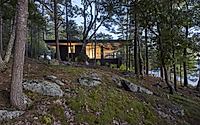
Sagamore North Cottage is a house in Muskoka District Municipality, ON, Canada, designed by Akb Architects for life close to the water and tucked from passing boats. Completed in 2025, the all-season retreat follows the island’s slope and uses dark cladding, broad roof planes, and sliding glass walls to balance privacy with long views, family gatherings, and quieter moments alone.


About Sagamore North Cottage
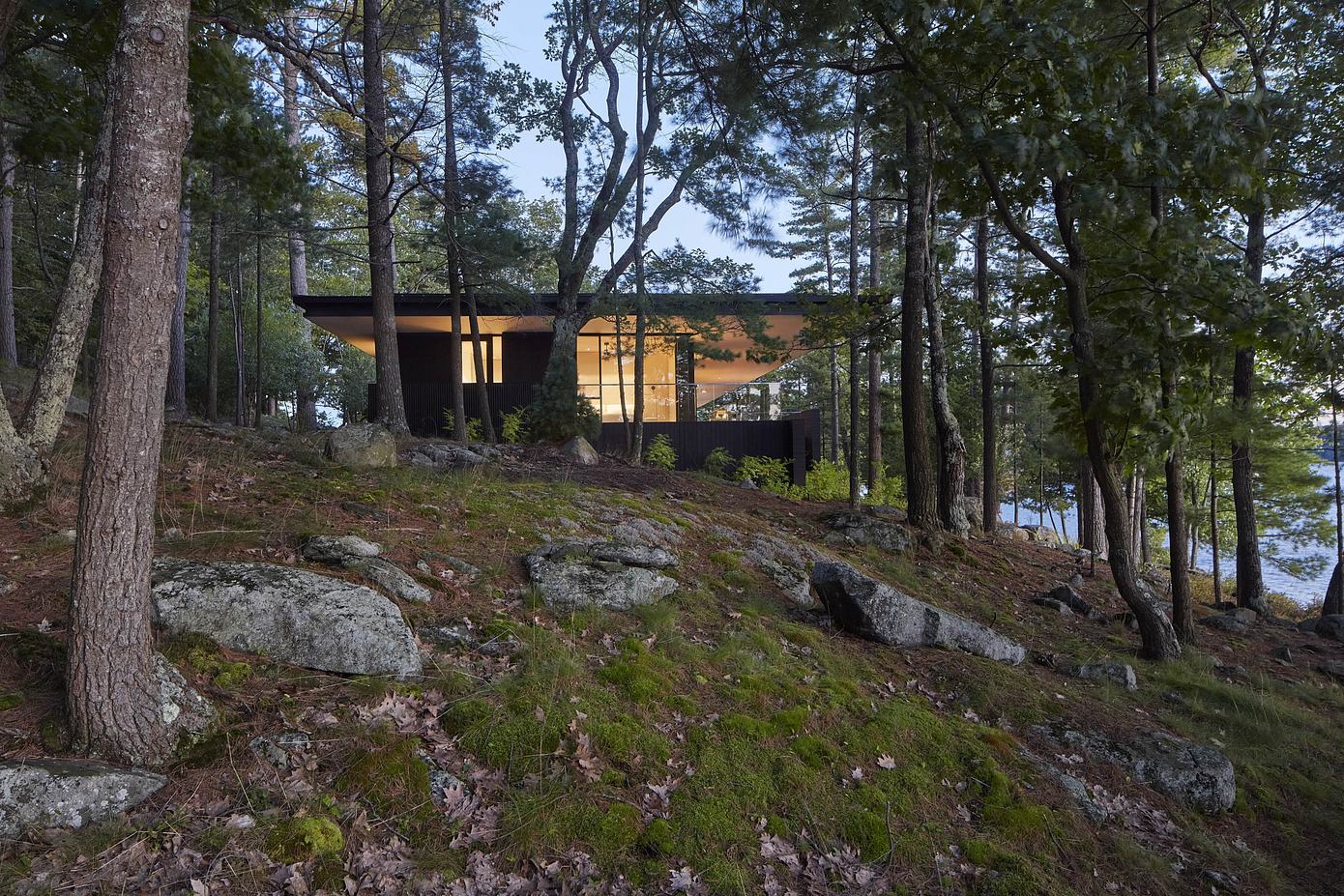
Located on an island near the water’s edge, this all-season family cottage is designed as a private refuge, hidden from view while maintaining a strong connection to the raw beauty of its Muskoka, Ontario, surroundings. An existing dock and boathouse—designed by the same architecture firm and widely published—continually draws curious boaters uncomfortably close to shore. That unintended attention makes privacy a central consideration in the design of the cottage.
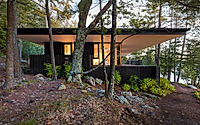
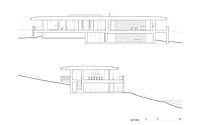
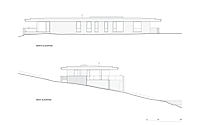
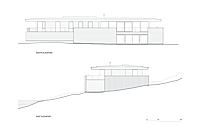
Inspired by the simple, familiar image of floating docks along the Muskoka lakes, the cottage is conceived as a series of planar elements turned vertically to form walls and guardrails that slip past one another, and elevated horizontally to create a unifying roof that hovers above the recessive elevations. This interplay of planes provides visual privacy without giving up access to lake views, using a reductive approach to form and material. The design follows the natural slope of the terrain, allowing the lower level to unfold into a generous multipurpose area that opens onto a stone patio. Framed by two vertical walls that become guards to the deck above, this secluded outdoor setting feels intimate yet roomy enough for larger gatherings along the shoreline.
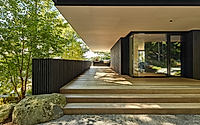
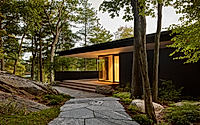
The main level sits above, sheltered by an extensive cantilevered roof. From the shoreline, only intermittent glimpses of the roof profile are visible by day, while black cladding allows the structure to recede into the shadows of the forested landscape. Dense tree foliage partly obscures views of the interior through the glass façades on both levels, helping the architecture keep its subdued presence, even when illuminated at night.
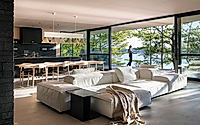
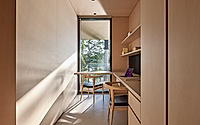
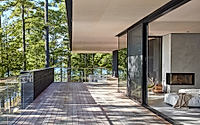
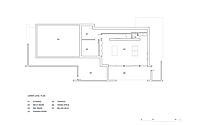
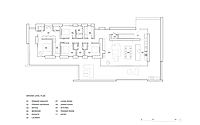
Rather than a grand retreat, the owners envisioned a welcoming but private layout equally suited to frequent family gatherings and solitary escapes. The result is a fluid relationship between interior and exterior, where the architecture creates both shelter and openness. The cantilevered roofline extends up to 16 feet (4.9 meters) beyond the cottage’s structural framework, covering 3,054 square feet (283.7 square meters) of decking in total. Wrapping around three sides, this protected outdoor living area doubles the main-level interior and contains an open kitchen, dining, and living area, a lofty corridor leading to four bedrooms, a primary bathroom, a small office, and a shared vanity room.
Floor-to-ceiling sliding glass walls in the communal areas dissolve the boundary between indoors and out, extending daily life into the landscape. These wall-less rooms create an immersive experience among the trees, while deep overhangs protect against southern sun and rain. The cottage can expand or contract in feel simply by opening and closing its waterfront glass partitions. The height and material of the interior ceiling continue as a single plane onto the exterior soffit, creating a physical sense of compression and intimacy.
Solid and void further shape the exterior experience, with openings between vertical planes aligned to the most expansive and prominent views from the deck. At the main entrance, the alignment of the deck width and overhang acts as a framing device and an inviting promenade leading to the first view of the lake from an elevated vantage point. Glass railings heighten the sense of connection to the surroundings. In contrast, solid projecting walls and semi-transparent wood screens are placed to obscure less desirable vistas or provide privacy from external sightlines.
Design Challenges and Innovations
As an art collector with a deep appreciation for the unspoken nuances of architecture, the owner embraced material innovation in pursuit of lasting physicality. The cottage’s modest palette—wood, concrete, metal, and stone—is sharpened through careful detailing, turning simple elements into meaningful experiences.
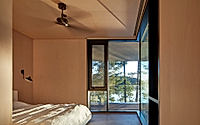
These discreetly tailored gestures enrich the sensory experience by bringing care and cohesion to the project. In the plywood walls, custom biscuit joinery eliminates visible gaps and fasteners, allowing for seamless continuity, while hand-troweled micro-cement floors introduce a distinct textural quality fully integrated into the architecture. A concealed hallway at the center of the building is illuminated by a wall-to-wall skylight, evoking a quiet sense of retreat and offering clear views of the night sky. Door levers discreetly signal flush thresholds to otherwise concealed rooms, reinforcing the home’s understated character.
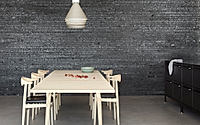
Most notably, the interior layout revolves around a central black granite wall that bisects the communal rooms on both levels, establishing a strong monolithic presence. Subtle variations in the grouting of the custom-cut stone further stress its solidity. Flush grout at the vertical mortar joints and raked grout at the horizontal joints emphasize the wall’s linearity, recalling the layered striations of natural rock formations. The granite is experienced as a true structural mass rather than a superficial finish, and its weight and mineral texture are mirrored by the property’s natural bedrock outcroppings visible through full-height windows.
A commitment to sustainable practices shaped the project from the start, beginning with geothermal ground-source heat pumps that meet all cooling and heating requirements. Reducing embodied carbon was also a priority, addressed by sourcing primarily local materials. The exterior cladding uses wire-brushed Canadian white pine with a locally supplied black coating, while the interior walls and soffits are finished in Canadian maple-veneered plywood. The black granite wall comes from the neighboring province of Quebec.
Deeply recessed overhangs provide natural shade and reduce solar heat gain. At the same time, double-pane operable glass walls maximize thermal efficiency and allow cross-ventilation to cool and refresh the interior. Abundant natural light reduces the need for artificial lighting during the day, while strategically placed step and soffit lights are kept to a minimum outside in order to preserve the cabin-in-the-woods atmosphere and conserve energy. In the kitchen, a modular system by Vipp, manufactured in stainless steel and powder-coated aluminum, was selected for durability and longevity.
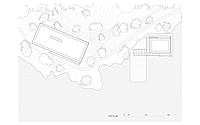
From the outset, the architectural team reduced environmental impact by placing the building within the clearing left by the existing cottage, preserving the natural bedrock and mature trees. The site’s gentle slope also enabled floor-to-ceiling glass walls on the lower-level walkout with minimal disruption to the existing ground plane.
This is a cottage shaped by tension and restraint—expansive yet enclosed, visible yet discreet. It is a place where architecture recedes into its surroundings while supporting retreat, renewal, and the shifting rhythms of solitude and gathering.
Photography courtesy of Akb Architects
Visit Akb Architects