House in Cabanyal by Pilar Martí
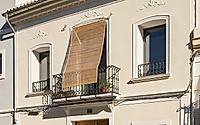
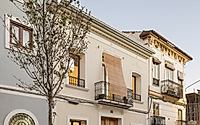
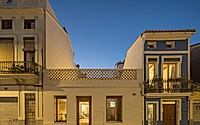
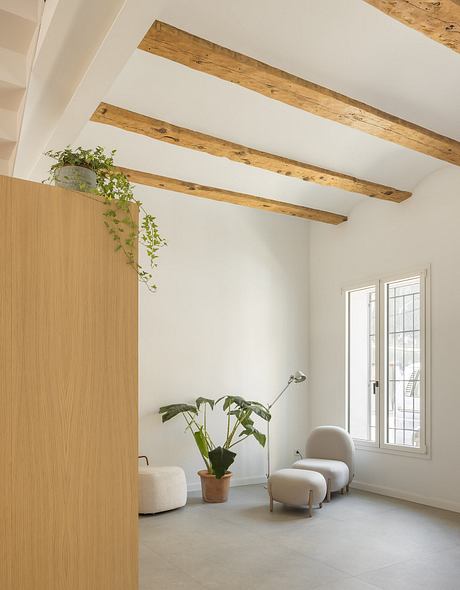
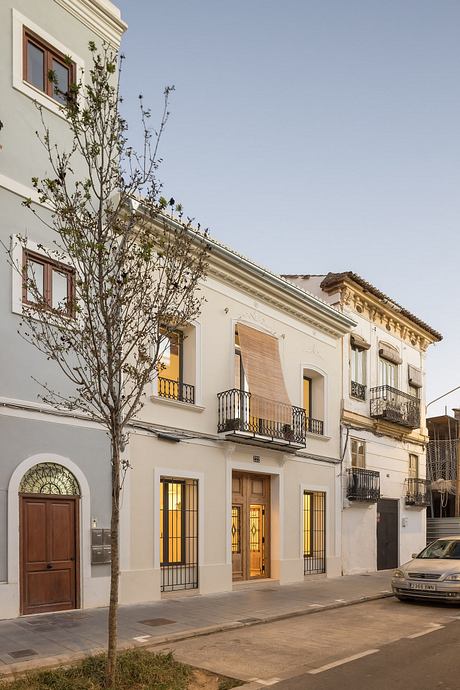
Valencia, Spain-based architect Pilar Martí has designed a house that fully restores its facade while recovering a courtyard that had been buried during its 14-year rundown, along with reinserting the building’s steeply pitched Spanish tile roof. Named House in Cabañal, the home showcases elements of Mediterranean living, featuring both an east-facing patio that serves a thermoregulator of the building, and a staircase containing volumetric and spatial games that form a nuclear element of the home.

The Characteristics of a Traditional Village House
Spanning between Calle Escalante and Calle Josep Benlliure in Valencia, the original building responds to the configuration of a pass-through dwelling that ran between two of the most characteristic and deeply-rooted streets. It occupies a privileged plot due to its orientation and the possibility of having a patio to the east that had been covered in unfortunate interventions and was part of the program of the previous building.
The Project’s Aims to Recover the Typology of a Village House
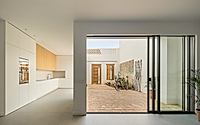
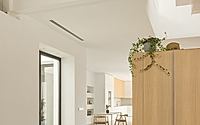
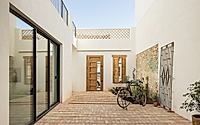
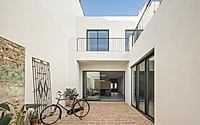
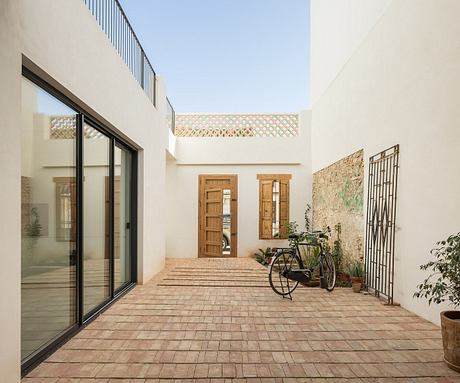
The project since the beginning, aimed to recover the typology of a the village house located in the Cabanyal that would allow bright, spacious rooms and recovering the patio towards the east as the main element of the house and thermoregulator, ensuring the cross ventilation by the opening of the windows located on both streets. On the ground floor there are the most open spaces, such as the living room and kitchen, along with a guest toilet and the staircase that leads to the upper floor.
The Staircase is a Central Element of the Home
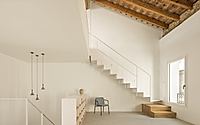
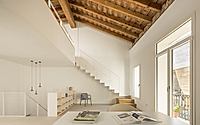
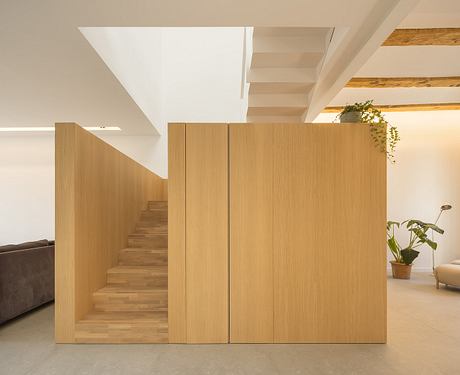
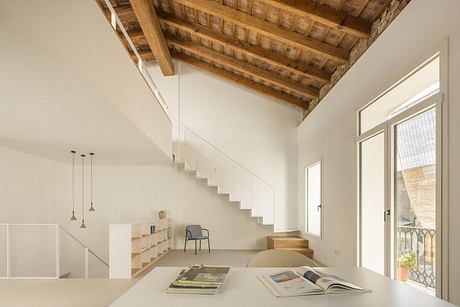
The staircase is erected as a wooden volume in which the staircase is modeled and which serves as an access podium to the next metal staircase layout. The staircase is decomposed into several elements that make up volumetric and spatial games that dematerialize it and form a nuclear element of the home.
The Functionality of the Roof Following the Renovation
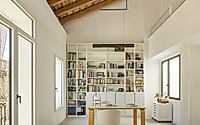
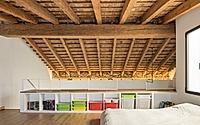
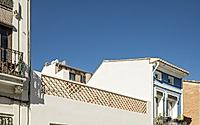
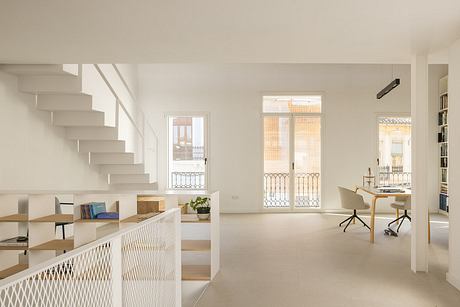
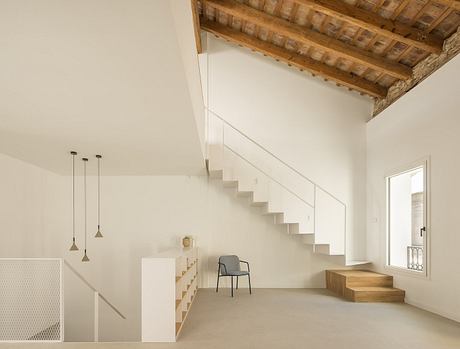
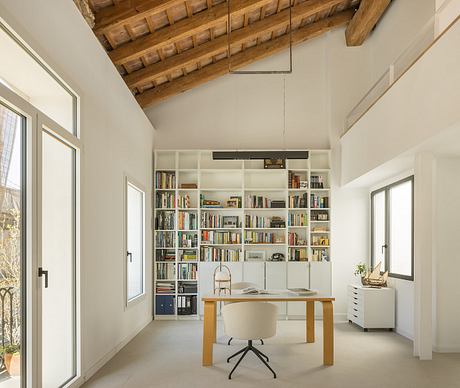
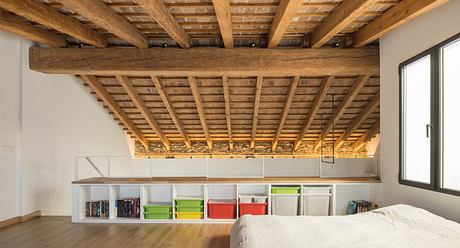
On the upper floor, the double height that connects the library area with the study and teenage bedroom is particularly relevant. The staircase leading up to the upper floor has materialized with sheet steel, in the same way as the last section of stairs leading up from the ground floor, seeking at all times to form a light staircase but at the same time to be present in the building. The roof is one of the elements that has deserved a greater degree of intervention in the rehabilitation, preserving the slope that faces Escalante street and the reconstruction of the new slope that pours its waters towards the staggered flat roofs that overturn towards the inner courtyard of the house.
The Distinction of the Newly Integrated Materials
In addition to the refurbishment of a dwelling in the Cabañal, the choice was made to incorporate manganese green, so present in the Andalusian and Mudejar legacy in Spain, as well as in the 14th-century ceramics of Paterna, combined with a ceramic with its uniform fired-clay colour, as well as having a matt texture in contrast with the green glazed ceramic. In this way, this generates a compositional element in the façade itself, as well as a lattice that filters the light especially in the summer, generating a play of light and shadow with a geometric pattern in a courtyard with the same use of handmade terracotta ceramics.
The Project Integrates Characteristics of Mediterranean Living into Its Design
The elements that make up the Mediterranean way of life, where the patio is another element of the housing program and allows connecting with a private space with the usual presence of a garden, give it a great quality of life linked to Mediterranean architecture.
Photography by Germán Cabo
Visit Pilar Martí