JW Marriott Crete Resort and Spa by block722
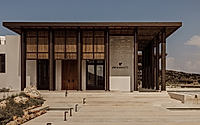
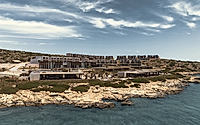
The new JW Marriott Crete Resort and Spa sits on the rocky hillside of Akra Pelegri in Marathi, Greece. Designed by Block722, the hotel harmonises perfectly with its landscape. Relying on the local architectural language and the region’s slow-living ethos, the project represents a quiet, environmentally-driven luxury that deeply respects tradition. It comprises 160 rooms and suites providing accommodation for up to 450 guests, alongside spaces for wellness, hospitality, dining, and relaxation.


Hospitality That Harmonises With Its Environment
The new JW Marriott Crete Resort and Spa sits on the rocky hillside of Akra Pelegri in Marathi, Greece. Designed by Block722, the hotel harmonises perfectly with its landscape. Relying on the local architectural language and the region’s slow-living ethos, the project represents a quiet, environmentally-driven luxury that deeply respects tradition. It comprises 160 rooms and suites providing accommodation for up to 450 guests, alongside spaces for wellness, hospitality, dining, and relaxation.
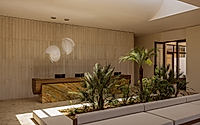
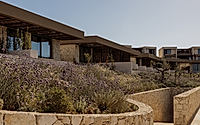
Immersion begins immediately on arrival, through an spacious square planted with native shrubs that impart a warm welcome. With each step, the sea slowly reveals itself, a moment that is carefully orchestrated to allow a progressive unveiling of both the architectural composition and the natural surroundings. Planting continues inside the lobby, becoming an organic part of the interior, framing the reception seating, while natural light enters from above through a skylight, activating the internal garden and enhancing the connection to the surrounding landscape.
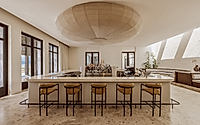
The reception area is the first of a series of interconnected indoor spaces, furnished in calm, earthy tones, and followed by the bar, the main restaurant, and the JW Market. This is the communal core of the resort, arranged as a sequence of clean geometric volumes, that open up towards the sea through a series of grand pergolas, acting as a filter between interior and exterior space.
Shared Spaces That Invoke Meditative Calm
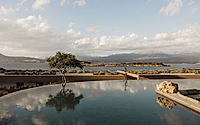
Forming the transition from indoors to out, the pergolas feature simple supports that recall ancient Doric columns while dense shading elements made of natural materials filter the Mediterranean sunlight, creating a constantly shifting interplay of light and shadow. These elements create ever-changing patterns of light and shadow across the verandas and the reflective pool of water that wraps around them. Here, natural materials, including raw, uncut boulders of rock work alongside the clean, geometric lines of the architecture to enhance tactility and connect guests to the elemental nature of their surroundings. The full mediative quality of the environment can be enjoyed in the islands of sunken seating reached by pathways across the water.
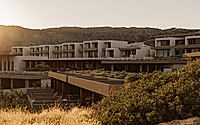
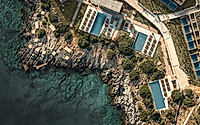
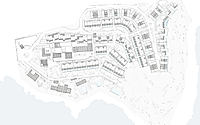
Further amenities, including restaurants, shaded seating areas, pools and wellness centre are harmoniously distributed across the lower part of the site, nestled between the rugged rocky terrain and the coastline. This spatial composition allows for gentle natural transitions between communal and private areas as the guest ascends towards accommodation units, which stretch over the higher elevations of the landscape.
Rooms That Are At One With Nature
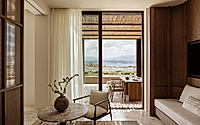
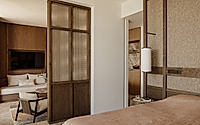
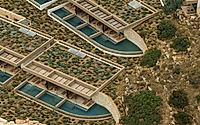
Designed into a series of one and two-level geometric structures that are carefully positioned on the natural slope of the terrain, the rooms and suites sit in perfect harmony with the landscape, while the amphitheatrical placement and human-scale architecture ensure uninterrupted views, privacy, and a seamless integration into the surroundings. Each room is conceived as an integrated living environment that dissolves the boundaries between interior and exterior space. Privacy is assured, while optimal orientation guarantees captivating sea views. Private pools appear to float within the landscape, creating natural cooling microclimates, while shaded terraces and planted rooftops allow the natural terrain to become an essential part of the guests’ daily rhythm.
Celebrating Local Craftsmanship, Materials And Environment
Block722’s vision of a harmonious marriage between contemporary architecture and ancient land is achieved through close collaboration with local suppliers, artisans, and manufacturers for nearly all material, making and construction needs. Generations of local knowledge and craftsmanship are directly embedded into the project’s DNA.
The material palette throughout reflects the immediate environment. Stone walls are constructed using material harvested directly from on-site excavations while concrete elements incorporate aggregates sourced from the same earth: The Marathi is quite literally born from its landscape. The colours, forms and textures of the fixtures and furnishings – made from raw, washed linen, terracotta tiling, earthenware, rattan and wood – are, meanwhile, drawn directly from the surrounding landscape, to create interiors that feel like natural extensions of the outdoors.
Honouring The Land With Regenerative Design
A profound commitment to sustainability and land stewardship has underpinned every design decision at the Marathi. Block722’s site-sensitive strategy was always to organically embed the built volumes into the coastal landscape, preserving the original topography through post-construction restoration.
The architecture engages meaningfully with its place through close collaboration with local suppliers, artisans, and builders at every stage of the process, lending the project authenticity and material depth. The material palette is drawn directly from the landscape. Stone walls are built using material quarried on-site, while aggregates from the same soil are used in the concrete area, the hotel quite literally emerges from the land that hosts it. The colours, forms, and textures of the furnishings and materials — including raw linen, terracotta, ceramics, woven fibres, and timber — shape interiors that feel like a natural extension of the outdoors.
The planting strategy was key. Focusing exclusively on native, drought-tolerant species with minimal irrigation requirements, it supports local biodiversity, preserving and enhancing the existing flora. At all times, the built elements have been carefully integrated to work with, rather than against, the natural terrain. Passive environmental approaches include optimal solar orientation, natural cross-ventilation, and deep pergolas, all of which provide effective shading, improving thermal comfort and reducing energy use. Active approaches include renewable energy production through the inclusion of photovoltaic panels, water sourcing through an on-site well, and green roofs that improve thermal insulation while visually blending buildings into the landscape. These systems work together to minimize the project’s environmental impact while creating a destination that actively enhances the health of its ecosystem.
A Blueprint For Responsible, Restorative Hospitality
Here on this dramatic Cretan coastline, construction and conservation have come together to embed contemporary, restorative hospitality sensitively and sustainably into one of the Mediterranean’s most treasured landscapes. The resort stands as a living example to architecture’s power to honour place while creating transformative experiences – ones that connect guests not only to the idea of luxury, but to the deeper rhythms of island life.
Photography courtesy of block722
Visit block722