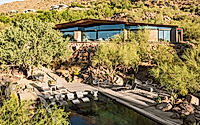
Copper Canyon House by Architecture-Infrastructure-Research
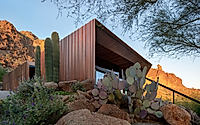
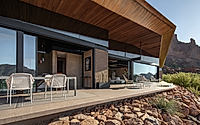
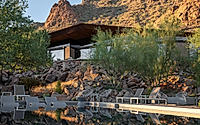
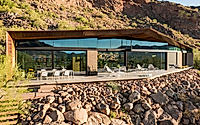
Copper Canyon House stands at the base of Camelback Mountain in Paradise Valley, AZ, United States, conceived by Architecture-Infrastructure-Research. The house reads as a thin copper tent raised on a concrete slab, poised above a scatter of boulders and washes. It’s a residential project that treats climate as a driver, pulling landscape and light through a broad central pavilion while carving quieter masonry rooms to the sides.


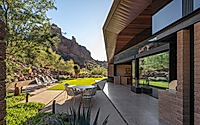
Sun throws a hard line across the copper roof. From the cantilevered concrete slab, the mountain’s boulders collect like a tide at the house’s edge, and the view carries straight through.
This is a house in Paradise Valley by Architecture-Infrastructure-Research, set within the Sonoran Desert’s washes and rock. The project treats climate as first principle, using a thin folded copper skin to shield heat and a series of cave-like masonry rooms to temper glare while keeping the mountain in sight.
Shape Sunlight
The copper tent stretches as a taut plane, trimmed to avoid roof penetrations and reduce east and west exposure. Recessed glazing pulls back from the roof’s edge to deepen shade at the perimeter, while garage doors sit flush with the standing-seam surface to keep the outline crisp.
Carve Shade
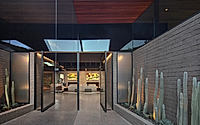
Deep vertical slots cut into the east entry and the west yard side blunt low morning and late-day sun. These incisions aim light where it helps and block it where it punishes, setting a cooler tone for arrival and exit during the hottest stretch of the year.
Open Courtyard Edges
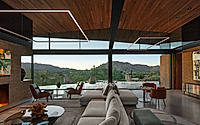
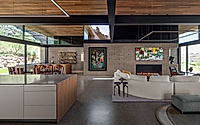
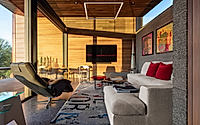
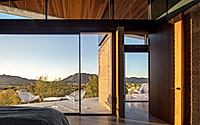
A ring of nine-foot-tall masonry volumes anchors wide-flange transfer beams, with slender micro-columns that lift the copper plane overhead. Between these masses, jumbo sliding panels—nine feet high and fifteen feet wide—open the central pavilion to north and south, letting the landscape read as one continuous ground.
Hide the Systems
Mechanical and electrical runs align to a clear datum coordinated in BIM: custom CNC-routed Corian grilles tuck ductwork and automation within the steel beam web. Lighting and window treatments share this band, so the courtyard remains free of visual clutter and the copper canopy holds the eye.
Material With Terrain
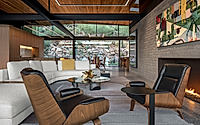
Copper, cedar, and CMU form a durable palette tuned to the Sonoran Desert’s wear. The mountain throws winter shade across the site—solar panels are out—yet the envelope counters summer’s glare, with the copper skin acting as a heat shield and the masonry rooms holding onto cool.
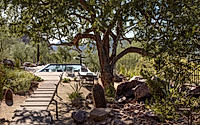
Wind moves across boulder fields and slips under the roof’s lip. Daylight cuts and softens by turns, and the main room stays open to the slope beyond.
The house reads as thin, precise, and calm—its mass grounded, its roof hovering. In that balance of shelter and exposure, the desert feels close and present.
Photography by Bill Timmerman, CJ Gershon
Visit Architecture-Infrastructure-Research