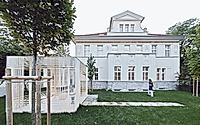
Vila Mirje by OFIS Arhitekti
Nestled in Ljubljana’s Mirje district, Vila Mirje stands as a dialogue between past and future. Layers of Roman heritage, Plečnik’s timeless interventions, and early 20th-century bourgeois elegance intertwine with contemporary design. Restored with care, the house preserves its frescoes, stoves, and stone staircases while embracing new garden pavilions and adaptable interiors. More than a renovation, it is a living palimpsest — a space where memory, change, and modern life coexist in harmony.


About Vila Mirje
The villa is located in Ljubljana’s Mirje district, an area where layers of history coexist and shape the urban fabric. Here, remnants of Roman Emona are interwoven with early 20th-century bourgeois residences, while Jože Plečnik’s interventions reinterpret the city’s past within a modern urban framework. Positioned near the Roman Wall—carefully preserved and monumentalized by Plečnik—the villa engages in a dialogue with one of Ljubljana’s most iconic urban landmarks. By situating the villa within this context, it becomes part of a layered historical narrative, where Roman heritage, early modern bourgeois life, Plečnik’s interwar interventions, and today’s contemporary reinterpretations coexist. The villa thus participates in a palimpsest of histories, connecting the past and present while engaging actively with the surrounding urban landscape.
The Villa and Its History
The townhouse villa at Mirje in Ljubljana was built in the early 1920s by engineer Miroslav Kasal as a refined example of bourgeois living in Central Europe. With its richly decorated façade, wrought-iron garden fence, and lush garden, it embodied the dignity and social aspirations of its era. Inside, secessionist tiled stoves, a representative central hall, and the Podpeč limestone staircase — the same material used by Jože Plečnik in his masterpieces — gave the villa its distinctive atmosphere.
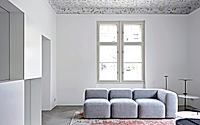
The villa’s interiors also reveal intriguing symbolic layers. Frescoes of angels signed by painter Maksim Gaspari, a friend of Kasal, incorporate a compass and ruler — motifs commonly associated with Freemasonry, to which Kasal is believed to have belonged. Even the preserved holy-water stoups on the staircase are interpreted as subtle indicators of Masonic symbolism. Together with decorative roller paintings, murals, and ornamental patterns uncovered during renovation, these fragments reflect the experimental and expressive spirit of the villa’s first owner.
Despite decades of poor maintenance and improvised post-war interventions, the house never lost its original character. Half of the windows survived and were restored; missing ones were reconstructed from historical models. Brass handles, stucco decorations, and fragments of the garden fence were carefully repaired, while deteriorated murals and painted patterns were revealed as evidence of its layered past. Rather than erasing these traces, the renovation integrated them, allowing the villa to narrate its own century-long story of bourgeois origins, wartime and socialist transformations, and contemporary renewal.
This complex history shaped the design approach. The renovation was conceived not only as seismic reinforcement and technical reconstruction, but also as a cultural reinterpretation. By opening the villa towards the garden and inserting transparent pavilions, the once introverted bourgeois house becomes part of a more porous urban landscape. In this way, the villa regains its dignity as a historical artifact while adapting to the realities of contemporary life — at once rooted in memory and open to new interpretations.
Continuity, Change, and Contemporary Living
Designing an early 20th-century bourgeois villa today means confronting its shifting identity across a turbulent century. Originally conceived as a symbol of stability, dignity, and bourgeois lifestyle, such villas were later transformed through waves of political and social change. After the Second World War, respect for pre-war architecture was often lost, particularly in Eastern Europe, where functionalist and socialist housing replaced the bourgeois typology. Many villas were divided into multiple apartments, converted to offices, or adapted with improvised interventions that compromised their spatial clarity.
The Villa on Mirje bears these traces. Rather than erasing them, the renovation integrates fragments of this history as part of its narrative: unfinished layers, revealed murals, decorative patterns, and scars of less successful additions remain visible. They tell the story of different inhabitants and shifting values.
Today, the challenge is how to reflect this layered past into contemporary life. The villa must accommodate new forms of living shaped by hybrid work, fluid family structures, and the growing influence of artificial intelligence in daily routines. Its architecture embraces adaptability, creating porous spaces that can absorb evolving patterns of inhabitation. The project thus connects heritage with speculation: rooted in memory, but open to change, it is both a witness of history and a framework for the lives of tomorrow.
Garden and Pavilions
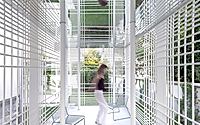
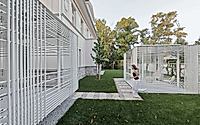
Two transparent garden pavilions were implemented as a counterpoint to the historic house, placed in relation to the villa and its garden. They are designed as lightweight woven structures, composed of 2 cm circular steel profiles. Horizontally and vertically interlaced, the profiles create the impression of a three-dimensional wireframe model – a spatial mesh that defines volume not through solid walls, but through rhythm, layering, and transparency.
Their texture simultaneously reveals and conceals: from certain viewpoints, the density of profiles filters the gaze, creating veiled, semi-private atmospheres, while from other positions the pavilions open up, offering uninterrupted views into the garden. One pavilion is directly connected to the villa’s living space, extending the interior into the garden. The second stands on the site of the former garden pavilion, reviving historical memory through contemporary reinterpretation.
Interior Concept
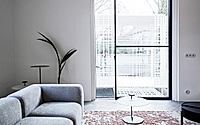
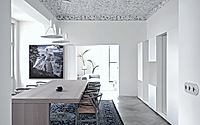
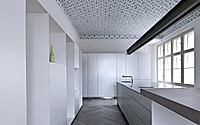
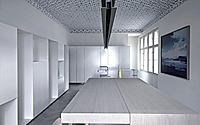
The interior organization follows the original bourgeois logic of the villa. The ground floor, historically the more public level, accommodates the reception hall, living room, dining area, and kitchen. These spaces retain their axial connections and proportions, complemented by contemporary interventions. The existing Podpeč limestone staircase – a material also used by Plečnik – continues to connect the villa’s vertical sequence: the first floor houses private bedrooms, while the attic level is dedicated to guest rooms and communal space.
Custom-made furniture avoids imitation and instead provides a counterbalance: abstract, metal-clad volumes that align with the villa’s proportions, functioning as storage while shaping light and atmosphere. Furniture thus transcends utility, becoming a discreet architectural layer within the house.
Dialogue of Old and New
Where possible, original materials and elements were preserved: half of the windows were restored, brass handles and fixtures were reintegrated, and stucco decorations were reconstructed. Historical traces – from painted patterns to damaged fragments of the garden fence – were incorporated as evidence of continuity.
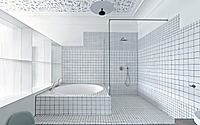
New interventions, such as openings toward the garden, the pavilions, and the contemporary furniture, create a deliberate contrast. The interplay avoids mimicry in favor of complementarity: the historic villa remains legible in its authenticity, while the new additions articulate a distinctly contemporary layer.
Legacy and Future
The renovation of the Villa on Mirje is not merely conservation. It is a layered architectural narrative that integrates the villa’s bourgeois origins, post-war transformations, forgotten typologies, and scars of time. At the same time, it repositions the villa for contemporary life: porous, adaptive, and aware of technological and social shifts shaping our present and future.
The villa thus becomes both a witness of history and a framework for contemporary living — a dialogue across time that remains deeply rooted in the identity of Mirje, while opening toward the possibilities of tomorrow.
Photography by Tomaz Gregoric
Visit OFIS Arhitekti