Casa a Trastevere Reframes a 19th-Century Flat for Today’s Living
Casa a Trastevere renovates a two-level apartment in Trastevere, Rome, Italy, by architect Mario Leonori. Set within a late 19th‑century building, the home opens to long views toward the ghetto and Piazza Venezia. The project reworks the plan for contemporary living while preserving tangible traces of age, from timber roof beams to a quiet terrace that pulls daylight deep inside.


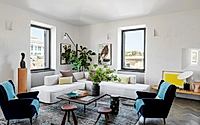
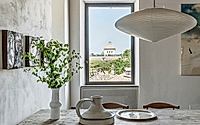
Sun washes through tall, deep-set windows and lands on herringbone underfoot. From the terrace, the skyline draws the eye while the rooms sit calm and measured.
This is a renovated duplex apartment in Trastevere, Rome, by Mario Leonori. The work centers on material contrast and craft: ancient bones kept in view, contemporary layers set with restraint. The plan serves a young family’s routines without losing the house’s late‑19th‑century character.
Balance Old And New
On the lower level, gray terracotta laid in herringbone stitches together living, dining, and circulation. Overhead, historic timber beams and pale plaster carry the weight of time with a light touch. The upper level shifts to oak planks, warmer underfoot and quieter in tone, underscoring the private rooms. That change of grain—terracotta below, oak above—sets a clear rhythm for daily movement.
Stair And Balcony
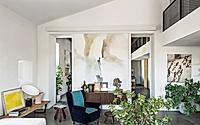
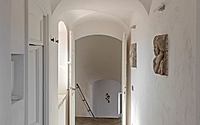
A linear balcony cuts along the full length of the living room and links study to master suite. The black metal guard reads crisp against white walls and old beams, drawing a fine horizon through the volume. From the study, daylight drops into the seating area, and conversation rises back—privacy held, connection maintained. It’s an elegant splice of levels.
Kitchen As Anchor
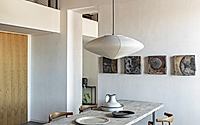
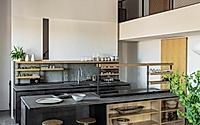
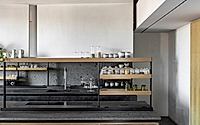
The kitchen sits at the heart of the lower floor. A central island in iron and peperino stone forms the working core, durable and tactile, with open oak niches for everyday tools. Crafted shelving, simple hardware, and a low rail keep lines clear while admitting sightlines to dining and lounge. Material honesty does the heavy lifting here—no gloss, just balanced heft and use.
Color In Baths
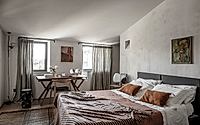
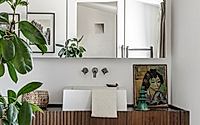
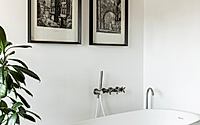
Bathrooms are wrapped in resin, each tuned to a different hue drawn from Roman facades. Smooth walls meet slim fixtures and framed prints, giving the rooms quiet character without clutter. The master suite pairs that finish with oak underfoot and soft textiles, a measured counterpoint to the robust materials downstairs.
Terrace And Outlook
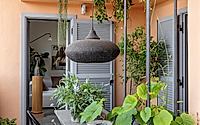
Beyond the living room, a terrace painted in warm tones holds plants, a slender pergola, and a simple table. Breezes move through shutters while the view stretches toward the ghetto and Piazza Venezia. The outdoor room reads as another chamber of the house, carrying the interior palette outward and softening the threshold to the city.
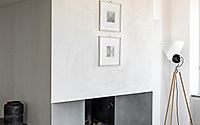
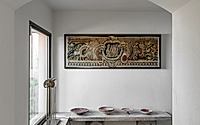
Back inside, art, collected objects, and a few midcentury chairs sit against plain plaster and patterned rugs. Nothing shouts. Material choices do the talking—stone, iron, terracotta, oak—binding present life to a building with memory.
Photography by Foto: Helenio Barbetta, Styling: Chiara Dal Canto
Visit Mario Leonori