Ocean River House by Rado Iliev
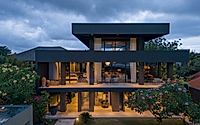
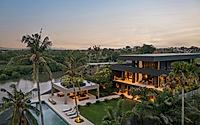
Ocean River House sits on a river estuary in Bali, Indonesia, where the Indian Ocean pulls the eye and the breeze. Designed by Rado Iliev as a house that renews rather than replaces, it keeps the original structure while stretching upward and outward to claim stronger light and longer views. The result favors a modern stance without losing local gravity.


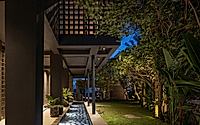
Water moves first, pooling at the edge before the ocean takes over. From the entry the garden draws you forward, light sliding across dark render and stone.
This is a house rebuilt by restraint rather than demolition. The existing structure stays, the upper floor extends for long views, and a reworked roof lifts the main room while keeping the footprint disciplined.
Keep the Bones
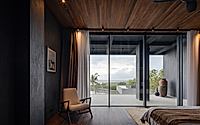
The brief asks for a modern house yet insists on the old frame. Retaining the original structure underpins every move, allowing new volumes to climb without a new foundation game. The upper level now holds living, the master, and a child’s suite, all angled to watch the Indian Ocean from height. An office steps up again, surveying the open plan and the horizon in one sweep.
Lift the Roof
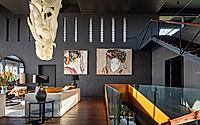
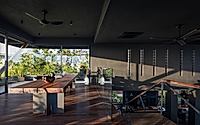
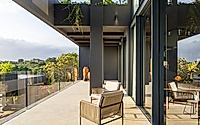
At the core, the roof rises to open a tall central nave. The main living area reaches 7 meters (23.0 feet) high, a vertical breath that draws heat upward and daylight deep across the room. Two large custom chandeliers nod to Balinese papier-mâché figures, holding the volume visually without crowding the view. Quiet below, a long terrace links the public rooms to wind and water.
Stage the Ground
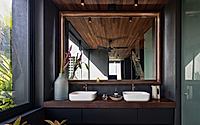
The ground level consolidates guests and service into a tight plan. Three guest suites, a TV room, utility, garage, and staff kitchen tuck beneath the elevated life above. Bathrooms break apart: garden-side showers pull daylight, sinks act as a calm centerpiece, and toilets sit in their own rooms. A 22 meter (72.2 feet) pool holds the river edge and doubles as a retaining wall for the raised garden, its length set by three existing coconut palms.
Orchestrate Arrival
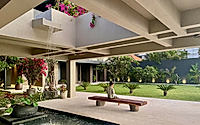
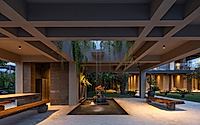
Entry starts at the road with a massive traditional door. A colonnade and elongated pond to the left steer the walk toward the garden, then the pool, then the ocean beyond. At the water’s edge, a pavilion brings shade and utilities while a flooded roof lets water spill into a small pond with a planted edge. Hanging greenery drops from a perimeter planter, brushing the pond surface and softening the hard line between terrace and river.
Tune the Palette
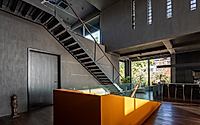
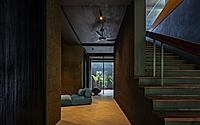
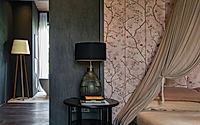
Material choices lean dark, drawing from volcanic sand beaches nearby. Rendered walls read cool and steady, with stained and lacquered Balinese stone lining the lower lobby for a tactile, local register. A white herringbone stone floor runs through the ground level and into the garden, bright enough to temper heat. Doors and stair treads use black-stained solid ironwood; upstairs floors share that timber, deepening over time to chocolate black.
Craft the Objects
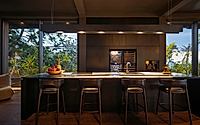
A dining table spans 4 meters (13.1 feet), two 8 cm (3.15 inch) ironwood planks on 2.5 cm (0.98 inch) steel sheet bases. The kitchen island sets black and white natural stone in clear contrast, a simple move that reads direct and strong. At night the pavilion roof glows: a shallow volume filled with river stones and illuminated water, visible from the large upper terrace. Small moment, big draw.
The garden keeps its elders intact. No trees fall; a pink frangipani holds the lawn while palms set the pool. By evening, sunsets pull across the estuary and into the rooms, the raised roof catching color and letting the house idle into dusk.
Photography by Indra Wiras
Visit Rado Iliev