Greenkamp by Atelier ST
Greenkamp sits in Berlin, Germany, on one of the last open parcels within the historic Eichkamp estate. Designed by Atelier ST, the house answers a village-like context of trees, schools, and small homes with a compact form and precise material contrasts. It’s a family house with a quiet stance, tuned to the rhythms of the Grunewald and the legacy of early twentieth-century planning.


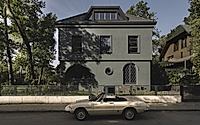
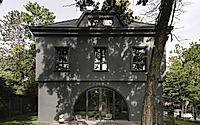
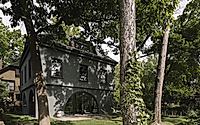
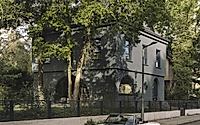
A paved forecourt gives way to a dark, quiet mass set among tall deciduous trees. Light catches the roof tiles and slips across lime-washed plaster before pooling at the entry.
This is a compact house in Berlin’s west by Atelier ST, planned for a family of six and set within Bruno Taut’s Eichkamp estate. The throughline is material: a dark, mineral exterior that recedes into foliage and a bright, all-wood interior that carries warmth, precision, and craft.
Dark Envelope, Warm Core
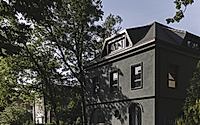
Outside, mineral lime plaster in a deep green tone lets the volume sink into the garden while a pre-patinated ceramic tent roof resolves the compact, almost square plan. Projecting upper storeys add relief and shadow, giving the solitary form depth without noise. Window shapes—circular, semi-circular, and tall rectangular—cite Art Deco motifs from the estate’s founding era and tune daylight across rooms. The terrain lifts gently at half-height plinths and embankments, softening the step from forecourt to garden.
Timber Rooms Unfold
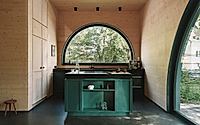
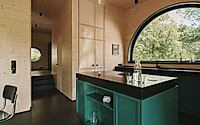
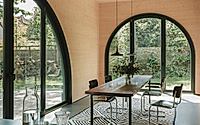
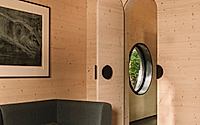
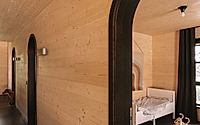
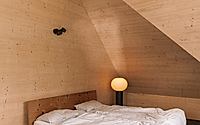
Cross the threshold and the tone shifts to wood everywhere: walls, ceilings, surfaces, and built-ins are crafted in timber, with a black mastic asphalt floor grounding the sequence. The foyer rises bright and open, its semi-circular double doors laced with diamond glazing bars that repeat on full-height sliding doors deeper inside. A half-level leads to the kitchen and dining room, the home’s center, where large semi-circular glazing pulls the garden into daily routines. The elevated living room sits adjacent as a quieter retreat with panoramic outlooks.
Windows Cut In Play
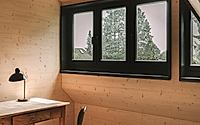
Openings are paced to modulate privacy and view rather than simply collect light. Round and arched apertures gather softer illumination, while high-zonal rectangular cuts stretch sightlines along the treetops. The palette stays restrained so texture does the work, from the mineral exterior to oiled timber grain inside. Each edge reads crisp against curves that ease transitions between rooms.
Ground And Roof Meet
The tent roof crowns the stack like a calm lid, unorientated and symmetrical to echo neighboring types. Below, shaped terrain, terraces, and half-height plinths stage thresholds between the public approach and the private garden. A custom wood-burning stove with green tadelakt seating sits at the heart, water-fuelled for continuous heating and scaled for family life. Timber stair flights, small galleries, and air wells connect upper levels of bedrooms, children’s rooms, and work areas with flexible use and steady light.
Evening returns the exterior to shadow while the wood interior glows. The house holds its edge between forest estate and city—quiet in posture, exacting in material character.
Photography by Clemens Poloczek, Berlin
Visit Atelier ST