Edwardian Home Renovation: Light-Filled Richmond House Transformation
Edwardian Home Renovation reimagines a three-storey house in Greater London, England, United Kingdom, with Footprint Architects steering a careful yet confident upgrade. The practice works inside Richmond’s established streetscape to refine circulation, improve light, and strengthen the link between the house and its long garden. In doing so, it nudges an Edwardian layout toward present-day family life while still reading as part of its familiar terrace.


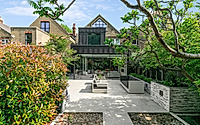
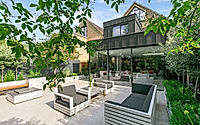
Morning light runs along the rear elevation, moving from the original brickwork toward the new extension and out into the garden. Views pull straight through the house, so arrival carries a quiet sense of direction.
This is a house remodeled for clarity. Footprint Architects reorganize the interior of a three-storey Edwardian home in Richmond, Greater London, England, United Kingdom, concentrating on how rooms connect to one another and to the garden. The project holds onto the familiar rhythm of the street while loosening the plan at the rear, where a new linear arrangement encourages everyday life to track toward the outdoors.
A three-storey layout can easily feel segmented, with everyday routines pushed into small, disconnected corners. Here, the renovation concentrates on opening the primary living areas, allowing one room to lead into the next without abrupt thresholds or dark pockets. The extension extends that movement toward the garden, so family life naturally migrates along a clear axis from front door to planting.
Shaping The Ground Floor
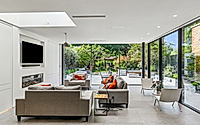
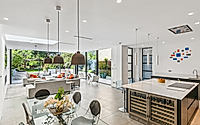
On the main level, the architects recalibrate proportions to reduce pinch points and create a more generous living zone. Walls that once chopped the plan into separate compartments give way to a connected sequence, where sitting, dining, and everyday gathering occur along one coherent route. The result is a ground floor that works harder without feeling overdrawn, encouraging movement yet still allowing for quieter corners.
Light is a key ingredient in that shift. Bringing daylight deeper into the interior reduces reliance on artificial lighting and sharpens the perception of depth from front to back. By refining openings and aligning views, the project turns the route toward the garden into a daily ritual rather than an occasional detour.
Extending Toward The Garden
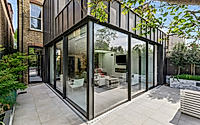
At the rear, the extension acts as a hinge between house and garden, drawing activity outward. Its linear form sets up a direct relationship between interior rooms and the outdoor terrace, so sliding a door or crossing a threshold feels like a natural continuation of movement. Everyday tasks spill toward the lawn in good weather, and even in cooler months the long view keeps the garden visually close.
Crucially, this new volume respects the existing building lines of neighboring properties. The rear elevation steps within a shared rhythm, keeping sightlines controlled and privacy intact for both occupants and neighbors. That careful alignment allows the house to grow without overshadowing adjoining homes, contributing to a coherent terrace rather than competing with it.
Balancing Old And New
The project works within an established Edwardian envelope, so the transition between original rooms and the new extension requires deliberate handling. Footprint Architects respond with a fine-tuned material palette that echoes the existing structure while signalling a subtle shift in character toward the rear. Interior surfaces mediate between older details and newer elements, giving the sequence a sense of continuity rather than abrupt contrast.
Externally, the palette syncs with surrounding properties to maintain a consistent streetscape facing the shared gardens. Tones and textures are chosen to sit comfortably with neighboring facades, reinforcing the idea that this is a careful evolution of an existing house. The extension reads as a natural continuation, not an isolated object.
Living With The Garden
Improved access to the garden becomes a daily advantage rather than a weekend luxury. Doors and circulation are set up to encourage frequent short trips outside, whether for a morning coffee, children’s play, or tending to planting. That pattern gives the garden a more active role in family routines, strengthening the sense of the house as a long, interconnected sequence of rooms and outdoor rooms.
Throughout, the renovation favors measured adjustments over dramatic gestures. The house stays rooted in its Richmond context, gaining clarity, light, and easier movement without losing the familiar presence of an Edwardian terrace. In the end, the project reads as a quiet realignment of plan and garden, tuned to the rhythms of contemporary life.
Photography courtesy of Footprint Architects
Visit Footprint Architects