Casa Ai Colli: Quiet Minimalism for a Travertine-Lined Rome Home
Casa ai Colli is an apartment by studio BGArchitetti in Rome, Italy, shaped around a young couple’s daily rituals and shared visual passions. Set in the Monteverde neighborhood, the project folds Japanese minimalism into Roman material warmth, using custom oak joinery and filtered thresholds to define a generous living area and quiet garden-facing rooms. Every move favors clarity over clutter while framing light, trees, and the slow shifts of the day.


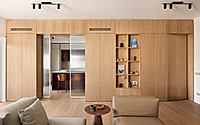
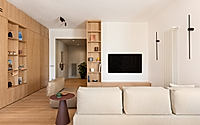
Soft daylight moves across oak grain and travertine, catching on the slatted screen that holds the apartment’s center. Shadows stretch, then thin out as the rooms open toward the private garden.
This is a home tuned to quiet rhythms. Each surface earns its place, and empty stretches between furnishings become as important as the pieces themselves.
Casa ai Colli is a 2025 apartment in Rome’s Monteverde neighborhood, designed by studio BGArchitetti for Bianca and Giacomo, a young couple immersed in the worlds of fashion and interior design. The project organizes a large living area into distinct episodes, guided by a continuous screen wall in natural oak that shapes circulation, storage, and light. Japanese aesthetics meet Roman materials, with Ma, Wabi-Sabi, and Zen principles translated into joinery, color, and the relationship between rooms and garden.
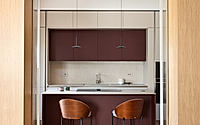
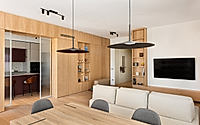
At the heart of the plan stands the oak screen wall, a single element entrusted with multiple roles and a strong visual presence. It draws a clear boundary between living and sleeping areas while concealing a sliding panel that leads to the quieter rooms. Toward the kitchen and dining room, sliding partitions in fluted glass and iron create a filtered connection, allowing visual contact and borrowed light without full exposure. Within its depth, the screen gathers closed storage, open shelving, hidden air ducts, and integrated lighting, turning infrastructure into a calm, continuous backdrop.
Japanese-Inspired Living
Bianca and Giacomo’s affinity for Japan sets the tone for how the main rooms are furnished and paced. The living area is read as a sequence of pauses and encounters, with generous negative surfaces between pieces that invite visual rest and focused use. Ma guides the placement of sofas, tables, and storage, so that movement stays fluid and sightlines remain open toward the gardens outside. Low visual noise supports a slower way of inhabiting the apartment, even within an urban context.
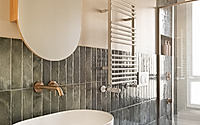
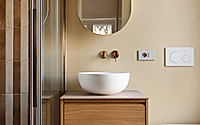
Wabi-Sabi enters through natural materials and quiet imperfection, rather than ornament. Oak parquet reveals its knots, while the grain of the screen wall reads as a vertical rhythm along the circulation edge. Neutral tones in bathroom resins and wall paints soften the contrast with stone and wood, giving the rooms a grounded, almost matte calm. This restraint in color allows small shifts in texture to register more clearly.
Light, Material, Color
Material decisions hold the narrative together. Travertine—long rooted in Roman architecture—lines the kitchen countertops and bathroom vanities, bringing a local stone into dialogue with the more far-flung Japanese references. Its pale, layered surface picks up Rome’s warm natural light, changing character from morning to evening. Against it, the oak joinery takes on different tones through the day, from soft gold to an almost copper burn at sunset.
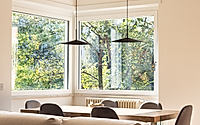
Natural light is treated as a finishing layer rather than an afterthought. It defines how colors read, how the oak screen’s depth is perceived, and when certain rooms feel most inviting. The couple gain an apartment that reads differently hour by hour, without relying on bold hues or heavy decoration. Even the integrated lighting in the screen wall follows this approach, staying discreet and supporting the material palette instead of competing with it.
Garden-Facing Rooms
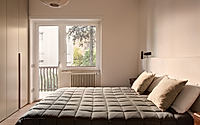
The quieter functions sit behind the oak threshold, where bedrooms open directly onto a private garden. This placement pulls the noisiest city layer away from where the couple rests and works. Views of a large magnolia and olive trees in the surrounding gardens become an everyday backdrop, reinforcing the project’s aim to bring the outdoors inside. Furniture layouts are oriented to keep these trees within sight from key positions.
Even in an urban apartment, contact with nature shapes choices about storage, bed placement, and circulation. The plan respects the desire for calm, but it does not seal the residents off from their context; instead, it frames the existing greenery as part of the home’s character. Monteverde’s parks and villas sit just beyond, while the private garden gives that larger landscape a domestic anchor.
In the end, Casa ai Colli reads as a careful reduction rather than an accumulation. The guiding quote by Bruno Munari about the difficulty of simplifying becomes tangible in the way surfaces, joints, and junctions recede from view. As light tracks across oak, travertine, and painted walls, the apartment shows how a few clear moves can support daily life with quiet precision.
Photography by Paolo Fusco
Visit studio BGArchitetti