Casa al Pradet by Clara Crous Studio
Casa al Pradet stands on the last triangular plot of a quiet street in Vilamacolum, Spain, where agricultural fields press close to the village edge. Designed by Clara Crous Studio as a self-built house for architect Clara and her partner Carles, the project grows from local farming knowledge, contemporary timber fabrication, and a deep familiarity with the rhythms of the land that surrounds it.


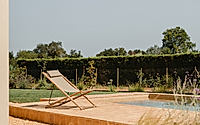
Corn fields have just been cut when the light timber frame rises, lifted above the ground and ringed by gravel that crunches underfoot. From the street, staggered volumes lean into the triangular plot, reading as a small cluster of rural buildings rather than a single object.
Casa al Pradet is a house in Vilamacolum, in Spain’s Alt Empordà region, conceived and built by Clara Crous Studio with an eye on self-construction and rural craft. The project grows from a light prefabricated timber frame and a palette of local materials that translate agricultural knowledge into domestic architecture. Material choices, fabrication methods, and even the construction calendar tie the building to its farming context.
Clara and her partner Carles secure the last available plot on their street, a wedge-shaped site at the lowest point of the village where rainwater drains toward the nearby river. Carles’s work in digital fabrication with wood and plastic, together with his family’s farming machinery, sets the groundwork for a house that can be produced largely from within their own orbit. Self-construction is not only a method here; it becomes a way to align design intent, technical resources, and time on site.
Raising The Timber Frame
The structure begins as a light timber skeleton, prefabricated in a workshop to compress onsite work and make the most of limited labor. Pieces arrive ready to assemble, reducing waste and allowing the team to work quickly between agricultural tasks and changing weather. Set 1.2 meters above the ground due to the site’s low position in the village, the timber frame lifts the house clear of runoff and damp. This elevated datum also gives the rural street a quiet new edge, a measured podium for the clustered forms above.
Building In Rhythms And Modules
Construction starts right after the corn harvest, when local workers can shift from the fields to the building site. That timing knits construction schedules to seasonal cycles, turning practicality into a guiding thread. From the timber base, the house unfolds as a loose chain of modules with different heights and outlines, echoing the way barns, sheds, and storage rooms accrete around traditional Catalan manor houses. Each volume meets the triangular boundary at a slightly different angle, so the composition responds to the plot instead of forcing a single rigid geometry.
Local Materials In Daily Contact
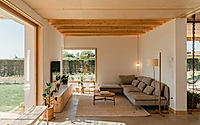
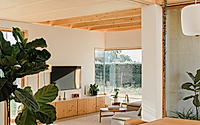
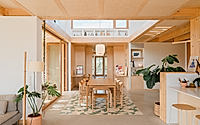
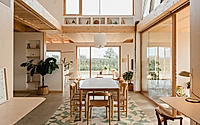
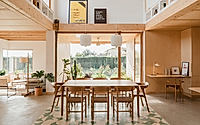
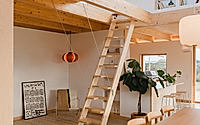
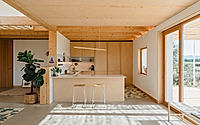
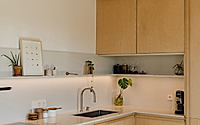
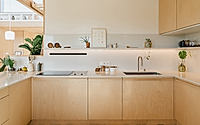
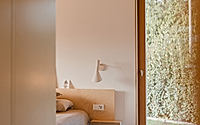
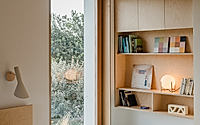
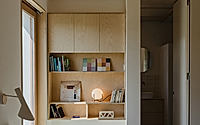
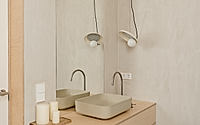
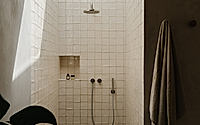
Cork, lime mortar, and adobe define the envelope, drawing on materials that handle Mediterranean light and temperature with quiet efficiency. Underfoot, hydraulic tiles and handmade ceramics trace subtle patterns across floors and skirtings, giving each room a tangible link to regional craft. Exterior surfaces and small junctions rely on those same elements, so thresholds, edges, and trims feel of a piece with the larger construction. Inside, wood carries from structure to built-in furniture, extending the frame into benches, shelving, and storage that share grain and tone.
Technical Control At The Envelope
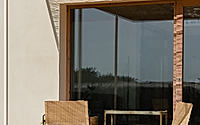
Traditional shutters line the façades yet move with contemporary precision, motorized and managed by a smart system tuned to sun exposure and wind. On hot or windy days, the envelope adjusts itself, tempering light and air without constant manual effort from the occupants. At ground level, a band of ceramic gravel wraps the house, aiding drainage around the raised base and visually grounding the timber volumes. Every layer at the perimeter, from shutter to gravel, works as part of a simple, legible construction strategy.
As the day turns, shadows from the staggered modules fall across the fields, tying rooflines back to the furrows beyond. Material decisions, from cork cladding to ceramic fragments underfoot, keep the house anchored to its rural context. Casa al Pradet stands as a compact study in how self-construction and local building knowledge can form a precise, durable home without losing touch with the land that supports it.
Photography by Montse Capdevila
Visit Clara Crous Studio