Van der Vlugt Residence: Coastal Resilience Refined For Keys Living
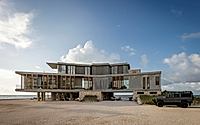
Van der Vlugt Residence stands along the Keys, United States, as a clear expression of coastal resilience by [STRANG] Miami. The elevated house draws from Sarasota School principles to meet sea level rise and storm surge with a calm, modernist posture. Robust concrete, louvers, and passive cooling strategies work in concert, giving this retreat an unhurried presence at the water’s edge while quietly addressing the realities of its exposed setting.


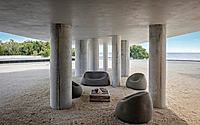
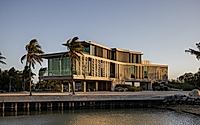
Concrete columns rise from the low-lying ground, lifting the living rooms into the coastal light. Shadows from deep louvers mark the day across elevated terraces and long glazed walls.
This is a house tuned to its shoreline climate. Van der Vlugt Residence, a coastal house in the Keys, United States, by [STRANG] Miami, treats environmental risk as a primary design driver. The project extends Sarasota School principles of environmental adaptation and material experimentation into a contemporary, storm-prone context, making resilience a visible part of daily life.
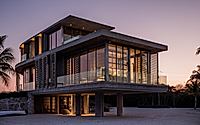
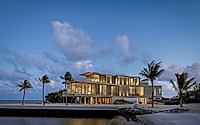
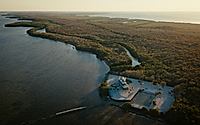
Ten feet above grade, the main level stands clear of sea level rise and storm surge, reading as a floating volume veiled by sun-catching louvers. Elevated living is not only defensive; it opens long views to water and sky while maintaining a sense of distance from the vulnerable ground plane. The robust concrete undercroft engages a pre-existing berm, so the house both hovers and touches down in measured ways.
Living Above The Surge
The resilient foundation relies on stout concrete columns that carry the house well above projected flood levels. A 50-foot cantilever projects out, expressing structural confidence while preserving the landscape beneath from heavy occupation. Below, the partially engaged berm shapes a sheltered threshold, softening the transition between exposed ground and protected upper level. Daily use plays out above this engineered buffer, where residents move between rooms knowing the weather-driven risk stays largely below their feet.
Shaping Light And Shade
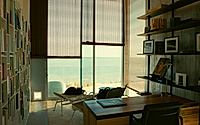
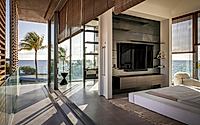
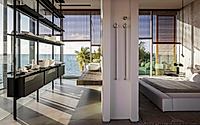
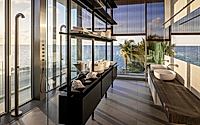
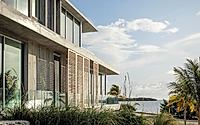
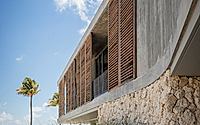
Louvers wrap the elevated volume, catching sun and casting long shadows that temper the subtropical glare. Floor-to-ceiling windows pull natural light deep inside, reducing daytime reliance on artificial illumination. Shading elements and glazing work together, encouraging cross-ventilation and passive cooling rather than a sealed mechanical shell. As the sun shifts, the house records the climate in real time, with moving bands of light and shade acting as a quiet environmental register.
Concrete, Water, And Line
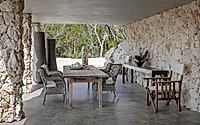
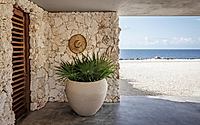
Board-formed concrete wraps exterior walls, its rugged texture echoing the Keys’ coastal geology. That same material flows indoors, where its grain and shadow play against a curved white bookshelf in the library. In the owner’s suite, metallic imprints of the board-formed surface on a key wall add a tactile reading of structure and weathering. Material continuity reduces visual clutter and reinforces the sense that climate protection and interior character grow from the same architectural armature.
Entry As Coastal Pivot
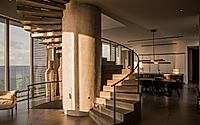
At the approach, a spiral staircase wrapped in cool gray microcement marks the pivotal point where the house’s curvature meets its main axis. This vertical element acts as a hinge between landward arrival and waterfront orientation, echoing the arc of the shoreline it traces. Climbing the stair, visitors move from grounded, shaded entry to open, elevated rooms oriented toward the water, reading the shift in altitude and exposure with each step.
A Continuing Coastal Legacy
Architecture Sarasota’s decision to anchor its documentary pilot here situates the residence within a broader conversation about climate-aware modernism. The house serves as a case study in how environmental adaptation and material experimentation, long central to the Sarasota School, absorb new pressures from rising seas and stronger storms. As light fades across the louvers and concrete, Van der Vlugt Residence stands not as a static object but as a working coastal prototype, testing how architecture can live with water rather than retreat from it.
Photography by Ryan Lester, Architecture Sarasota
Visit [STRANG] Miami