Suspended House Open to Nature by Atelier Victoria Migliore
Suspended House Open to Nature sits in Puilly-et-Charbeaux, France, at the base of a wooded hillside where the ground falls quickly into shade. Atelier Victoria Migliore works with the existing house and a new suspended extension to draw in light, clear away visual noise, and reconnect the domestic setting to its valley landscape. A once-heavy structure now reads as both grounded and airborne.


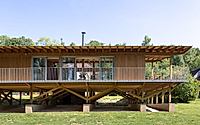
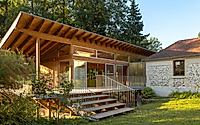
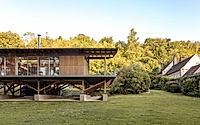
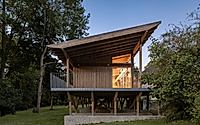
Low in the valley, the house stands against a wooded slope where trees filter the sun and hold the site in a soft penumbra. A new volume projects out toward the light, lifted above the ground so its pine structure meets branches and sky.
This is a house reworked rather than replaced, a rehabilitation that respects the original construction while setting a contemporary, suspended wing in dialogue with it. Atelier Victoria Migliore strips back the historic shell, pares down finishes, and brings stone, flint, and timber back into view. Material decisions drive the project: one body rooted in earth, the other raised and light, both tied to the Vexin landscape through their physical fabric.
Revealing Original Fabric
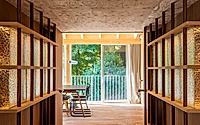
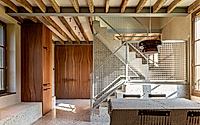
Inside the existing house, superfluous partitions come down and finishes are peeled away to free larger rooms and longer lines of sight. Short runs of wall that once chopped the plan give way to open volumes where the original timber structure stands legible again. Plaster coatings are carefully removed from the stone perimeter, and the old shutters are cleaned so their surfaces show age, grain, and jointing. With the flint fragments now visible within the stonework, the envelope reads as a thick, mineral crust that grounds the residence in its valley setting.
Suspended Timber Volume
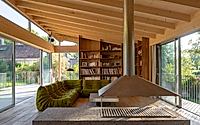
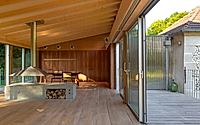
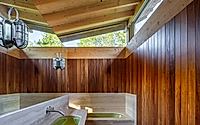
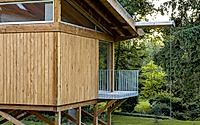
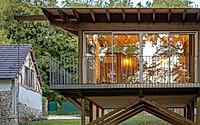
Perpendicular to this restored mass, the extension takes a different stance and moves toward light. The new element lifts three meters above the natural ground, a clear gap that lets vegetation grow on, air circulate, and shadow fall beneath. A triangulated pine structure rises from flint-aggregate concrete foundations, its fine members creating a rhythmic frame that draws the eye along the elevated body. This skeletal outline forms an aerial silhouette, an elongated room in the trees where sunlight can pour in from multiple sides.
Foundations In Local Stone
At the base of the extension, concrete mixed with flint aggregate forges a material bridge between old and new. The foundations pick up the same stony character found in the historic walls, echoing both color and texture underfoot. This continuity anchors the lightweight pine frame so it reads not as an isolated insertion but as a contemporary layer of the same geological story. Local resources shape the structural logic, tying the elevated volume back to the hillside and valley floor.
Linking Ground And Canopy
A wooden footbridge, clad in polished stainless steel, connects the original house to the suspended wing with a single clear gesture. The bridge picks up light and reflections of sky and foliage, so each crossing marks a shift from mineral enclosure to luminous timber frame. From this point the view opens toward the forest, and the new volume aligns with the tree line rather than the slope below. Movement through the project traces a vertical gradient, from stone and flint at the valley floor to pine structure engaged with branches and clouds.
As day moves on, the composition registers subtle changes in light and shadow across stone, concrete, and wood. The restored shell keeps its weight and texture while the extension above answers with slender structural lines and sun-filled rooms. Between anchoring and suspension, the house stands as a precise balance of materials, open to nature and to the slow passage of time.
Photography by Aurelien Chen
Visit Atelier Victoria Migliore