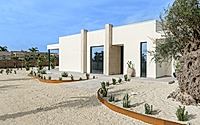
House P02: Mediterranean Villa Framed By Stone, Light, and Water Lines
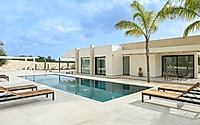
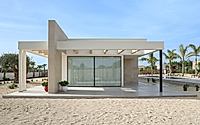
House P02 unfolds as a low, linear house in Avola, Italy, where concrete, stone, and water organize daily life under decisive Mediterranean light. Designed by Paolo Florio, the single-level villa reads as a sequence of orthogonal volumes, deep pergolas, and reflective pools that sit close to the ground. The result is a rigorously composed home that ties structural clarity to the rhythms of outdoor living around its garden and water courts.


Light falls across the pale plaster and stone, catching the vertical planes before sliding toward the water. Long roof plates cast deep shadows that track the day and cool the terraces.
This is a single-level house on the Mediterranean coast, organized as a composition of orthogonal volumes and calibrated courtyards. Located in Avola, Italy and designed by Paolo Florio, the project uses structure as both frame and filter for intense sun and open views. Structural clarity drives every move, from the reinforced concrete frame and stone-clad setti portanti to the pergolas that work as declared elements in the outdoor rooms.
Framing A Horizontal Grid
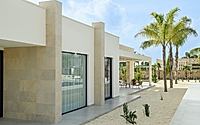
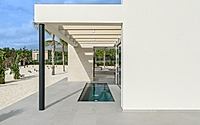
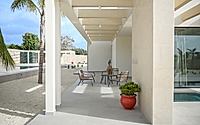
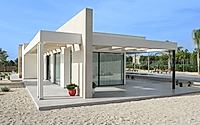
The villa rests on a rigorously horizontal layout, its plan drawn as a grid of pure, orthogonal volumes. Reinforced concrete frames, paired with load-bearing walls, allow generous spans and long, clear rooms that stay free of visual clutter. Flat roofs extend beyond the living perimeter to form deep overhangs, with beams concealed in the slab thickness so the soffits read as continuous planes. That structural reach shapes covered outdoor terraces where interior circulation slides naturally toward the garden and pool.
Stone Setti And Structural Rhythm
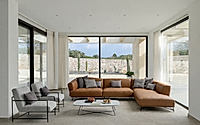
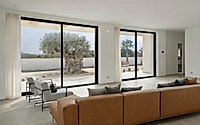
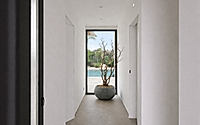
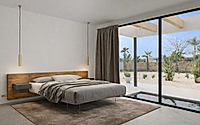
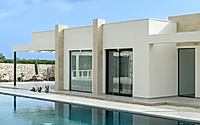
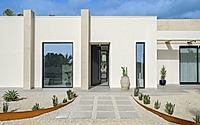
Vertical stone setti break the long elevations, giving the low silhouette a measured cadence. Each wall segment holds a dual role: it stabilizes the concrete frame and sets the façade rhythm in clear bays of solid and glass. Beige natural stone anchors the house to the dry ground, its warmer tone contrasting the light plaster that reflects Mediterranean sun. Between these structural blades, full-height glazing in black aluminum slides open, so living rooms extend directly to porticos and patios without a perceptible edge.
Pergolas As Bioclimatic Tools
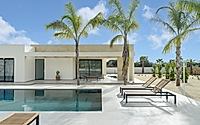
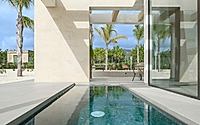
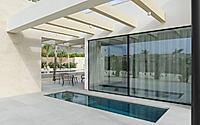
Linear pergolas run in concert with the main beams, conceived not as afterthoughts but as explicit structural arms. Slender elements modulate solar gain, filtering harsh radiation into striped shade that moves across floors and water through the day. Deep cantilevers and these open grids work together to temper the microclimate of terraces, dining areas, and outdoor lounges. Under their cover, rooms read as continuous with exterior courts, yet remain protected from glare and summer heat.
Water Planes And Grounded Volumes
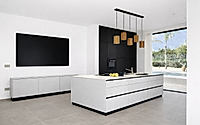
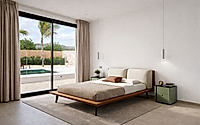
A long, linear pool stretches beside the main façade, finished in a green-veined material that turns the basin into a reflecting plane. Its surface multiplies the stone walls and roof plates, visually doubling the structural composition and throwing the sky back toward the house. Closer to the living area, a more compact basin defines an introspective court, where glass walls create crossed views between water, interior rooms, and garden. Large-format porcelain flooring runs inside and out, tightening the visual connection between these volumes, terraces, and gravel beds planted with olives, palms, and xerophytic vegetation.
In garden walls, low stone enclosures and planted screens maintain privacy while letting long sightlines slip toward the landscape. The whole composition reads as a quiet exercise in alignment, where structure, surface, and planting work in a single register. As light shifts across stone, plaster, and water, House P02 holds its calm horizontal line and lets the Mediterranean climate do the rest.
Photography courtesy of Paolo Florio
Visit Paolo Florio