Casinha da Melroeira: Reimagines a Ruin as Compact Refuge in Portugal
CASINHA DA MELROEIRA stands on a tight plot in Ourém, Portugal, where Filipe Saraiva – Arquitectos rebuilds a familiar ruin as a compact village house. The project follows a pentagonal volume that mirrors its neighboring Casa da Melroeira while carving out intimate outdoor rooms and framed views. Inside, salvaged pieces, handcrafted objects, and technical experiments turn a modest footprint into a layered home grounded in memory and everyday use.


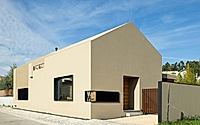
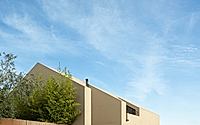
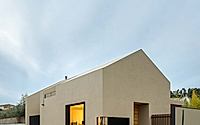
A compact white volume stands where a rural ruin once leaned toward the road, its pentagonal roofline catching shifting light. Carved recesses bite into the mass, creating small outdoor pockets that fold the village air back toward the interior rooms.
This house is a compact dwelling in Ourém, Portugal, developed by Filipe Saraiva – Arquitectos around the memory of a ruin and its threshing floor. The project grows from the pre-existing pentagonal footprint, maintaining the original limits while reworking the interior as a sequence of rooms oriented to a central void. At its core sits the question of how a small house can sustain family life, preserve local memory, and test new constructive solutions in the same tight frame.
Building On The Ruin
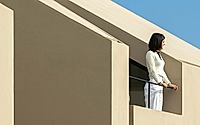
The project retains the outline of the former structure, treating its compact boundary as both constraint and anchor. Within that fixed envelope, carved voids open up along the edges, extending daily life outward into terraces and patios that double as breathing space. These recesses are not cut square to the walls; instead, they pivot, tilting toward particular shafts of light that shift the mood across the day. What began as a ruin in the landscape becomes a tight, legible volume that still acknowledges the old threshing floor as its conceptual center.
Light, Angles And Views
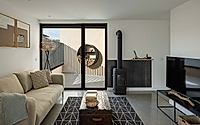
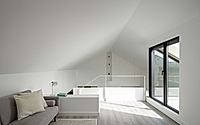
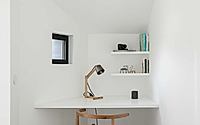
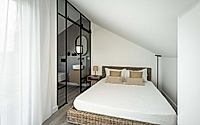
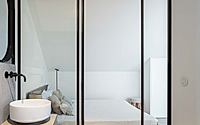
Angled cuts in the volume set up a precise relationship with sun and horizon. Interior rooms read these moves as changing brightness, from sharp morning light in the bedroom to softer, raking sun in the living room. On the upper level, the office and bathroom gain carefully aligned openings that lock onto the Castle of Ourém, turning a distant landmark into a daily reference. Light, view, and volume work together so each room feels tuned to its slice of the landscape.
Compact House, Flexible Life
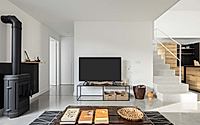
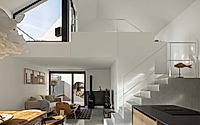
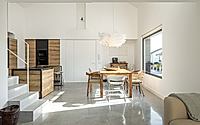
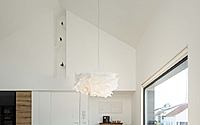
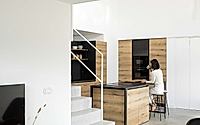
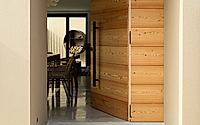
Without a predetermined client, the brief becomes an exploration of how a small house can absorb changing patterns of family life. Rooms connect around the remembered threshing floor, giving the bedrooms and living room a shared orientation that encourages quiet overlap rather than strict separation. A double-height entrance volume expands the modest footprint, using the pentagonal roof form to pull the eye upward and create a sense of release. Beyond that first tall room, more intimate corners tighten the scale again, offering quieter places to read, talk, or withdraw.
Crafted Details And Reuse
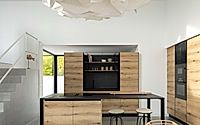
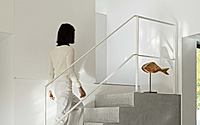
The house becomes an experimental field for both technical and material decisions. Continuity between walls and roof is pursued as a single volume, while exterior metalwork turns everyday elements—mailbox, railings, gargoyles, chimney, firewood storage—into precise, legible details. Inside, new construction meets reuse: antique-shop furniture, natural objects, and simple commercial pieces sit beside the Shell chair by Hans Wegner, acquired second-hand. The architect’s own hand-built elements, from the mezzanine lamp to the reworked dining light and blackbird sculptures and paintings, weave local stories directly into the rooms.
Memory As Material
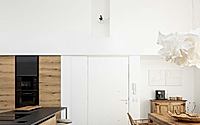
A small niche above the entrance holds a blackbird sculpture, a direct nod to the village name and its flocks. That single motif repeats in artwork and perspective drawings of the house, giving the interior an undercurrent of place-specific memory rather than generic decor. Recycling, handcraft, and second-hand pieces temper the experimental construction with a sense of continuity. In the end, the compact volume reads less as an object and more as an inhabited trace of the ruin that came before it, still rooted in the village road and sky.
Photography by Ivo Tavares
Visit Filipe Saraiva – Arquitectos