Itaca House by Studio Strato
Itaca House reimagines a Roman apartment as a villa-scaled house in the city, crafted by Studio Strato in Rome, Italy. Walls retreat in favor of stepped levels, cabinets, and glass, so each room reads clearly yet stays visually connected. The project threads everyday family life through a central square core, where living, dining, and quiet corners unfold in a continuous, light-washed sequence.


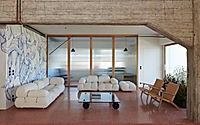
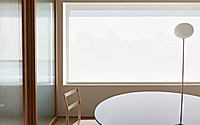
Daylight slides across the floor and climbs the tall walls before slipping through gaps at the ceiling line. A quiet square at the center gathers living, cooking, dining, and reading into one continuous scene.
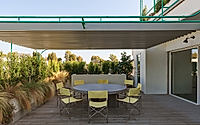
This house in Rome, Italy is planned as a generous city apartment that borrows the spirit of a villa through its dimensions, outlook, and large outdoor presence. Studio Strato reorganizes the interior with a clear goal: create a fluid sequence of rooms that stay distinct without feeling enclosed. Rather than stack doors and corridors, the architects choreograph levels, cabinets, and sliding glass so everyday routines move easily around the home.
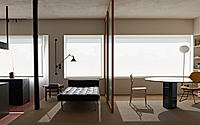
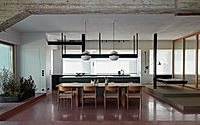
At the heart of the project sits a square core that concentrates daily life, drawing together the living area, kitchen, dining room, and relaxed reading zones. Boundaries remain legible yet permeable, because partitions stop short of the ceiling and keep sightlines open across the plan. Every edge invites movement, so residents drift from meal preparation to conversation to quiet rest without crossing hard thresholds. This central volume acts as both anchor and crossroads, tying the entire apartment to one clear geometric idea.
Square Core Living
Within the square, functions nest side by side in a loose ring rather than in isolated rooms. A person reading in one corner still feels linked to cooking and dining activity across the way, since the only true separations are partial walls and freestanding furniture. The composition encourages diagonal views, which stretch toward windows and pull natural light deep into the plan, softening the transition between social zones and quieter corners.
Shifting Thresholds
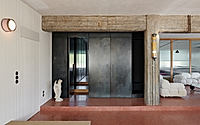
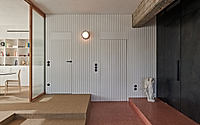
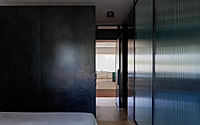
Instead of solid masonry partitions, Studio Strato works with steps, built-in wardrobes, and large sliding glass to signal changes in use. A short rise in level marks one territory; a full-height cabinet marks another, yet both still allow air, light, and sound to slide around them. This approach avoids abrupt breaks and turns circulation into a gentle loop, so movement follows an intuitive path that circles and reenters the square core from multiple directions.
Timber, Steel, And Glass Partitions
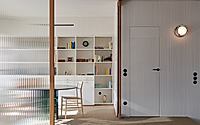
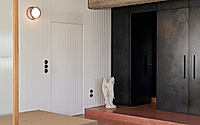
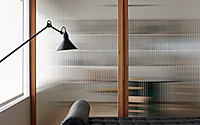
Wood, steel, and glass compose the key dividers that stand in for traditional walls. Warm timber elements outline quieter nooks, dark steel frames lend precision to openings, and transparent panes maintain a shared visual field across the apartment. These elements read as furniture and architecture at once, giving each room identity while preserving the overall continuity of the plan. Natural light moves between them without obstruction, reinforcing the sense of openness that underpins the project.
Art On The Only Wall
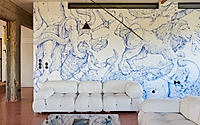
One true dividing wall remains, yet even this surface resists acting as a barrier. The site-specific work Constellation by artist Pietro Ruffo spans this plane, turning an ordinary partition into a large-scale narrative field. Residents encounter it not as a limit but as a pause in the sequence, where architecture, visual culture, and daily routine intersect. The mural effectively dematerializes the wall, recasting it as a canvas that threads meaning through the circulation path.
By day, light pours through unobstructed openings and filters around each partial divider, echoing the promise of a villa within the urban context. At night, the square core glows like a single shared room, even as individual corners settle into their own rhythm. The apartment maintains its city address, yet its plan holds a measured sense of freedom, as if every route through it were the start of a small holiday.
Photography courtesy of Studio Strato
Visit Studio Strato