Casa Nola by Yemail Arquitectura
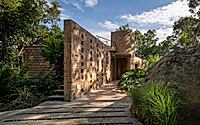
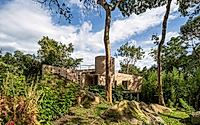
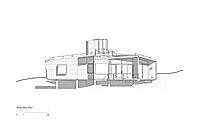
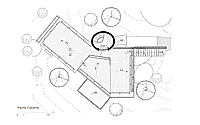
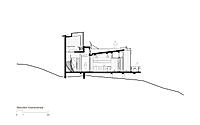
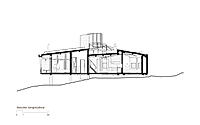
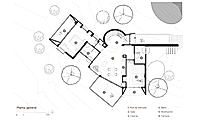
Casa Nola stands as a house in Cachipay, Colombia, by Yemail Arquitectura, set among water, soil, and trees in a charged rural landscape. The project treats movement as a starting point, asking how bodies ascend, lie down, and cross thresholds while staying in dialogue with light and climate. Built in 2024, it treats the ground, large stones, and fired clay mass as equal partners in shaping daily life.
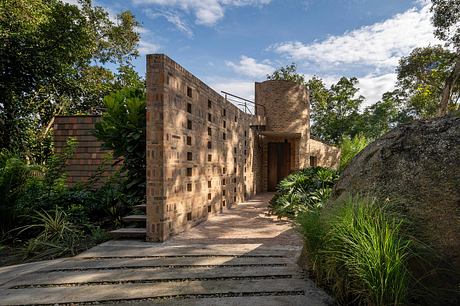
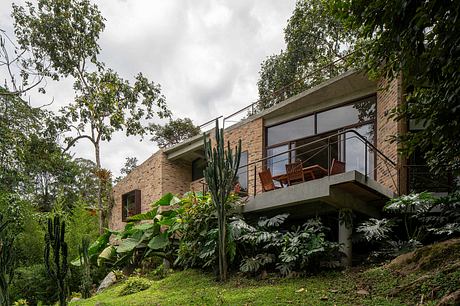
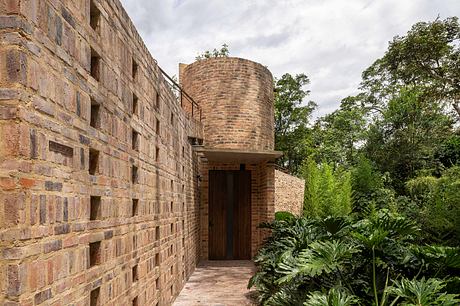
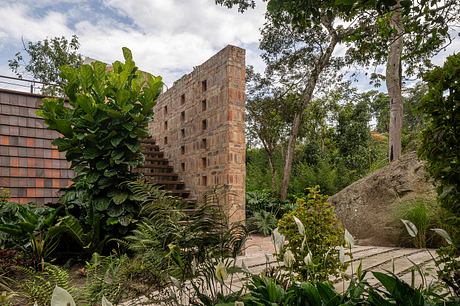
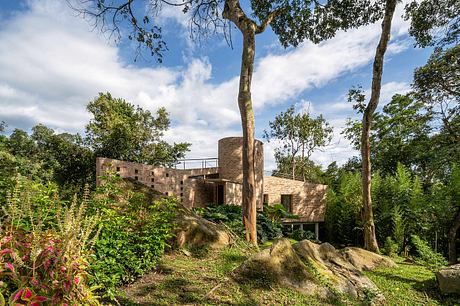
Morning light folds over a body of water and low masonry, tracing edges where roof, terrace, and ground trade roles. Air passes through open passages and shaded recesses, so a person walking, resting, or lying down always stays close to trees, soil, and the reflected sky.
Casa Nola is a house in Cachipay, Colombia, by Yemail Arquitectura, set in a landscape defined by water, large stones, and dense canopies. The project works with a simple architectural vocabulary, yet it treats movement and relative position as the real structure. Rather than framing views alone, it treats each route—up, down, across a roof—as a sequence of encounters with light, air, and the land.
Moving Around Mass
Here, walking begins with a question: how does a body relate to a stone. Paths bend and tighten around large existing rocks, so every turn acknowledges their weight and presence. This choreography builds a quiet ethic, where the built mass steps back and makes room for water, soil, and the possibility of a tree crossing the room untouched.
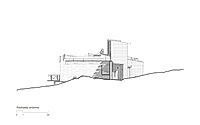
Architecture is treated as a partner to gravity and matter, not a mask laid over them. Heavy components read as specific weight instead of picturesque gesture, allowing the inhabitant to feel where mass sits and where air pushes through. That clarity of movement and pause keeps the house legible, even when routes fold back on themselves.
Clay Volume As Shelter
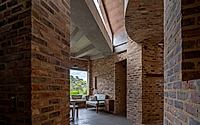
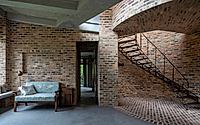
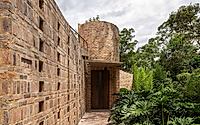
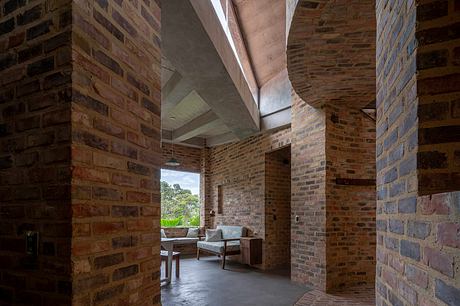
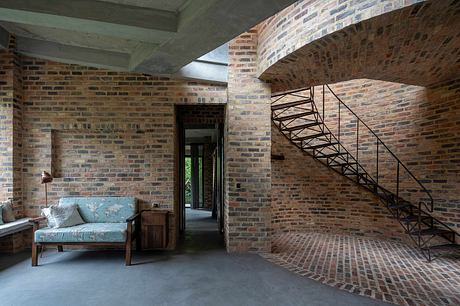
A broad mass of fired clay holds the role of shelter, absorbing heat and shaping interiors where bodies can rest, turn, or lean. Its thickness is not abstract; it becomes something to move along, touch, and inhabit, giving every room a sense of being held rather than simply enclosed.
Within this clay body, the arrangement follows an idea of sequence rather than isolated rooms. Transit and pause interlock, so thresholds carry as much weight as centers, and the order of movement feels as considered as any single view. That approach allows wind, temperature shifts, and shifting light to register as part of daily routes.
Roof As Terrain
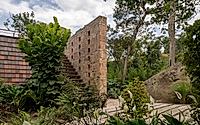
Roofs are not just coverings; they become ground for the feet. The project imagines walking on the roofs as naturally as walking along a path, so elevation changes stretch the body differently with each step.
From those upper planes, the house reconnects to canopies and distant sky without breaking from its own mass. Moving across them, a person experiences the building as landscape, with edges, plateaus, and gentle drops that echo the surrounding topography. This expanded circulation treats height as another way to read water, foliage, and horizon.
Terrace, Water, And Pause
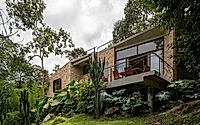
The terrace becomes a horizontal hinge, spreading people out between interior clay mass and the body of water ahead. Here, lying down, sitting, or standing all register as distinct positions in relation to the surface of the pool and the line of the trees.
Movement slows at this edge, and the route turns from transit into pause. Architecture accepts being traversed by breeze, light, and incidental plant growth, so nature can cross without resistance. That elasticity of route and rest gives daily routines a quiet rhythm, measured by shadows and reflections rather than rigid compartment lines.
As evening arrives, the house reads as a set of grounded volumes threaded by paths of air and water. People move with, not against, the geography and its shifts in light. In that measured exchange between mass, route, and environment, Casa Nola maintains its simple pact with the landscape and its inhabitants.
Photography courtesy of Yemail Arquitectura
Visit Yemail Arquitectura