Casa Safran Cenisio: A 1960s Milan Flat Redesigned
Casa Safran Cenisio is an apartment in Milan, Italy, redesigned by Icona Architetti Associati within a 1960s residential building in the Cenisio area. Completed in 2025, the renovation overturns the original plan to create a more generous living zone, two bathrooms, and a flexible study-guest room, while balancing Milanese modernist references with colors, materials, and collected objects linked to the owner’s travels in India.
About Casa Safran Cenisio
Inside a distinctly Milanese apartment in a 1960s residential building in the Cenisio district, Icona Architetti Associati carries out a complete renovation that overturns the original layout and turns it into a welcoming alcove for a young client who often invites friends over for dinner. One of her requests is to weave her large collection of souvenirs and memorabilia from travels in the East, especially India, into the new interior. That pull toward the exotic, however, is never meant to become an “ethnic” house, which would have conflicted with the apartment’s own history. Instead, the aim is to let the typical traits of Milanese architecture from that period coexist with chromatic and formal references drawn from Eastern sources, partly by recovering existing elements and binding everything into a coherent whole.
The initial work moves in two directions. On one side, the plan is reorganized to improve the distribution of the rooms. On the other, the apartment’s atmosphere is defined through a hybrid, multicultural moodboard able to hold modernism and exotic references together without forcing either one. Though the home measures just 90 square meters (968 square feet), it is thoroughly reworked to obtain a comfortable day area with living room, dining room, and separate kitchen, along with two bathrooms—one en suite to the main bedroom—and a study that can become a guest room.
Color and material bring the clearest synthesis between different traditions. Terracotta, indigo blue, saffron, milk, and mint meet oak and Venetian terrazzo in an interior that fuses two cultures without flattening either one. The result is not a collage but a calibrated mix, with each room shifting the balance slightly.
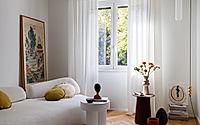
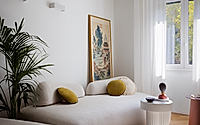
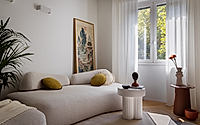
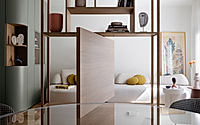
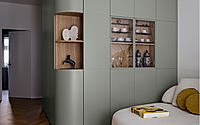
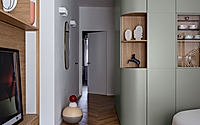
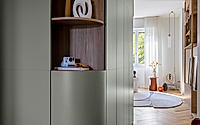
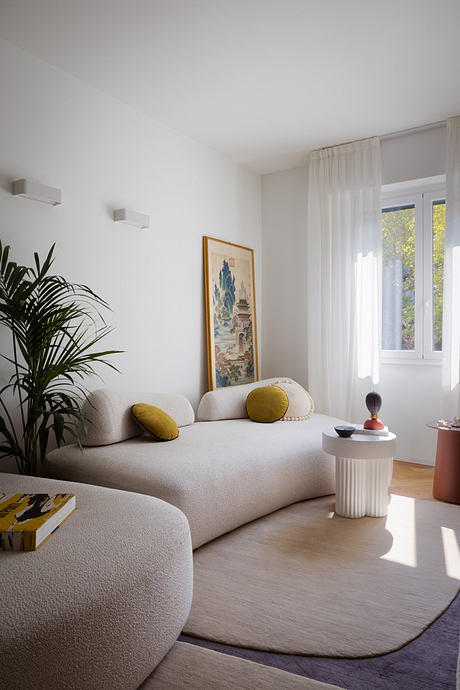
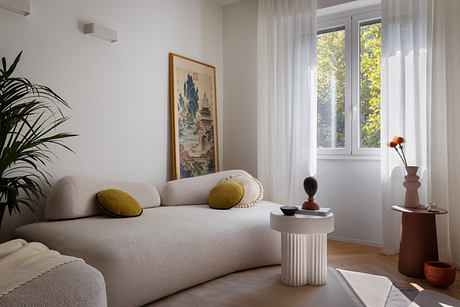
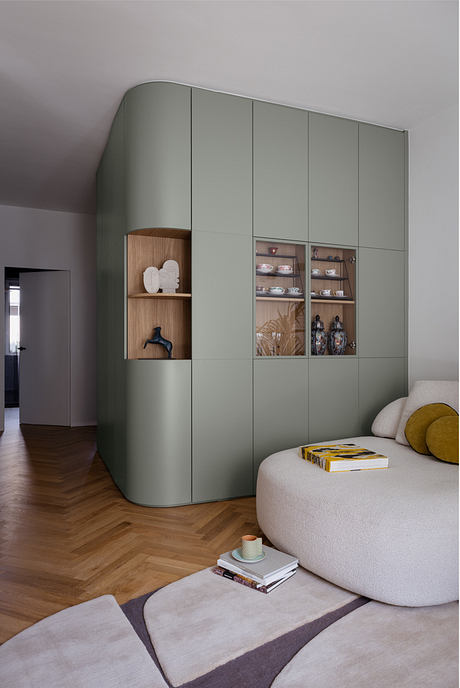
The apartment’s main room is the living area. It is reached from the entry by moving around a full-height L-shaped storage wall in milk and honey tones that wraps the two walls with a soft, continuous presence. Rounded corners are carved into this structure as niches for the owner’s many collected objects. A curved sofa sets the room’s orientation and is paired with a freestanding reading corner. Narrow-strip natural oak parquet, used here and in the bedrooms, recalls the rhythm and warm tones of the original wood floor, which unfortunately could not be preserved.
Opposite the sofa stands a custom oak bookcase and TV unit placed at the center of the wide opening between the living room and the dining room. The piece works in two ways at once: it visually separates the rooms, yet also ties them together through the passages left open on either side. One becomes a shortcut to the kitchen, the other leads toward the small terrace.
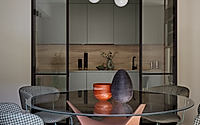
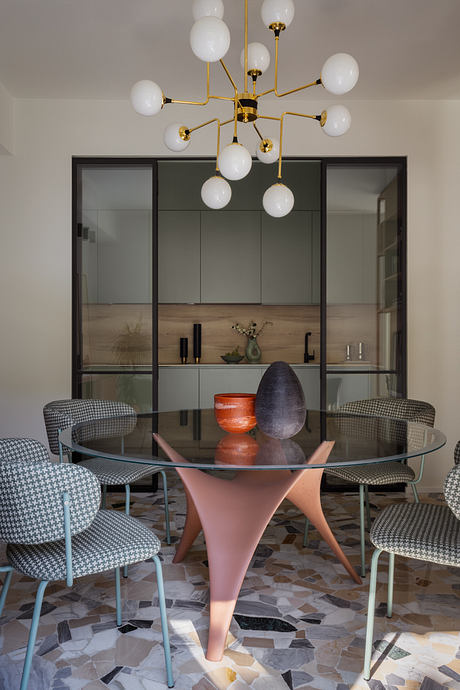
The dining room retains its beautiful original floor in coarse-seed terrazzo, a material typical of postwar Milan. The surface is ground and polished, bringing back its earlier depth and brightness, which are further amplified by the glass top of the large circular modernist table set at the center of the room. Above it hangs a substantial brass and frosted-glass chandelier, while a terracotta sideboard introduces a clear note of color nearby.
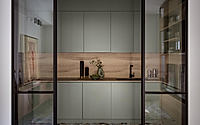
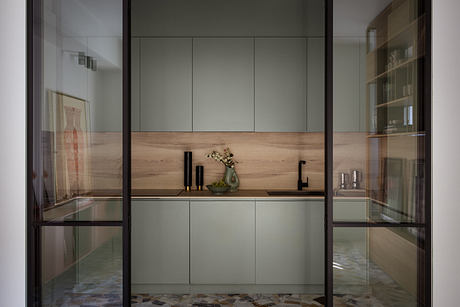
The kitchen occupies a closed service niche fitted with a full-height glazed door with dark metal profiles. Its cladding is lacquered in milk and mint, extending the chromatic continuity established by the living room cabinetry, while the beige stone countertop picks up the tones of the oak.
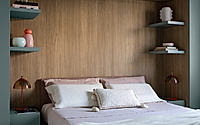
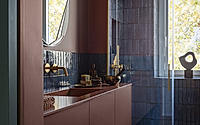
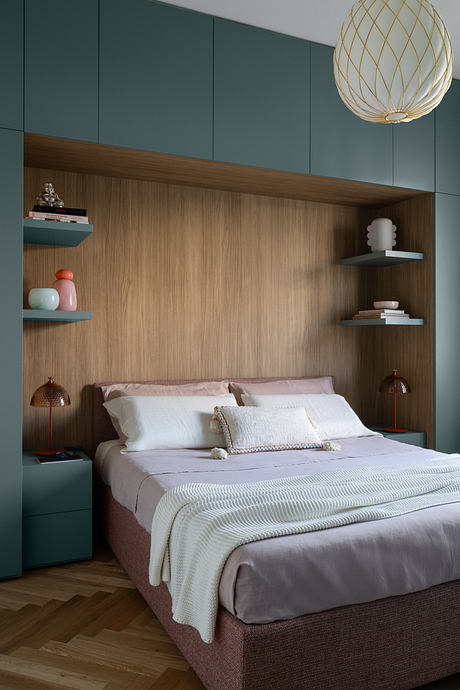
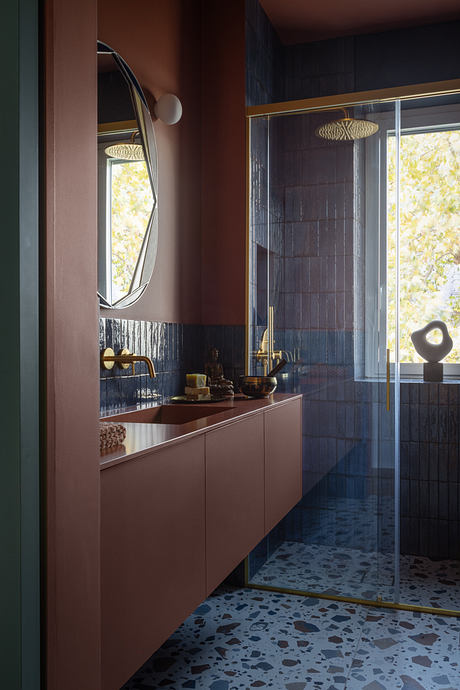
The main bedroom, together with its en-suite bathroom, is conceived as a cave-like retreat—protective, intimate, and comfortable. A large full-height storage system integrates the headboard, bed, and bedside tables into one object. The cool blue lacquer acts as a counterpoint to the warmth of the parquet and headboard. In the en-suite bathroom, the cultural overlap is especially clear: cement tiles that echo the texture of terrazzo flooring and slim indigo tiles meet the stronger, more saturated notes of terracotta and brass in the furniture, finishes, and painted surfaces, all of which recall the East for the owner.
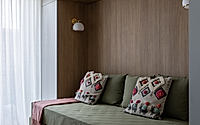
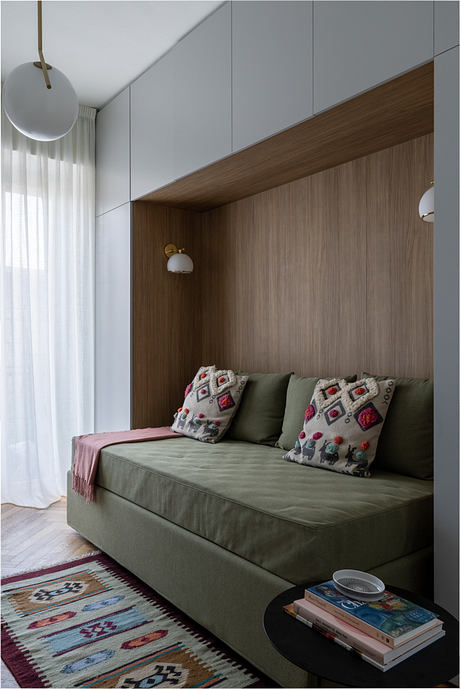
The guest bathroom repeats similar references on a smaller scale. Here, the indigo tiles give way to square beige tiles with a relief pattern that recalls the fine embroidery of Indian decorative motifs. The home is completed by a study fitted with custom storage and a sofa integrated into the millwork, which converts into a double bed for visiting friends.
The balance between these two worlds is constantly recalibrated from room to room. In some areas, Milanese restraint comes forward; in others, saturated colors take the lead. Yet everything remains in dialogue, producing a new architectural vocabulary whose character is stronger than the sum of its sources.
Photography by Monica Spezia
Visit Icona Architetti Associati