Ginkgo Valley Treehouse by Moguang Studio
Ginkgo Valley Treehouse, located in Suizhou, China, is a house designed by Moguang Studio in 2023. The project features a playful, decentralized interior that offers an engaging alignment with the surrounding landscape, while a dynamic relationship between orthogonal and non-orthogonal systems shapes the spatial experiences. Aspects in color and materiality develop the diverse quality of the project, revealing a harmonious existence with the natural setting and creating opportunities for rich experiences.
The Origin
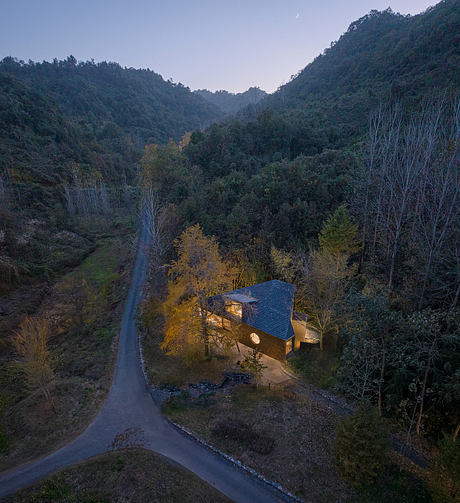
Guangjiachong Valley in Suizhou City, Hubei Province, is just a 15-minute drive from the famous Ginkgo Valley Scenic Area. The Treehouse is one of a series of scattered individual buildings designed by the architect for the Lost Villa · Ginkgo Valley Hotel project in Guangjiachong Valley.
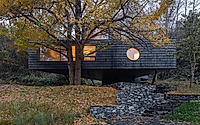
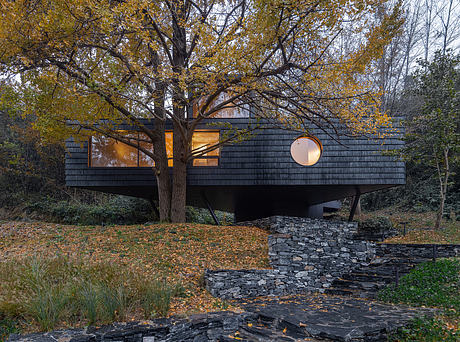
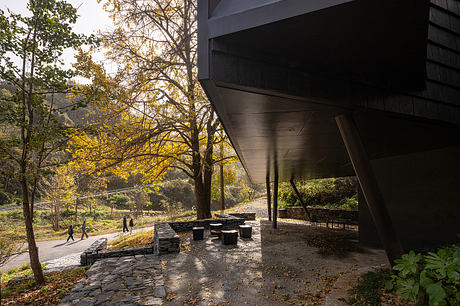
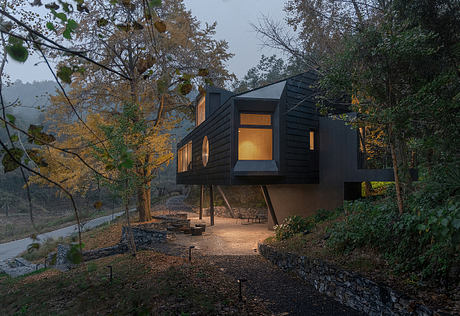
The Treehouse is located at the junction of two paths leading into the valley. The environment is somewhat bustling, and within a limited 90㎡ plot, the design needed to avoid the roots of three ancient trees while accommodating two standard guest rooms of no less than 50㎡ each and a utility storage room. During their first site visit, the designer and the owner established a clear strategy: to elevate the entire building. This approach not only created two distinct spatial qualities—quiet above and dynamic below—but also utilized the lush ginkgo canopies to provide privacy and scenic views for the guest rooms. Meanwhile, the ground level was freed up as a semi-outdoor activity area, naturally supporting a variety of vacation activities such as dining, roasting ginkgo nuts, swinging, and relaxing in the shade.
Site and Geometric Order
The Treehouse in the forest responds to the site’s paths and tree contours with precise geometric order. The purpose of the geometric form is not to directly present aesthetic appeal but to emerge from a synthesis of design conditions based on on-site visual perceptions.
The designer extracted geometric control lines from the irregular plot boundary and refined the relationship between volume, site, and the human body through plan and sectional iterations. A significant move at the ground level was rotating the central staircase core by 60 degrees from its original vertical axis alignment. This adjustment opened up space and introduced new structural expressions.
Visitors, drawn by the trees and swings, enter the elevated ground floor, turn to discover the staircase entrance, and ascend to the terrace overlooking palm groves and the guestroom entrances. This journey through the forest prolongs the sense of exploration, making the site feel expansive despite its small size, while providing direct engagement with the rich natural surroundings.
The tension between the in-situ reinforced concrete staircase core and steel columns at the elevated ground level gradually dissolves amid swinging motion and dappled shadows. The metallic fluorocarbon paint on the core and columns subtly reflects the surrounding environment. As night falls and the indoor lights glow, the treehouse resembles a spaceship perched in the woods, ready to embark on its voyage.
Boundaries and Bodily Experience
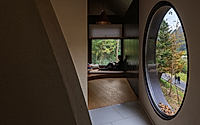
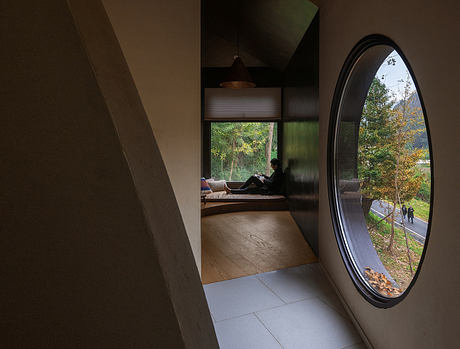
This experiential project design simultaneously considers architectural and landscape alignment from the outset. In its abstract form, “geometric openings” replace “figurative windows,” with operable panels concealed within walls to maintain the purity of these openings. The interplay between the treehouse volume and the landscape is internalized in the alignment of window openings with scenic elements, shaping how people use the interiors and move along their paths. This reveals the extraordinary within the everyday natural landscape: guests can both stay comfortably indoors and wander freely outdoors.
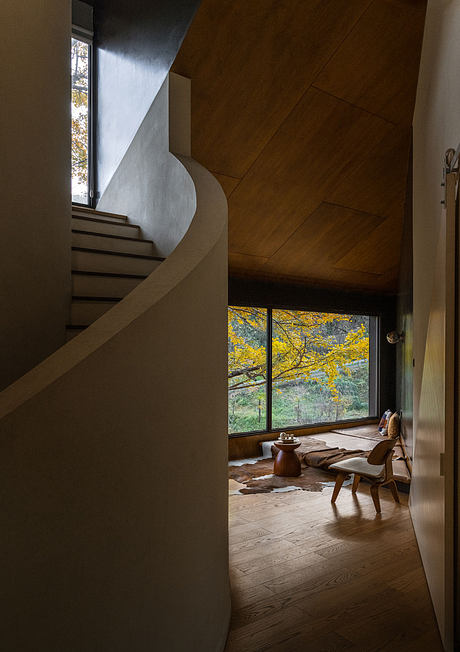
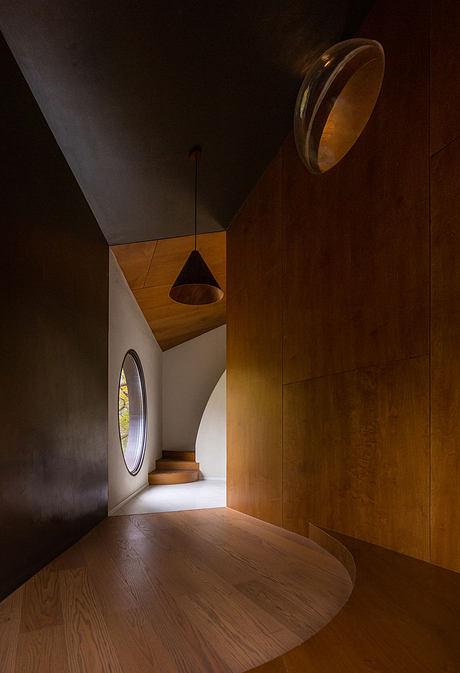
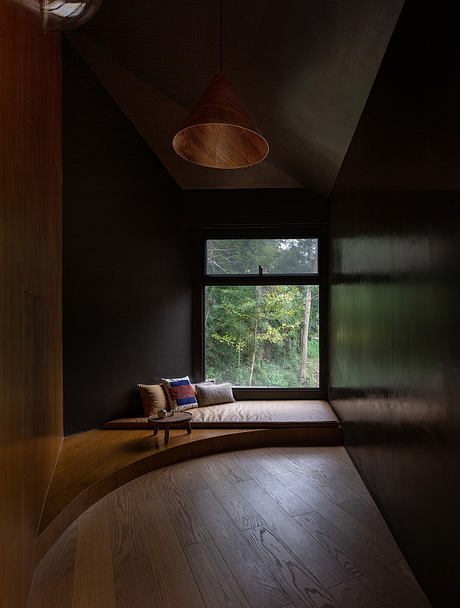
Through the interplay of orthogonal and non-orthogonal geometric systems, the design creates subtle connections between rooms, moving away from traditional “start-to-end” spatial experiences. The irregular transitional spaces enliven the architectural atmosphere, adding a playful and decentralized quality to the vacation environment. Dynamic spaces with undefined boundaries imbue each area with a sense of movement, as bodies traverse and light shifts. The northeast guestroom incorporates an entry foyer and tea room through a 60-degree rotation of the public staircase and bathing area. Meanwhile, the southwest guestroom uses a curved staircase to delineate the foyer, bathing area, and tea room.
Reflective brown metallic paint, rough white stucco, and wood finishes create diverse material expressions in light absorption, reflection, and hue. The surface treatments guide sightlines, enhance the sense of enclosure, and blur the transitions between interior elements. The colors enhance the dynamic quality of the irregular planes. Light diffuses through the metallic surfaces, with hues shifting in response to the surrounding vegetation, creating abstract yet beautiful small spaces.
Structure and Construction
Given the three ancient trees on the site, the building employs a mixed structural system: isolated foundations, steel structure and concrete shear walls for the first floor, and a lightweight steel structure for the second floor. The length of the lightweight steel components is determined as needed, while structural wall thickness is kept within 150mm to save space and maximize usable area.
The building façade features 30x45cm charred cedar planks, with portions polished and coated with matte clear varnish. The subtle gloss and cracked texture of the charred cedar harmonize with the natural wilderness. The carbonized wood surface acts as a protective armor for the building, offering resistance to termites, pests, and moisture.
Photography courtesy of Moguang Studio
- by Matt Watts