Casa Concordia by Area Architetti
Casa Concordia is a residential building located in Bolzano, Italy, designed by AREA Architetti in 2020. It’s part of an urban regeneration project that replaces a cinema and creates 22 housing units, as well as an underground garage for 40 cars.
Context
The project is part of a recovery plan (also carried out by AREA Architects), of private initiative (cooperative), in urban planning agreement with the Municipality of Bolzano for the urban regeneration of an important part of the city: the areas “ex-Concordia” cinema and “Cristo Re” square. It is the result of a design competition (1st Prize) held by Cooperativa Cooperdolomiti in cooperation with the Curia of Bolzano. It involves a demo-reconstruction resulting in a residential body of 22 dwellings (on the site of the former Cinema Concordia), with an underlying two-story underground garage (40 car garages) and the recovery of the exterior surfaces of an important historic square, the Cristo Re Square. The new building enclosing the cloister is in close relationship with the square and church, the parish center and the commercial axis of Corso Italia. The entire quadrant, is located at the center of a residential area rich in public and private services.
Architectural Solutions
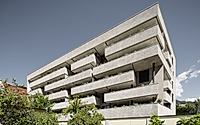
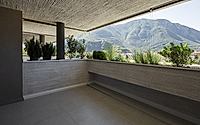
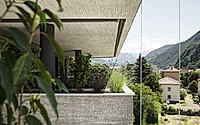
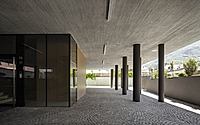
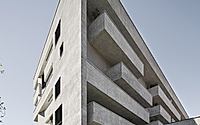
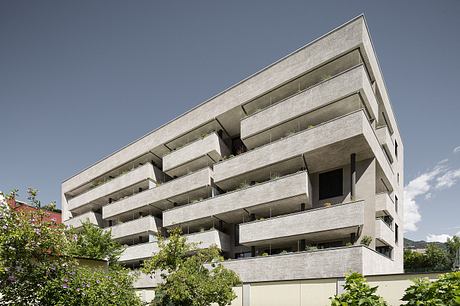
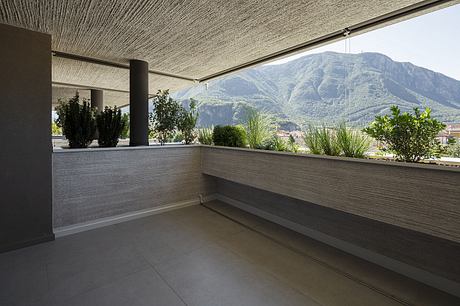
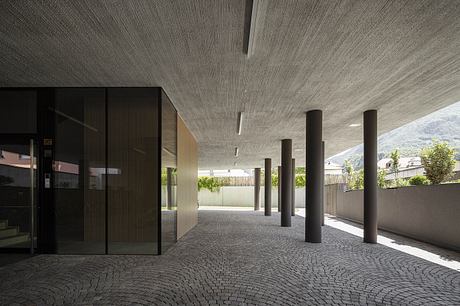
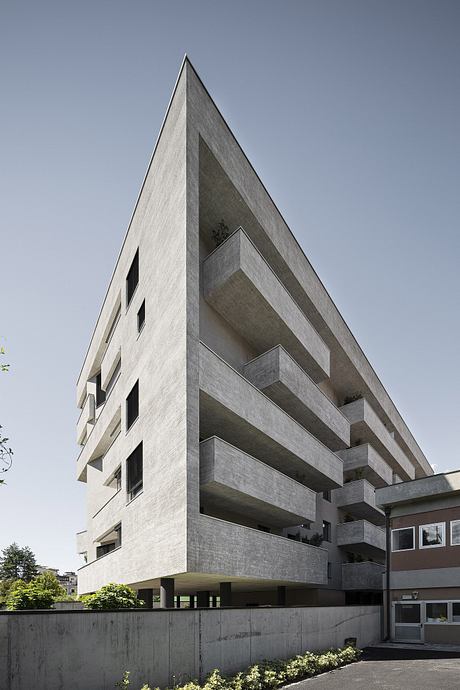
Starting point was the study of the spatial and functional relationships between the new residential volume, Christ the King Square, the Church and the commercial axis of Corso Italia. The preparatory analysis focused on the identification of critical issues related to the fragmentation of urban spaces, emphasized by the high green curbs, the lack of pedestrian continuity, and the widespread presence of parking lots in the square. This was followed by a viability analysis, with a focus on excluding interference between pedestrian, bicycle and vehicular flows to optimize accessibility and usability of the square and the new building. The objectives identified and achieved are expressive clarity with respect to function, constructive simplicity, contemporary, innovative, minimalist architectural image, harmonious integration into the built context through the study of alignments and heights, the completion of the Dominican cloister through the closure of the fourth side facing the building, and spatial continuity with the square and the ground-floor bicycle path achieved by detaching from the ground the entire volume, which is “suspended” on pilotis. Responses to these objectives generated the volumetric contours of the building, the architecture of which was better delineated in subsequent design steps: a purposeful “excavation” of the volume produced an interplay of voids and solids, which is presented with numerous, large, green loggias/terraces as strongly characterizing elements.
Materiality
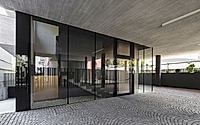
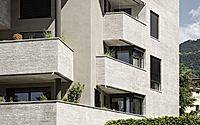
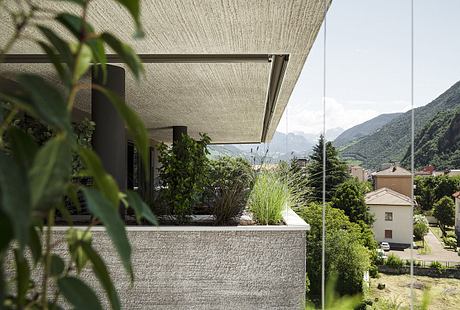
Facade materiality and textures are characterized by a dichroma aesthetic that emphasizes the distinction between the darker, smoother interior living core and the hollowed-out envelope of the loggias, with a rougher, ridged surface, treated with softer colors.
Interior
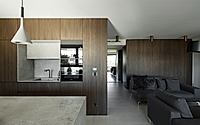
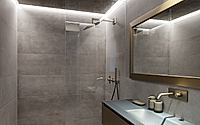
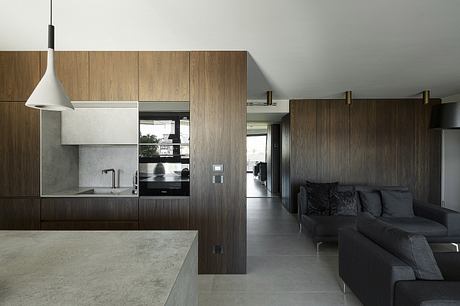
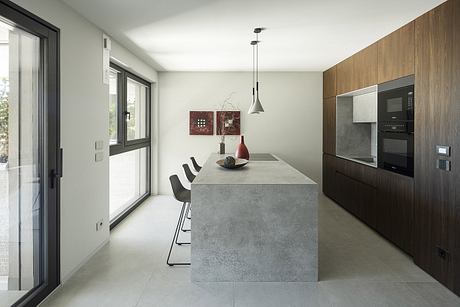
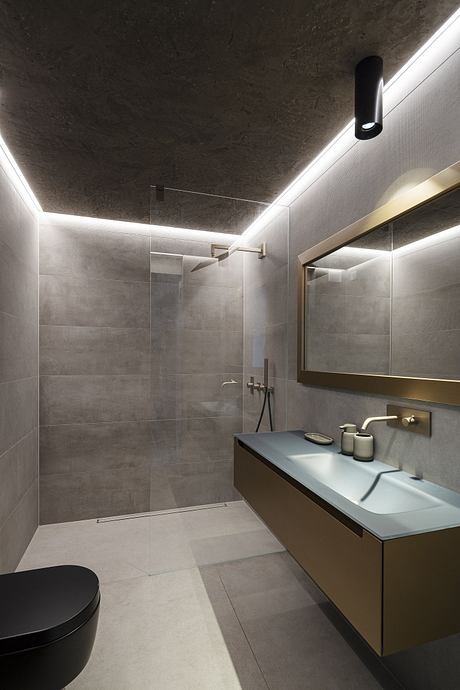
The interior distribution of the living quarters is designed to optimize sunlight exposure and living comfort. The living areas (living room and kitchen) face south and have large windows to take advantage of direct sunlight. The sleeping areas and bathrooms, on the other hand, are positioned to the north with small openings. The main bathrooms are windowed, with natural ventilation and lighting.
Outdoor spaces
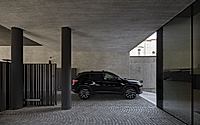
The outdoor spaces are designed to promote usability and integration with the square: the use of porphyry cubes reinforces the continuity. On the ground floor, protected spaces accommodate bicycles and wheelchairs. Public pedestrian and bicycle surfaces pass under the building on the ground floor and are identified by paving that differs from that used for the private areas of the building. The construction of the underground garage on two levels made it possible to significantly reduce the presence of cars on the surface and on the square. The position of the access ramp, strategically bordering the cloister, was designed not to impact the context and to “stitch up” the spatial arrangement of the surfaces facing the square.
Environmental and energy aspects
Plant technologies have been carefully designed to be integrated without impacting the aesthetics of the architecture. The project is ENZEB CasaClima “A nature” certified with high efficiency. Winter solar gain maximized and summer solar gain minimized by adopting terrace overhangs and sunshades with appropriate overhangs according to solar exposure.
Both the building envelope and systems are high-performance and energy-efficient. V.M.C. machines are integrated into the windows and doors with point system for each room. Heat pumps for heating and cooling with exploitation of renewable sources to reduce CO2 emissions (photovoltaic, solar thermal for domestic hot water production). With intelligent energy management, continuous monitoring of energy consumption and performance is guaranteed. The materials used are low environmental impact compared to the Climate House A Nature, preferring recycled and local materials.
Water resource management was given special attention, such as permeability of the land surface, collection of rainwater with reuse for irrigation, reduction of summer heat island effect and air pollution to reduce temperature and improve thermal insulation. In addition to the large green area on the roof and in the gardens, plants and vegetation have been placed on the terraces, which are equipped with large ponds with evergreen plants (270 plants) and drip irrigation system, from the degrees climatic and environmental benefits, such as filtering sunlight, air purification and reduction of fine particulate matter. The presence of trees and vertical gardens provides shade and air cooling through evapotranspiration.
Photography by Samuel Holzner
Visit Area Architetti