Shoreline House by Splyce Design
Shoreline House sits in Victoria, Canada, where suburban plots meet a rocky inlet and tall firs. Splyce Design renovates a 1960s house and threads in a compact, single-storey addition that respects sensitive shoreline habitat while sharpening the home’s relationship to light and view. The result is a coastal house with a new primary suite and a measured environmental stance.


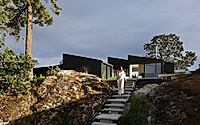
Wind lifts between firs as the inlet flashes silver beyond the rocks. From the street, the composition steps down toward water, new volumes slipping past the old.
This is a house—renovated and extended on a tight coastal site in Victoria—by Splyce Design. The project retains the 1960s structure and adds a low-impact, single-storey wing, keeping habitat disturbance in check while clarifying how the home meets view, light, and grade.
Recast on Constraints
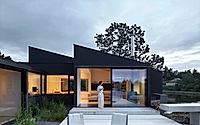
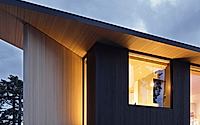
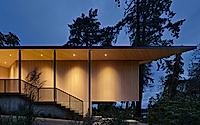
Waterfront setbacks draw an irregular envelope, so the new primary suite bends to the boundary and pulls off the ground. One short wing perches on recessed concrete foundation walls, reducing excavation in the marine protected area and letting native ground weave beneath the edge. The volume’s minimal footprint does the quiet work of restraint. A cantilevered screen wall runs to a fine point, sharpening the profile against sky.
Old Forms, New Grain
The addition wears light-stained cedar that reads bright beside the darker, shed-roof forms of the original house. Darker finishes on the existing structure echo the granite shoreline, while the new timber skin catches coastal light and seasons in place. Junctions are deliberate. Where bodies meet—old to new, wild to cultivated—the craft turns precise but never loud.
A Choreographed Approach
Arrival starts at the suburban curb and pivots toward the inlet through a colonnade-lined stair that gathers you to the door. The sequence compresses, then releases to view, a measured reset that frames the water rather than chasing it. Inside, circulation stays clear and compact to protect landscape. Short runs connect rooms, keeping the plan calm for daily use.
Light, View, Privacy
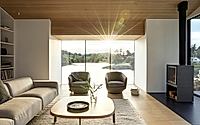
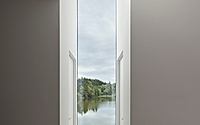
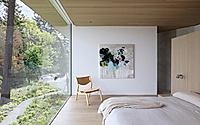
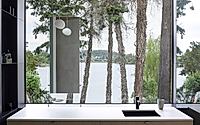
Glazing varies to intent: expansive panes pull in horizon and shifting reflections, while other windows tighten to precise scenes of rock, bark, and tide. Frames tuck from sight at key spans, dissolving the boundary between room and inlet, then reassert at corners to hold privacy and structure. Daylight tracks across the interiors, animating surfaces without glare.
Landscape in the Loop
Patios and paths nest into existing topography, threading through native vegetation instead of overwriting it. Hard edges soften near moss and grasses, so outdoor rooms read as terrain, not terrace (a small but telling difference). Movement outside mirrors the plan inside, gentle and edited. The house participates without dominating.
Evening cools and the cedar deepens as the inlet darkens. The addition still hovers, light skimming the cantilever and the stair, a measured presence along the shore.
Photography by Ema Peter
Visit Splyce Design