Tetherow by Hacker
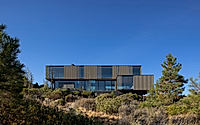
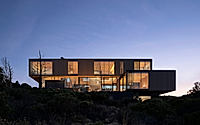
Tetherow Overlook House sits on a bluff in Bend, OR, United States, designed by Hacker as a family house rooted in the high desert. The project organizes daily life around terraced platforms and articulated volumes, linking interiors to the surrounding pumice hills and distant horizons. Across its 2024 composition, rooms track light and wind while providing settings for art, gathering, and quiet work.


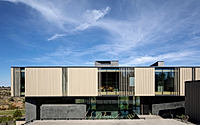
A long shadow slides across pumice and scrub. From the entry court at the crest, the house steps down in measured platforms that catch light and release long views toward the desert.
This is a family house in Central Oregon’s high desert, composed by Hacker as a sequence of moves rather than a single gesture. The plan organizes living across terraces and distinct wood-clad volumes, guiding circulation, calibrating privacy, and shaping how air and sun pass through the rooms.
Arrive And Descend
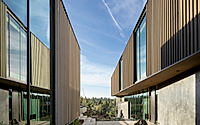
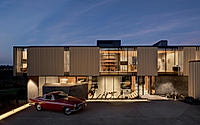
The approach lands at the highest point, a semi-enclosed court formed by the garage, a perched bedroom volume, and a parking platform. A patinated steel pivot door opens from an entry terrace into an intermediate level, where the grade begins its steady drop toward everyday living.
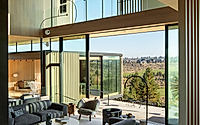
Step down and the eastern horizon snaps into view. Floors, ceilings, and wall planes run outward to exterior terraces, turning thresholds into brief pauses that set up the next descent.
Volumes Set Roles
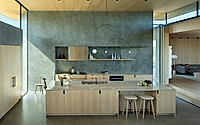
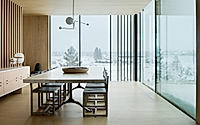
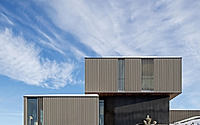
Three rectangular wood volumes carry specific roles: garage and studio, bedrooms, and a dining room set a few steps above the kitchen. Between them, faceted mass walls—abstracted from nearby volcanic rock—steer movement, form boundaries, and direct sightlines across the bluff.
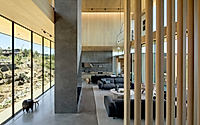
Surfaces maintain a steady texture, even across windows, so each volume reads as a continuous object. Those monolithic masses are carved and chamfered to temper sun and wind, creating places of shelter without breaking the rhythm of the walk.
Rooms On Platforms
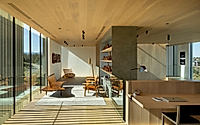
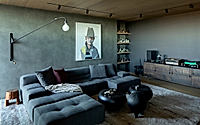
Living unfolds in short runs: media lounge, living room, and kitchen each occupy its own level, connected by a few deliberate steps. The dining room perches above, close enough for conversation yet framed to command sky and distant terrain during meals.
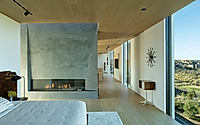
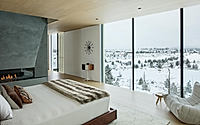
Upstairs, a primary suite joins an open workspace, a gallery overlooking the living room, and two guest rooms. Each landing is a small outlook, tuned to a distinct view or shaft of daylight.
Stairs Link Levels
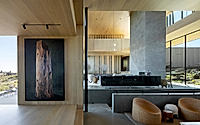
A central stair rides alongside a finely crafted wood screen that filters views while keeping the rooms visually connected. The screen’s cadence brings order to the interior and establishes a calm backdrop for art.
Another stair drops between living room and kitchen to a lower level set into the hillside. Down there, entertainment and spa rooms hold steady temperatures and open discreetly to the slope.
Shelter And Exposure
Exterior cladding recalls weathered tree snags, coarse slats running continuously across walls and windows. That consistency lends each volume a durable presence and modulates glare during the brightest hours.
Between the masses, outdoor pockets catch shifting breezes and seasonal light—microclimates that connect daily routines to the region’s intense sun and quick-cooling evenings. These interludes make the walk through the house feel attuned to the day.
Late light warms the wood and darkens the facets. As the plan descends, the sequence of rooms, terraces, and stairs keeps the surrounding desert in play while marking quiet thresholds for family, guests, and art.
Photography courtesy of Hacker
Visit Hacker