Armstrong Cottage by Peter Braithwaite Studio
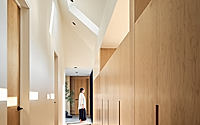
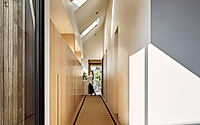
Armstrong Cottage sits in Peterborough, Canada, as a family retreat by Peter Braithwaite Studio. Two slender pavilions rise within a lakeside canopy, set lightly on the land yet engineered for a tough island site. The off-grid house ties childhood summers to a future-facing build, trading heavy foundations for bedrock-fixed steel and a kit-of-parts structure. It’s a modern escape with pragmatic grit.


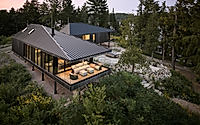
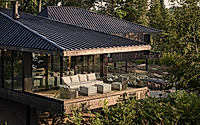
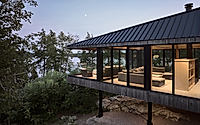
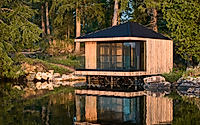
Sun strikes the lake and skips beneath the structure. From the dock, two slim pavilions lift into the trees, their underbellies clear for wind and wildlife to pass.
This is a house, not a lodge, tailored for a young family on an island site in Peterborough, Canada. Peter Braithwaite Studio shapes the retreat around assembly and structure—how the volumes stand, how they touch the ground, and how each piece reaches the island without excess.
Set On Stilts
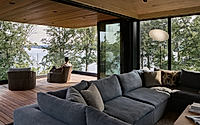
Sleeping and living separate into two pavilions, each placed within natural clearings and raised on stilts above the forest floor. The elevated stance lets the landscape slip under the rooms, the building hovering in the canopy while minimizing disturbance to soil and habitat. It feels measured and direct.
Bedrock Connections
Steel wide flange columns anchor directly to native bedrock, cutting concrete to a bare minimum and avoiding its impact on fertile topsoil. That connection trims material transport while giving the light volumes a firm bite into the island, a clear structural diagram with clean load paths. The move is both rugged and precise.
Kit Of Parts
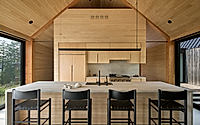
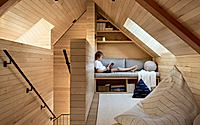
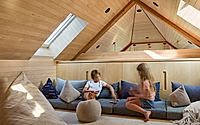
Everything above the columns reads as a kit designed for capacity and carry. Wood and steel beams, laminated-beam rigid frames, hip members, and wood rafters arrive by barge and join with plates and bolts. Pieces stay modest in size, maximizing inherent strength while simplifying lifts and alignments. Assembly is clear, repeatable, and fast.
Moving To Site
Island work sets its own tempo. The team commissions barges, builds docks that rise and fall with seasonal lake levels, and times heavy transport for winter when the water freezes. Each constraint folds back into the build logic—shorter members, fewer wet trades, and fixings that can be tightened without elaborate staging. Logistics become part of the craft.
Living Off Grid
The house is net zero and sips energy through efficient systems with low embedded impacts. Elevated volumes encourage shade and air movement, reducing demand while the compact structure keeps materials in check. Nothing shouts; it just works.
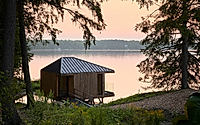
By dusk, the pavilions read as light frames between trunks. Water moves below, and the bedrock holds steady—one decisive contact, little else. The project earns its quiet by building only what’s needed, where it matters most.
off-grid house, net zero cottage, elevated pavilions, steel columns to bedrock, kit of parts assembly, laminated beam frames, hip members and rafters, barge transport construction, seasonal lake docks, low embodied energy, island construction logistics, light touch foundation
Photography courtesy of Peter Braithwaite Studio
Visit Peter Braithwaite Studio