6 HPP Ses Veles Puigpunyent by Fortuny-Alventosa Morell Arquitectes
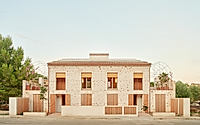
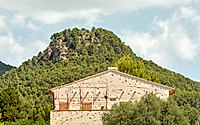
6 HPP Ses Veles Puigpunyent lands in Puigpunyent, Spain as a compact multi unit housing project by Fortuny-Alventosa Morell Arquitectes. The two-level, gable-roofed building folds six dwellings around patios and terraces, pairing passive performance with an island supply chain. It leans on vernacular craft and a clean construction logic to cut impact without frills. The tone is quiet, the ambition is clear.


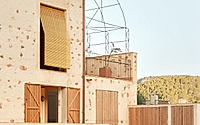
Morning light heats the lime-washed mass and slips across the patios. A gable roof collects warmth while the volumes below stay stout and cool.
This is a compact multi unit housing project in Puigpunyent by Fortuny-Alventosa Morell Arquitectes, focused on building with the island’s own matter and know-how. Six dwellings stack across two levels, organized for everyday use and tuned for low energy demand through material choices and simple, robust assemblies.
Build With the Island
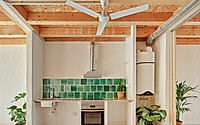
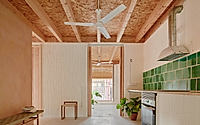
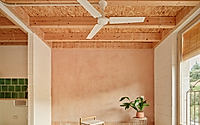
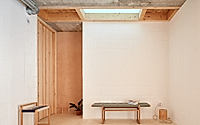
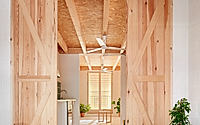
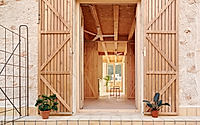
The exterior walls are cyclopean lime, packed with stones and earth taken from the excavation itself. That dense shell reads as a single, continuous body and anchors the project in its terrain. Inside, partitions use local ceramics filled with residual quarry sand, then finished in clay and straw for a dry, tactile surface that breathes. Floors and carpentry rely on FSC wood, with interior lime floors and locally sourced tiles and roof tiles rounding out a tight island supply chain.
Thermal Mass, Air, Shade
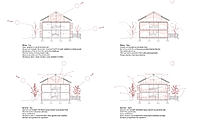
Material heft carries climate work here. High thermal inertia in floors and walls damps temperature swings, while hygroscopic finishes help regulate humidity without gadgets. Cross ventilation runs through each dwelling, with deep reveals and solar shading cutting summer gain as patios pull cooler air. In winter, the assembly banks heat during the day and gives it back slowly at night.
Trombe Roof Strategy
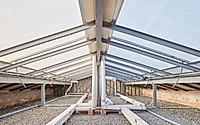
Above, a Trombe-type roof functions as a seasonal engine. It captures warmth in colder months, then vents in summer to purge hot air and lighten cooling loads. The move trims reliance on active systems and keeps energy use near zero. It’s a single diagram—sun, air, mass—handled with clarity.
Rooms Around the Kitchen
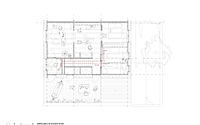
Four one-bedroom dwellings sit at ground level with private outdoor rooms that double as filters for light and ventilation. Two two-bedroom dwellings occupy the upper floor, each stepping out to its own terrace for daily spillover (coffee, laundry, a chair in shade). Inside, open and adaptable rooms center on the kitchen, encouraging direct relationships between cooking, eating, and living without wasted circulation.
Circular Thinking
Construction choices point to future unbuilding. Systems are assembled so materials can be separated and reused, cutting waste and granting a second life to components. Emissions drop by half compared to conventional methods, while the island-sourced palette reduces transport distances and keeps value local. It’s a modest brief handled through careful, resource-aware craft.
Evening shadow cools the patios and low walls. The mass holds steady, the carpentry glows, and the roof exhales—an everyday rhythm set by matter, air, and sun.
Photography courtesy of Fortuny-Alventosa Morell Arquitectes
Visit Fortuny-Alventosa Morell Arquitectes