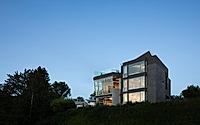
The Stair House by NAKO Design
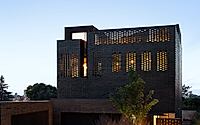
The Stair House is a family home in Edmonton, Canada, shaped by NAKO Design in close collaboration with a client who’s an architect himself. Behind a modest brick façade, the house orchestrates four levels through a sequence of sculptural stairs and quiet rooms, setting a composed rhythm for daily life. The project reads as both workshop and dwelling, where material precision meets a warm, livable plan.


A low brick face meets cool air and soft prairie light. Inside, the first steps drop below grade before the house starts its upward run.
This is a house of stacked moments in Edmonton by NAKO Design, organized around stair and level. The work focuses on how the vertical core shapes movement and rooms, aligning complex geometry with calm finishes to guide a family’s day.
Descend, Then Rise
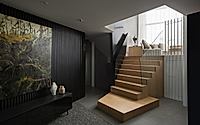
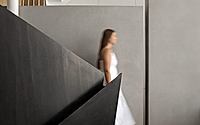
Entry sits below grade, charcoal walls and slatted wood closing out the street. That compression sharpens attention as a sculptural metal tulip stair unfurls through four levels, its smooth rail doubling as art while resting on warm wood plinths. The path turns and opens toward a quiet family room, trading that cocooned entry for a measured breadth. Light collects at each landing, then slips away.
Strings And Screens
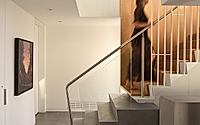
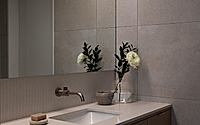
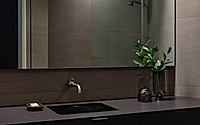
Higher up, a concrete plinth grounds a second stair that pairs white oak with a powder-coated screen. Inspired by musical strings, corded metal climbs to the ceiling, tying floors together while casting linear shadows across the landing. Nearby sit a library, two bedrooms with adjoining ensuites, and a small powder room. Black-and-white schemes flip from one bath to the next, a studied contrast that clarifies form.
Dining To Living
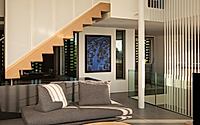
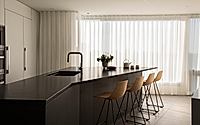
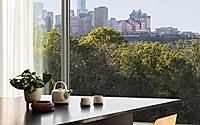
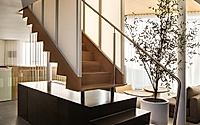
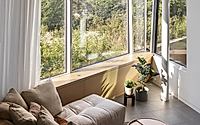
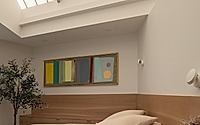
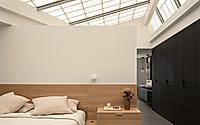
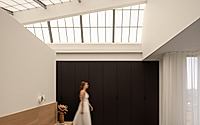
A third stair separates dining from living and gathers the home’s key materials. Suspended wood, metal, and shoji-style panels repeat here, then reappear as an oversized skylight in the penthouse primary suite. The move creates a steady cadence between social rooms and private ones, keeping sightlines gentle while allowing long views. Daylight sifts through the shoji plane, soft and even.
Geometry In Balance
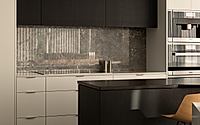
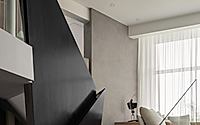
Angles shift, ceilings rise and fall, yet the composition stays legible: circulation anchors the narrative. Black-stained wood, white oak, stone, concrete, and metal set a restrained palette that eases those complex junctions. Bathrooms finish the argument with green Japanese tile, blown glass lighting, and concealed pivot doors—quiet moves that reward close inspection. Nothing shouts; edges read crisp, and the joints feel sure.
Quiet Closures
By the top landing, the skylight settles the room and loosens time. Below, the brick façade holds the line while interior grains and screens keep warmth in the walk. The house ends as it began, with steps and a pause, the route remembered through the hand that trails the rail.
Photography by Tina Kulic
Visit NAKO Design