Passo Passo Reimagines a Historic Gatehouse for Contemporary Life
Passo Passo turns an early 20th-century gatehouse in Como, Italy into a compact house by Parentesi Studio for a young couple who joined the work on site. The project keeps the villa entrance intact while reworking interiors step by step, pairing restored elements with measured contemporary interventions. Across basement, two main floors, and a newly usable attic, it traces a precise balance between memory and present-day living.


Light catches the brass lines in the floor and runs along the pale terrazzo, mapping out where walls once divided the ground level. A compact gatehouse that once guarded a grand villa now opens to a house calibrated between careful preservation and present comfort.
This house in Como, Italy, renovated by Parentesi Studio for a young couple, occupies an early 20th-century gatehouse at the villa entrance. The project focuses on adaptive reuse, retaining distinctive architectural elements while introducing measured updates for contemporary living. Every move responds to what was already there, from tile carpets underfoot to the attic turned bright atelier.
Reworking The Ground Floor
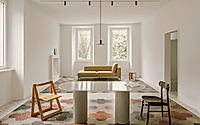
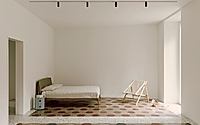
On entry, the reconfigured right wing reads as one generous living area rather than a cluster of small rooms. Two partition walls once divided this level, and their removal unlocks a clearer connection between daily activities. The traces of those walls stay legible as brass profiles set into the floor, so the past layout remains quietly drawn in metal. A light-colored terrazzo runs along the long corridor, the true distributive axis of the house, tying the rooms together underfoot.
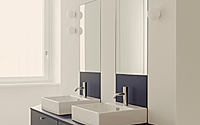
The kitchen stays in its historic position but gains new presence through a central island that anchors cooking and conversation. It works as a gathering point where movement from corridor to living room slows around shared meals. Nearby, the bathroom unfolds as a short narrative rather than a single box, conceived as a sequence of glimpses and changing atmospheres that reveal themselves step by step. Each turn encourages a different reading of light, surface, and distance.
Maintaining Character While Updating
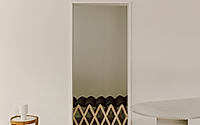
Throughout the house, original elements hold their ground and set the tone. Three carpets of hexagonal cement tiles are carefully restored, their patterned fields framed by the new terrazzo like islands of memory. Distinctive fireplaces, thresholds, railings, and vaulted ceilings are kept in place, giving the rooms texture and weight. The intent is not nostalgia; it is an active balance between what was inherited and what present use demands.
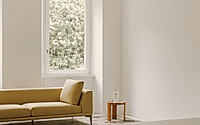
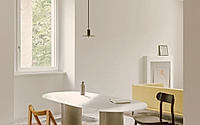
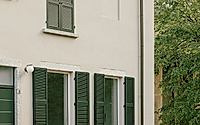
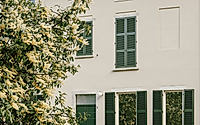
Technical upgrades sit behind this historic envelope to support contemporary comfort. A ceiling radiant heating system replaces older heating methods and frees walls from bulky equipment. Existing windows that no longer met energy standards are replaced by new wooden frames with a regular design and single panes of glass. These windows increase natural light and strengthen the visual link between interior rooms and the surrounding grounds.
Circulation Up Through The House
The grand staircase, preserved in its original position, gives the compact house a ceremonial vertical spine. It leads from the active ground level to the quieter sleeping area on the first floor, marking a clear shift in rhythm. Every landing reinforces orientation, and familiar railings keep the historic character at hand. Daily movement through the house, from basement to attic, becomes a repeated reading of old and new elements in close conversation.
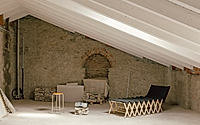
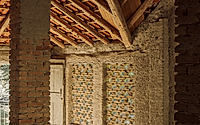
Above, the roof structure is entirely rebuilt to meet current performance, while the original tiles are recovered and set back in place. This careful exchange makes the large attic fully usable without erasing its inherited presence. Brightness and a calmer atmosphere define this upper level, which lends itself to multiple roles, first and foremost as an atelier suited to work and reflection.
Attic As Flexible Atelier
The attic marks the project’s most visible transformation while still reading as part of the gatehouse. New structure sits behind the familiar roof covering, aligning technical renewal with visual continuity. Light enters more generously, and the open volume encourages flexible occupation over time. Here, the balance between old shell and updated frame becomes both spatial and atmospheric, supporting creative work, quiet study, or informal gathering without fixing a single use.
By keeping historic surfaces legible while threading in present-day systems, Passo Passo advances step by step rather than through one dramatic gesture. Brass lines in the floor, restored tile carpets, and reused roof tiles all record past configurations even as new rooms support contemporary routines. The house stands at the villa entrance as a compact example of how preservation and renewal can share the same threshold.
Photography by Nicolò Panzeri
Visit Parentesi Studio