Ga.o House by 85 Design
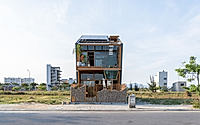
Ga.o House sets out a calm yet ambitious hybrid environment in Hòa Hải, Ngũ Hành Sơn, Đà Nẵng, Vietnam, conceived by 85 Design as both office and home. The prefabricated steel structure wraps working rooms, gardens, and compact living quarters around light, air, and water, translating Vietnam’s push toward sustainable urban growth into a very local, very tactile experiment. Staff and residents move through planted terraces, waterfalls, and double-height volumes tuned to the tropical climate.


Morning light cuts across the steel frame, catching the shimmer of water moving between pond, balcony waterfall, and rooftop systems. A soft rustle of leaves and distant street sounds filters through generous openings, setting an urban tropical rhythm.
Within this compact office property in Hòa Hải, Ngũ Hành Sơn, Đà Nẵng, 85 Design arranges daily work and home life around climate, energy, and resource cycles rather than decorative gestures. The project functions as a hybrid living-working arrangement, where offices, bedrooms, terraces, and planted thresholds are tuned to sun, rain, and wind. Every decision leans toward cutting fossil fuel use, reusing materials, and letting natural forces do as much work as possible.
Ga.o House adopts a prefabricated steel frame that reduces construction waste and simplifies future recycling, aligning structure with broader sustainability goals. The team keeps built volume modest and opens generous outdoor areas so breezes and daylight can serve as primary environmental control, cutting artificial cooling and lighting demands. Solar panels, rainwater collection, and smart systems interlock with this open layout, translating regional policy ambitions into everyday routines. Workplaces and domestic rooms remain flexible, ready to shift as needs and technologies change.
Steel Frame And Tropical Air
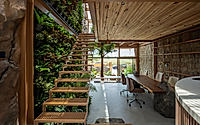
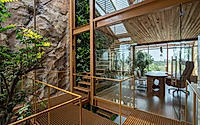
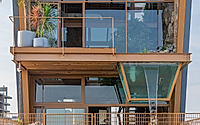
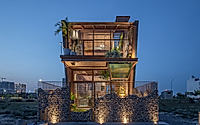
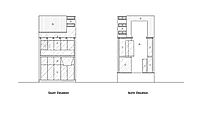
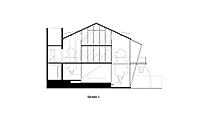
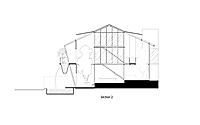
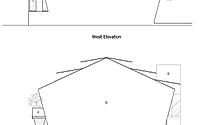
The prefabricated frame stands as a clear armature, with walls and volumes arranged to pull air through double-height voids and operable roof sections. By holding built mass back from the lot edges, the project creates corridors for cross-ventilation, so warm air rises and escapes through the tall central opening. This structural clarity supports a 60–80% reduction in fossil energy use, anchored by passive cooling rather than mechanical dependence. Open terraces and shaded balconies then become everyday extensions of the working environment.
Water Circulation And Microclimate
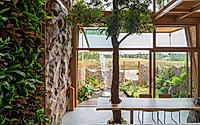
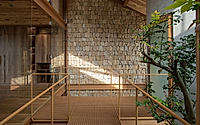
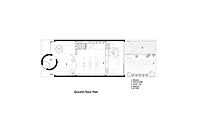
Water moves visibly and audibly from ground to roof and back again, tying the architecture to Vietnam’s abundant rainfall. At the entrance garden, a pond anchors mature trees, salvaged stone steps, and shifting floor levels, while collected rainwater supports irrigation and reuse. Higher up, a balcony waterfall and large glass fish tank connect hydraulically with the garden pond, creating a subtle cooling effect and a constant, quiet sound. This closed-loop system turns routine precipitation into a resource that helps regulate interior comfort.
Living And Working In Flux
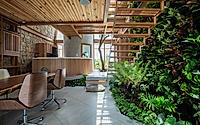
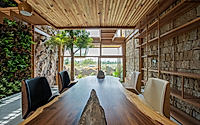
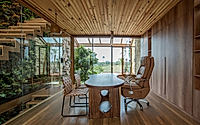
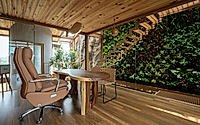
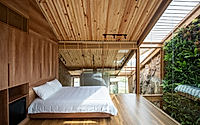
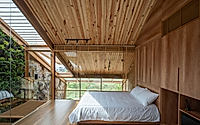
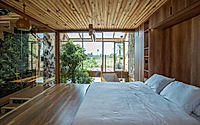
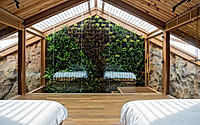
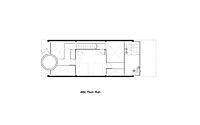
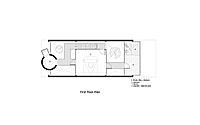
Daily life unfolds across two floors and an attic, with each level able to flip roles between work and rest. On the ground floor, the office shares the plan with a compact bar that supports staff meals and social breaks without leaving the site. One level up, a private office converts into a bedroom when a foldable bed swings out from behind the desk, letting the same room serve long days and overnight stays. The attic then holds a small bedroom with a sweeping 180-degree view, extending mental distance from the work below.
Green Surfaces And Smart Systems
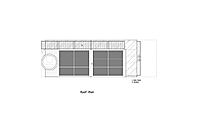
Vertical planting runs as a continuous green wall from ground floor to rooftop, thickening interior air quality and tying different levels into one living surface. Above it all, solar panels spread across the larger roof area, generating around 11,000 kWh each year under the control of smart management technology. Air conditioning units and water tanks share this upper platform, consolidated into a compact technical field that supports long-term carbon reduction goals. Over its lifespan, the building is projected to offset more than 200 tons of emissions, equivalent to a modest urban forest.
As day turns to evening, light softens across the steel, water, and foliage, and the hum of equipment gives way to the sound of moving air. Workers, residents, and visitors navigate a compact urban lot where climate systems are not hidden but legible. In this direct contact with sun, rain, and greenery, Ga.o House frames a practical route toward lower-impact city life.
Photography courtesy of 85 Design
Visit 85 Design