Residencia Chavarria by Carazo Arquitectura
Residencia Chavarria stands in Puntarenas, Puntarenas Province, Costa Rica, as a low, porous house by Carazo Arquitectura that trades thick walls for garden-filled thresholds. Composed around an interior courtyard and wrapped in modular brick, the home reads as a continuous exchange between enclosure and vegetation. Shifting between open and sheltered zones, it reworks domestic life for a humid coastal climate and lets everyday routines unfold in tandem with light, air, and greenery.


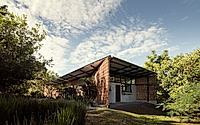
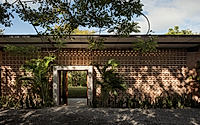
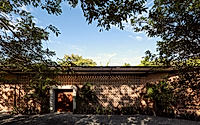
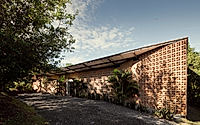
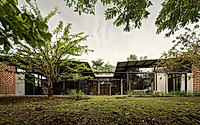
A gravel drive cuts through dense green and ends at a quiet brick wall, its perforations catching slivers of sun and shadow. Beyond a single rectangular opening, the house unfolds not as a sealed volume but as a walk through filtered light, moving between garden, gallery, and room.
This house in Puntarenas by Carazo Arquitectura is a low courtyard dwelling that keeps the tropical climate close rather than shutting it out. Classified as a single-family house, it treats the garden as its central room and organizes daily life around air movement, shade, and controlled exposure. The project works through porous limits and measured orientation, using structure and material to temper sun and channel breezes.
Brick Screens Filter Climate
From the exterior, modular brick walls stretch under a slim metal roof, reading as a continuous lattice rather than a solid perimeter. The patterned brickwork permits ventilation while casting a fine-grained shadow across walkways, softening the intensity of the coastal sun. Behind this breathable skin, glazed walls and concrete frames create a second line of enclosure, so rooms stay shaded yet connected to the surrounding vegetation. At certain points, the lattice thickens around doorways, making entry feel both precise and gradual.
Living Around The Garden
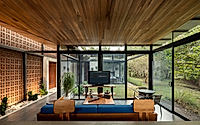
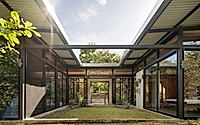
Once inside, the sequence pivots toward an interior garden that sits at the center of the plan like an outdoor living room. Rooms and corridors wrap this planted courtyard, producing constant diagonal views from one side of the house to the other through glass and foliage. Tall sliding panes open living areas directly onto the grass, so cross-ventilation works naturally and daily movement traces the edge of the greenery. The garden is not a backdrop; it becomes the hinge between social zones and quieter bedrooms.
Corridors As Open Thresholds
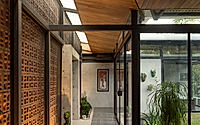
Circulation threads along the garden edge in narrow galleries where brick on one side meets glass on the other. Underfoot, dark floor tiles run in straight bands, while a line of river stones and planters softens the junction with the wall. These corridors read almost as outdoor paths, bright by day and gently lit at night, so moving from kitchen to bedroom means walking beside plants and filtered air. Every threshold extends the sense of being halfway between house and landscape.
Wood, Concrete, And View Lines
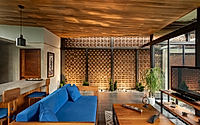
Inside the living room, a warm timber ceiling draws the eye across the width of the house and out toward the garden. Built-in concrete elements, such as the kitchen counter and structural frames, ground the interior against the lighter steel and glass. Furnishings in wood and bold upholstery sit low, preserving sightlines beneath the horizontal ceiling so the courtyard remains the dominant visual focus. Even with the television at center, the gaze continues past it, through clear glass, to lawn and trees beyond.
Roof Plan And Shelter
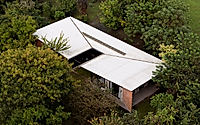
From above, the roof reads as a set of folded planes that open around the central void, channeling light down while protecting the interior garden from heavy rain. Corrugated metal sheets rest on a lean structural grid, creating generous overhangs where brick walls, glazing, and vegetation tuck into shade. The geometry leaves a linear skylight along the inner edge, so soft daylight washes the circulation routes without direct glare. Shelter and exposure are negotiated in section as much as in plan.
By the time one returns to the entry wall, the house feels less like an object and more like a clearing shaped for everyday use. Air, shade, and plant life work with brick, glass, and timber to make domestic routines part of the surrounding garden. In this coastal setting, Residencia Chavarria treats climate as collaborator, letting nature occupy the center of the home rather than the edge.
Photography courtesy of Carazo Arquitectura
Visit Carazo Arquitectura