Tangram House by TETRO Arquitetura
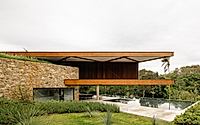
Tangram House occupies a gently sloping lakefront site in Lagoa Santa, Brazil, and comes from the studio TETRO Arquitetura. The house holds the street with a discreet horizontal line, then turns inward to frame trees, lawn, and water rather than traffic and cars. Across two levels, the project choreographs daily life between a sheltered upper volume and an open lower level that leans directly toward the lake.


From the street, a slim roofline traces the horizon. Step past the retaining walls and the city slips away, replaced by trees, lawn, and the broad surface of the lake.
This house is a two-level residence in Lagoa Santa, Brazil, designed by TETRO Arquitetura as a clear sequence from street edge to water. A triangular figure organizes the rooms, the roof, and the movement through the plot, turning the project into a choreographed passage rather than a freestanding object. Daily life unfolds along this path, always retreating from the road and leaning toward the view.
Placed at the highest point of the lot, the volume reads as a quiet bar from the public side, with retaining walls and landscaped embankments building up a calm threshold. These elements, together with the main structure, draw a visual barrier that screens passing cars and activity. Once inside the gate, the orientation flips: the house opens away from the street, and every step down the slope deepens the relationship with the lake and the planted grounds.
Triangular Roof As Guide
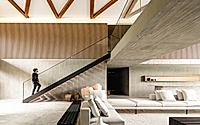
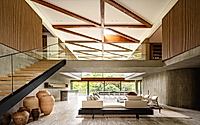
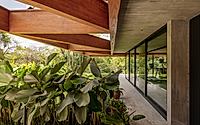
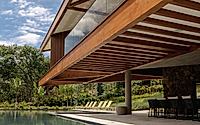
A triangular plan gives the project its name and sets up the internal order. That geometry extends upward into a glued laminated timber roof composed of a sequence of triangular planes. The large shelter turns its broader face toward the water, protecting privacy on the street side while fanning open to the lakeshore. Under this continuous cover, skylights slice the roof, pulling daylight onto living areas and circulation on the upper floor so that routes between rooms stay bright and legible.
Lower Level Toward Water
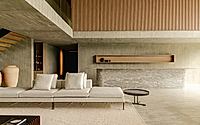
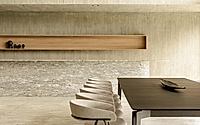
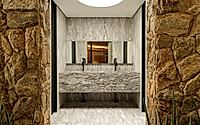
On the lower level, the plan concentrates social life along the lakefront edge. Living room, kitchen, gourmet area, wine cellar, and pool sit in a line that tracks the water, held behind large glass panes and broad verandas. Part of this level bites into the retaining wall, where a support kitchen, bathroom, and wine cellar nestle into an inhabited thickness between concrete and earth. Here the pool water seems to extend the lake, and interior rooms flow straight out to terraces with hardly any visible boundary.
Upper Level For Retreat
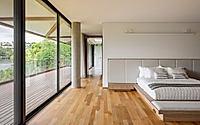
Above, the upper floor gathers the more private routines of the family. A shared family room anchors five bedrooms: the master suite, two children’s rooms, and two guest rooms. Every bedroom opens to the view yet remains sheltered by the deep eave of the triangular roof and the distance from the street below. From these rooms, the daily backdrop is lawn, trees, and water, with urban noise held firmly outside the layered threshold.
Mixed Structure On Slope
Structure follows sequence, alternating solidity and lightness along the slope. Exposed concrete slabs and walls register the heavier elements and lock the house into the terrain, echoing the stone walls that retain the ground. Timber roofs and verandas bring a contrasting sense of delicacy at the edges where interior meets garden. Walking from upper entry to lower terrace, a visitor passes through this calibrated mix of mass and canopy, always guided toward the lake.
By the time one reaches the pool, the street line is long forgotten. Only the roof edge and horizon run together, tying architecture and landscape into a single horizontal mark. In that measured gesture, Tangram House holds back the city and gives everyday routines to the lake, the trees, and the changing light.
Photography by Manoel Sá
Visit TETRO Arquitetura