The Nest: Prefab Off-Grid Retreat
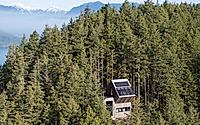
The Nest rises from the crest of Keats Island, BC, Canada, as an off-grid retreat by DSS | Daria Sheina Studio. This compact, three-level escape leans on prefabrication and mass timber craft to negotiate rugged topography and dense Pacific Northwest forest while keeping a light footprint. Inside and out, the project turns its tight footprint into a vertical sequence of rooms tuned to mossy ground, filtered canopy light, and views out to Howe Sound.


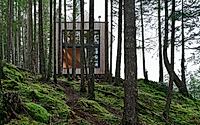
Filtered light cuts through the evergreens and lands on cedar boards as the retreat steps up the ridge. Underfoot, moss softens the rock.
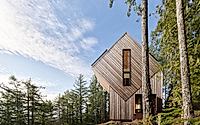
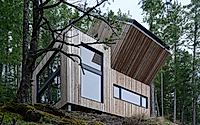
The path arrives at a compact timber volume rotated against its twin, a precise assembly that reads as both shelter and instrument for view. This is The Nest, an off-grid retreat on Keats Island in British Columbia, shaped by DSS | Daria Sheina Studio as a compact three-level home built around prefabrication, mass timber structure, and a direct connection to its rugged Pacific Northwest setting. Every construction choice serves the remote location, from helicopter-lifted panels to systems that let the house stand alone in the forest.
Stacked Volumes On The Ridge
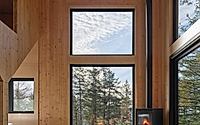
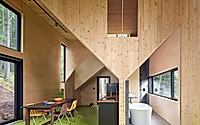
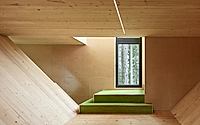
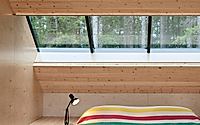
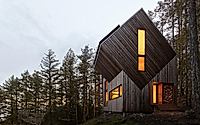
Two geometric volumes rotate against one another to form a vertical sequence of rooms that climb the island’s highest elevation. The footprint stays small. Inside, the triple-height composition reads as generous, with each level angled toward a different slice of forest, rock, and Howe Sound beyond. That rotation turns structure into viewpoint, so the compact retreat gains depth without spreading across the fragile terrain.
Cedar Shell, Mass Timber Core
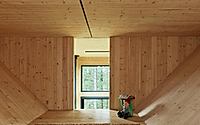
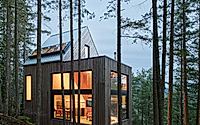
Western red cedar cladding wraps the exterior, set to weather into the greens and browns of the surrounding canopy. Underneath, mass timber replaces structural steel, concentrating strength in thick wood elements that tie back to the island’s forest character. Careful engineering trims concrete footings and excavation, allowing the building to land lightly on the ridge while keeping the structure stable in an exposed position. Over time, the aging cedar skin and reduced ground disturbance keep the house visually and physically rooted in its setting.
Prefab As Construction Strategy
Given the site’s inaccessibility—reached only by water taxi or foot-passenger ferry—prefabrication shifts from convenience to necessity. DSS | Daria Sheina Studio works with BC Passive House to model each element virtually, dialing in size, weight, and connection points long before leaving the factory. Those components travel by truck and barge, then lift into position by helicopter, turning installation into a short, choreographed build window rather than an extended remote construction campaign. The main structure lands in just two days, proving how precise off-site fabrication can compress time and reduce risk in harsh terrain.
Off-Grid Systems In The Forest
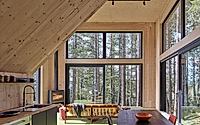
Self-sufficiency underpins the building’s technical core. Solar arrays power the retreat, while an incinerating toilet and a rainwater collection and filtration system remove dependence on island infrastructure. Inside, exposed wood surfaces and green Marmoleum flooring echo the moss and trunks just beyond the walls, keeping finishes simple and durable. Large lift-and-slide doors open the living level directly to the landscape, so air, scent, and forest sound move through with minimal barrier.
The owners describe the retreat as a place that pulls them away from city life and back into the trees. From the high ridge, the cedar shell, timber bones, and off-grid systems work together as a compact, precise instrument tuned to weather and view. When the sun drops behind Howe Sound, the house settles back into the canopy, reading as a small, crafted volume set quietly above the water.
Photography by Andrew Latreille
Visit DSS | Daria Sheina Studio