Mustard Building: Calm Coastal Apartments With Light-Filled Terraces
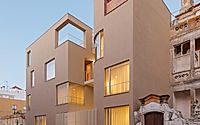
Mustard Building stands in Vila Real de Santo António, Portugal, where Aurora Arquitectos works within strict heritage rules to extend an existing urban house. The new four-floor volume turns a protected city-center plot into a compact residential complex, drawing on calm interiors and generous openings to the patio. Here, measured gestures reshape daily life without losing sight of the original rose-hued story.


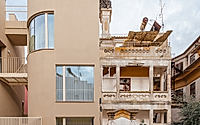
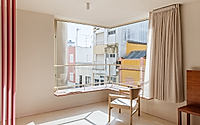
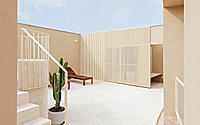
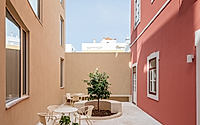
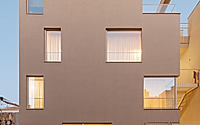
Late sun drops into the narrow patio and catches the new volume in a soft mustard glow. Sliding windows pull back and living rooms lean into the sky.
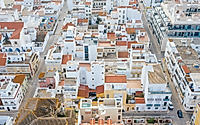
This house project in Vila Real de Santo António, Portugal, by Aurora Arquitectos works within a protected city center and strict rules on height and façade character. The studio adds a four-floor building behind an existing rose-house, using a central patio and a rooftop level to organize contemporary apartments. Daily life turns around material calm, measured color, and a close relationship between interior rooms and outdoor air.
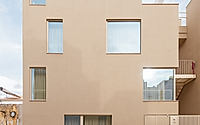
The municipal code sets the frame. New construction must reach exactly 12m in height and avoid any repetition of the historic Pombalino rhythm of tall, rectangular French windows. Rather than mimic, the architects split the new volume in two, opening a narrow slot of light over the central patio and lifting shared amenities to the roof. Within those boundaries, they carve out a different kind of domestic interior.
Sliding Windows And Patio Light
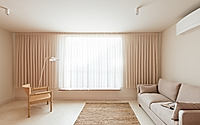
One-pane sliding windows run slightly off-grid across the façade, breaking from the orthogonal order of the old streets. Each pane withdraws fully into the wall so the living room edges blur toward the exterior. On warm days, rooms read almost as terraces, with air moving directly from the patio through to the front. This simple movement of glass restructures how residents sit, gather, and look out.
Calm Interiors As Counterpoint
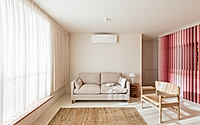
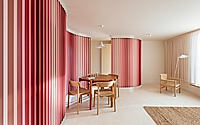
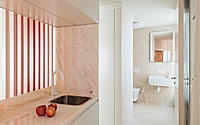
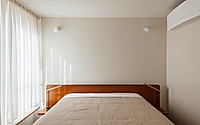
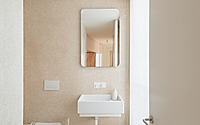
Inside, the architects choose restraint. Wood surfaces and cream terrazzo floors repeat from flat to flat, giving the apartments a steady material rhythm and a sense of quiet continuity. Against the layered history of the existing building, this new interior world feels intentionally even, almost meditative. Each apartment reads as a variation on the same calm palette rather than a collection of competing gestures.
Pink Gradient Partition
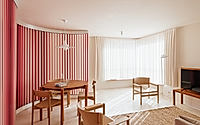
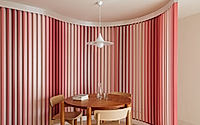
Across these subdued rooms, one vivid element runs like a thread. An open partition in wood, painted in a gradient of pink, organizes the social zone of each flat and sets up slow shifts in hue as you move. It screens, frames, and gently directs circulation without closing rooms off completely. The color links back to the original rose-house on the plot, tying mustard and pink into a single, continuous narrative.
Shared Roof And Everyday Rituals
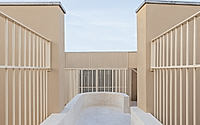
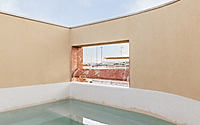
Up on the top floor, the project reserves precious area for collective use rather than extra units. A small swimming pool and a sunbathing terrace cap the building and look back over the protected city fabric. Residents find water, sky, and social contact at the very top, above the quiet interior sequence below. The house becomes both stacked private rooms and a shared vertical resort for daily rituals.
By treating regulations as a starting script, Mustard Building develops its own interior grammar of sliding glass, soft materials, and one bold chromatic accent. The former back-of-plot zone now holds a lived-in courtyard world, tuned to local weather and to the long story of the rose-house. Light, color, and simple textures keep the architecture grounded in everyday use while hinting at the larger city just beyond the terrace rail.
Photography by do mal o menos
Visit Aurora Arquitectos