Hayden House: Regenerative Mountain Living in Aspen’s High Valley
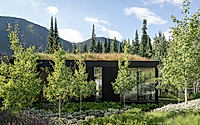
Hayden House settles into a high Colorado valley above Aspen, CO, United States, where forest and meadow meet at 8,500 feet. Design Workshop shapes the house as a year-round family retreat, building on regenerative strategies that protect most of the land while framing long views to distant peaks. Inside and out, modular pavilions, planted roofs, and restored ground plane tie domestic life to the seasons without overwhelming the fragile montane setting.
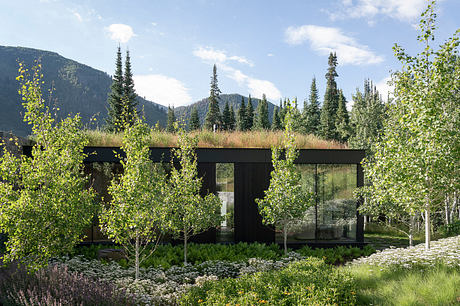
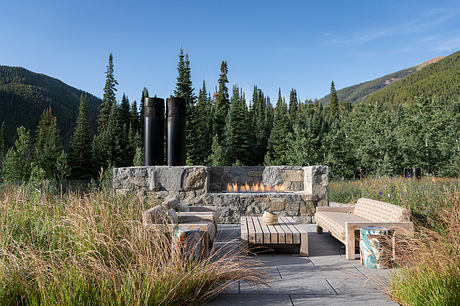


A gravel drive rises from the valley floor and bends toward a quiet shoulder of land where timber, stone, and meadow start to overlap. From here, distant snow-capped peaks line the horizon while conifer trunks, native grasses, and wildflowers close in at the edges, pulling the house into a thick alpine frame. Light catches the planted roof and drifts across the pavilions in a slow, lateral sweep.
This house stands as a year-round family dwelling in the Montane Life Zone above Aspen, shaped by Design Workshop around the rhythms of high-altitude climate. Architecture and landscape work as one system, tuned to elevation, sun, stormwater, and the long view down the narrow, glacially carved valley. The story centers on context and ecology, tracing how careful siting and regenerative strategies allow new construction to sit lightly on a sensitive hillside.
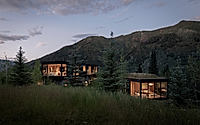
Set on the flattest shoulder of a 10.5-acre parcel, the house touches only a small fraction of its setting, with disturbance limited to less than ten percent. Most of the forest canopy and native groundcover remains intact, so the building reads as a quiet inflection rather than a clearing carved from the woods. Privacy from the public valley floor comes not from tall walls but from elevation shifts and preserved woodland, which screen everyday life from the road below.
Pavilions On The Slope
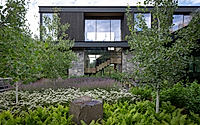
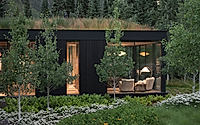
Architecture and landscape share a single idea: modular pavilions set in a pinwheel configuration, each wing rotated to take in a different slice of terrain and sky. This arrangement breaks down mass, so rooms step with the undulating topography rather than marching along a straight bar, and the gaps between wings become sheltered courts. Every pavilion faces a distinct character—one toward dense mixed-conifer stands, another toward open meadow, another toward the long valley view.
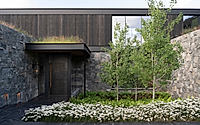
Fabricated off-site, the modules arrive as a precise kit, reducing construction traffic and the time heavy equipment needs to sit on fragile soils. Regional prefabrication also steadies quality in a remote labor market while shortening the building season in a climate with long winters. Wood and stone cladding wrap these volumes so they register as grounded objects, yet the pattern of courtyards keeps air and light moving between them.
Green Roof As Valley Floor
Above the pavilions, a 3,000-square-foot green roof extends the meadow across the house, planted with drought-tolerant grasses and forbs documented directly from the site. This living surface holds stormwater, slows runoff, and insulates interior rooms while softening the roofline against the surrounding slope. Seen from higher ground, the planted plane blurs building edges, turning the composition into a gentle rise in the broader vegetative mosaic.
Integrated solar panels sit within this elevated landscape, tying household energy use to county greenhouse gas reduction goals without drawing attention away from the restored plant communities. Underfoot, the roof’s soil layer and roots reduce heat gain on sunny alpine days, then release stored moisture and coolness into the evening air. The result is a kind of second ground, working as both habitat and environmental shield.
Regenerative Ground Plane
At grade, the project advances regenerative landscape principles that reach beyond simple preservation to active repair of soils and hydrology. Infiltration basins catch and slow stormwater running off the slope, giving it time to percolate, filter, and recharge rather than race to the valley floor. Restored native plant communities fill these depressions, stabilizing banks, welcoming pollinators, and knitting together the meadow with the dark edge of the conifer forest.
Cut aspens become mulch for a network of garden trails, closing the loop between disturbance and renewal in a tangible way. Walking these paths, residents move across shifting microclimates—past cool, shaded understories, through open wildflower meadows, and along the quieter basins where water disappears into the ground. Every route keeps living systems close to daily routines.
Courtyards And Daily Views
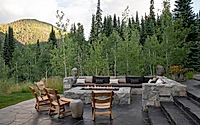
The pinwheel plan shapes a cadence of courtyards, each with its own exposure, wind pattern, and outlook, so the family can choose where to gather as conditions change. One court might trap low morning sun for breakfast, another might draw in cross-ventilation for warm afternoons, and a more enclosed pocket might hold heat into cool mountain evenings. Interior rooms borrow these outdoor rooms as extensions, trading walls for planted edges and framed outlooks.
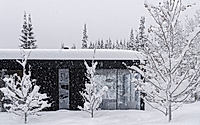
Inside, views are tuned more than they are widened, trimming distant peaks between tree trunks or catching a close-up of meadow grasses brushing against stone. Everyday rituals play out against this steady environmental drama, from snow settling on the green roof to summer storms filling the infiltration basins. Climate and ground form the constant companion to domestic life, rather than a scenic backdrop glimpsed from afar.
By the end of the short drive back down to the valley floor, the house recedes behind preserved forest and native undergrowth. Only the adjusted topography, repaired soils, and strengthened vegetative bands speak to the intervention on the slope. In this high-altitude setting, Hayden House reads less as an object on display than as a careful negotiation with climate, water, and land.
Photography courtesy of Design Workshop
Visit Design Workshop