Casa Dragones by V Taller
Casa Dragones anchors a contemporary house in Mérida, Mexico, with a grounded reading of climate and terrain by V Taller. The project reinterprets Yucatecan courtyard traditions through patios, arches, and planted voids that fold daily life into sequences of filtered light and shifting shade. Across its concrete base and lighter upper volumes, the house leans on local materials and open-air circulation to shape a calm, climate-responsive way of living.


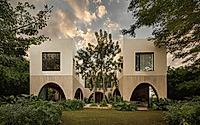
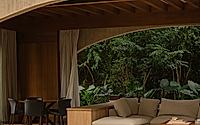
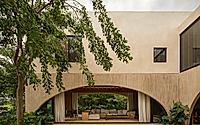
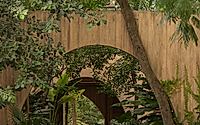
Shade gathers first under the low concrete plinth, where cool air drifts between planted patios and pale stone. Beyond, arches frame slivers of sky and foliage, pulling daylight deep into the house in slow, shifting bands.
This house in Mérida is a contemporary courtyard dwelling that draws from Yucatecan architecture while staying rooted in present-day life. V Taller structures the residence around patios, thresholds, and a heavy base that read the region’s heat and light as primary design drivers. Every move negotiates between shelter and exposure, using local materials and open volumes to register climate as a constant companion.
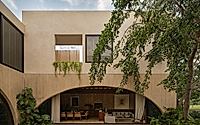
Casa Dragones is organized as a house of layers. A reinforced concrete plinth grounds the ground floor and holds the most public and collective activities close to vegetation and water. Above, more orthogonal volumes hold private rooms around quieter patios, where filtered light and cross ventilation temper the warm air without mechanical dependence.
Plinth And Territory
The reinforced concrete plinth reads as a stone-like base, tying the house to the ground and signaling a clear datum against the flat terrain. Rather than form a continuous bar, this mass breaks into a cadence of arches that establish a walkable perimeter, so circulation always traces the edge between room and garden. Those repeated openings recall regional construction, where arcades temper sun and funnel breezes along shaded corridors. Within this base, intimate corners and collective zones sit only a few steps from outdoor planting, keeping everyday routines close to soil and shadow.
Patios As Climate Rooms
Patios act as open-air rooms that structure the plan and mediate the climate. They strengthen the relationship between inhabitants and vegetation, extending daily life outward while still feeling enclosed by walls and volumes. From the heavy base, more orthogonal upper elements rise, their quieter surfaces framing courtyards that guard privacy and soften direct sun. These voids carry the lineage of Mexican domestic architecture, working as articulating nodes where circulation, rest, and shared rituals naturally converge.
At the core of the house, a reflecting pool deepens this climatic strategy. Water recalls the region’s subsoil and cenote culture, but here it also cools air and fractures light across adjacent surfaces. Reflections animate ceilings and walls, multiplying perceptions of surrounding limestone and Chukum in continuous, rippling motion. The pool becomes a quiet device that links sky, ground, and interior in one shallow plane.
Light, Ventilation, And Sequence
Rooms align around patios so that each one receives light from more than a single direction and air can flow across rather than along narrow corridors. The continuity between walls and openings encourages this diagonal movement, turning screened thresholds and generous doorways into active instruments for comfort. Cross ventilation, made possible by the arrangement of volumes and porous edges, reduces the need for mechanical cooling in Mérida’s heat. Movement through the house becomes a slow sequence of temperature shifts, alternating between bright sun, dappled shade, and cooler interior air.
Material Palette From Place
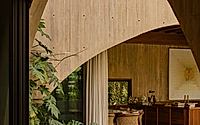
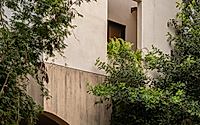
Material choices follow climate and local practice. The exposed concrete plinth, its formwork lines left legible, carries the notion of grounding and thermal mass at the lower level. Above it, walls finished in Chukum—a traditional Yucatecan coating—help regulate interior temperatures and guard surfaces against humidity and wear. Limestone underfoot and warm wood elements round out the palette, setting up a tactile contrast between rough base, smooth planes, and softer joinery.
Throughout the day, shadows from arches and foliage move across Chukum walls and limestone floors. These slow patterns lend each room a sense of continual transformation without any change in furnishings. Light becomes another material, tracing the thickness of walls and revealing the depth of thresholds as it advances.
Vegetation As Structure
Landscape is treated as integral architecture rather than applied scenery. Native trees such as Chaka and Jabín are preserved inside patios, where their canopies cast broad zones of shade that ease the microclimate. In several moments, trunks pass directly through openings in walls or roofs, folding built fabric around existing growth instead of the reverse. Dense foliage and broad-leafed planting link one courtyard to the next, so views from interior rooms always catch some fragment of green.
Ground-level grasses and low vegetation trace limestone paths, giving each route a tactile edge underfoot and at eye level. Movement through the house becomes a reading of textures: cool stone, rough concrete, smooth Chukum, and layered planting that softens every boundary.
In the end, Casa Dragones stands as an open framework tuned to its setting rather than a sealed object. Its patios, pool, and planted voids hold memory of vernacular forms while meeting present climatic needs. As light shifts and trees grow, the house continues to adjust around them, maintaining a steady conversation with air, shade, and the ground that anchors it.
Photography by V Taller
Visit V Taller