Casa Origine by Pianozero Architetti
Casa Origine turns a former village fuel station in Caserta, Italy, into a layered apartment by Pianozero Architetti. The project converts a symbolic communal place into a contemporary home that still holds the traces of its working past. Across courtyard, stair, and upper rooms, the architects orchestrate a quiet shift from public memory to private ritual while keeping the site’s original role present in daily life.


Light falls into the former forecourt where cars once idled, catching stone, foliage, and the pale surfaces of the renewed house. A familiar village landmark now reads as an intimate dwelling, but the echo of movement and gathering still hangs in the air.
Casa Origine is an apartment in Caserta, Italy, by Pianozero Architetti that converts the town’s first fuel station into a contemporary home. The project treats the building as a place of shared memory and private attachment, using adaptive reuse to thread past and present. Every move responds to what existed before: community life in the courtyard, family history in the structures, and the changing needs of a multilevel household.
The architects work with layers of time rather than a blank slate, describing the house as a kind of contemporary anastylosis where old fragments find new roles. Material contrasts, sectional shifts, and thematic thresholds organize the dwelling, turning circulation and daily routines into a quiet reading of history.
Recasting The Courtyard
Outside, the former forecourt is split into two complementary gardens that reinterpret the working yard. One becomes a “stone garden,” a hard-wearing meeting ground where friends and family can gather much as drivers once paused under the canopy. The other, the “olive garden,” grows above the old underground tank, a deliberate gesture that ties rooted planting to the memory of stored fuel. Together they stitch public habit and private use, turning a once utilitarian surface into a place for slower encounters and quiet reflection.
Spiral Core And Vertical Gallery
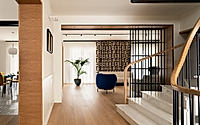
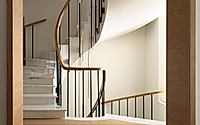
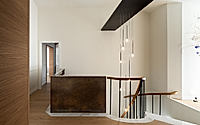
Inside, the apartment rises around a central void that organizes the levels and draws light inward. At its heart stands a white marble helical stair wrapped in a continuous timber band, a sculpted element that people climb, lean on, and circle as they move. This stair does more than connect floors; it acts as a vertical gallery where artworks stack in sequence, turning passage into a daily exhibition. Shifting views across the void keep the memory of the whole house present, even from its most tucked-away rooms.
Portals, Walls, And Daily Rooms
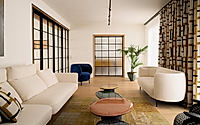
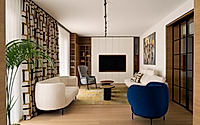
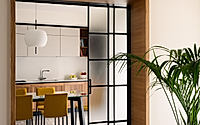
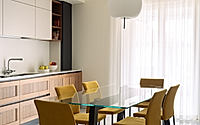
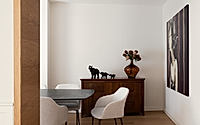
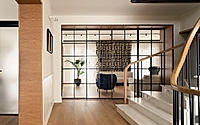
The ground level leans into convivial life, with the kitchen as its pulse. An open, dynamic layout lets the cooking area face a dining room anchored by a large communal table on one side and a living room shaped by deep sofas on the other. The transitions between these areas are choreographed through thematic portals that mark shifts from social to intimate, broad to enclosed. Along the lower portions of the walls, more romantic and decorative treatments meet pure, linear surfaces in the working zones, giving everyday routines a measured theatrical frame.
Upper Level Retreats
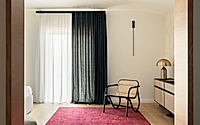
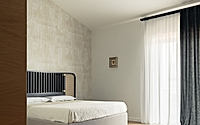
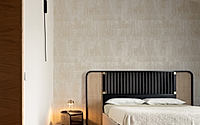
On the upper level, circulation divides into two wings to match the family’s evolving needs. One side gathers services and two bedrooms, creating a compact cluster where shared routines stay close at hand. The other side forms a suite for the owners, arranged as a sequence of three rooms—bedroom, walk-in closet, and private bath—linked by continuous light and consistent material tone. Here the language of the project softens, translating the more public gestures downstairs into a quieter setting for rest and reflection.
Back in the courtyard, the olive tree holds its place above the buried tank, anchoring the house to its working past. Inside, every climb of the stair and every crossing of a portal folds memory into present use. Casa Origine stands not as an erased site, but as a reformed one where architecture, time, and family history move together.
Photography by Carlo Oriente
Visit Pianozero Architetti