Villa EF: A 1960s Retreat by Depaolidefranceschibaldan Architetti
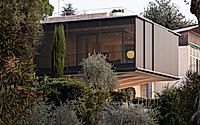
Villa EF unfolds along the shoreline of Bardolino, Italy, where Depaolidefranceschibaldan Architetti revisit a 1960s holiday house with a calm, contemporary attitude. The reworked villa grows out of the hillside in three volumes, tying lake, garden, and interior rooms into one extended sequence of terraces and loggias. Stone, glass, and soft green metal set a measured tone that lets the surrounding olives and water carry the scene.


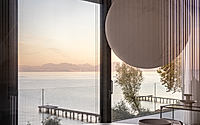
The hillside falls gently toward the Lake Garda shoreline, and Villa EF meets it with a measured cascade of built terraces and planted edges. Morning light tracks along stone walls and glass panes, catching the pale tones of Lessinia stone before dissolving into reflections on the water.
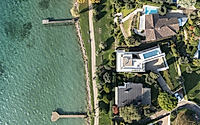
This house in Bardolino is a renovation and expansion of a 1960s villa, reworked by Depaolidefranceschibaldan Architetti as a layered retreat set between slope and shore. Three volumes step into the natural declivio, with shared rooms and terraces unfolding toward the lake in a sequence tuned to light, views, and breeze. Architecture, landscape, and climate read together rather than as separate parts.
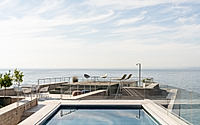
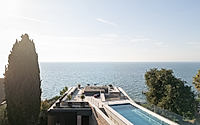
The project belongs to a belt of holiday houses that grew along this eastern edge of Lake Garda during the twentieth century, surrounded by olives, cypresses, and oleanders. Against that backdrop, the intervention keeps a clear, compact outline while stretching daily life outward toward the water and upward to a rooftop solarium and pool.
Stepping With The Hill
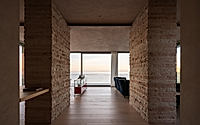
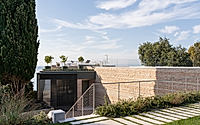
The villa organizes itself in three primary volumes over two levels, each adjusted to the natural slope rather than forcing a flat platform. The main body projects toward the lake, a second parallelepiped sits slightly behind, and a third new volume closes the entrance courtyard against the earth. Between them, outdoor rooms emerge as extensions of interior living areas, so movement from entry to water passes through a chain of thresholds, always with a glimpse of the shore ahead.
Mediating Lake And Interior
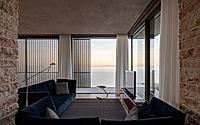
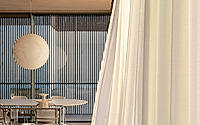
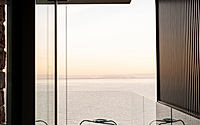
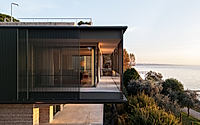
Toward the lake, the house adopts a double frontage that manages sun, privacy, and outlook in a single layered elevation. A deep, openable loggia wraps this side, turning balconies into habitable outdoor rooms where large French windows slide back behind a plane of movable sunshades. These sliding elements regulate light and heat through the day and, when lined up, visually dematerialize the upper volume so the horizon and sky read more strongly than the built edge.
Stone, Water, And Continuity
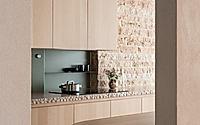
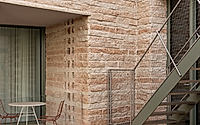
Material choices tie the villa tightly to its immediate landscape, with a neutral, light palette drawn from local stone and the natural shoreline. Lessinia rosata stone clads exterior walls in horizontal bands with a split finish, recalling the striations of nearby rocky hillsides and giving a tactile rhythm to the facades. That same stone continues into interior rooms, letting floors and walls carry the outside in and reducing the jump between terrace, living room, and courtyard. Above, a rooftop solarium and pool crown this stone base, adding a final inhabited plane where water, sun, and view meet.
Filtered Light And Nautical Echoes
Details tune the building to its microclimate and to the vegetal setting of olives and lake vegetation. Sunshades, window frames, and metal elements take on the muted green of olive leaves, so terraces read against a soft, natural tone rather than stark contrast. Guardrails alternate clear glass panels with stainless steel mesh stretched on metal tubes, a direct nod to nautical construction that still keeps long, open views. Around these lean components, wide glass walls and reflective surfaces catch surrounding trees and sky, so architecture edges in and out of sight as one moves along the garden.
As evening light drops behind the hills, the villa settles back into its slope, its pale stone bands holding the last warmth of the day. Terraces, loggias, and pool deck keep residents close to breeze and water while the hillside shelters them from behind. The house reads as one more layer in the terrain, built to register small changes in light, color, and air along the shore.
Photography courtesy of Depaolidefranceschibaldan Architetti
Visit Depaolidefranceschibaldan Architetti