Hotel Castel Badia / Sonnenburg: Adaptive Luxury in an Old Monastery
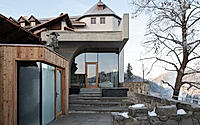
Hotel Castel Badia / Sonnenburg crowns a historic hilltop above Castelbadia, Italy, where null17 Architektur reworks an 11th-century Benedictine monastery into a new five-star hotel. The project retains the ensemble’s layered past while preparing 29 individual rooms, a spa in the former cells, and a herb garden revived from medieval sources. Guests move through a building that carries Roman traces, a 12th-century crypt, and contemporary interventions held in one careful, unified vision.


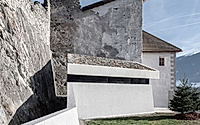
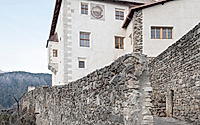
Stone walls catch the mountain light as it shifts across the day, brushing old plaster and newly revealed masonry in quiet alternation. A narrow path climbs from the village toward the former cloister, where the building’s centuries of use are legible in every threshold.
This hotel inhabits a dense historic complex on the heights above Val Badia, transforming an 11th-century Benedictine monastery into a contemporary retreat without freezing it in time. The project is a listed ensemble, restored and further developed under the unified responsibility of null17 Architektur, who oversee both planning and execution. Their work concentrates on how a protected structure can serve a present-day program while keeping its fabric, its traces, and its ritual routes intact.
At its core, the hotel remains a monastery with new habits: 29 individually conceived rooms, a spa, and shared areas occupy the former convent buildings. Historic elements stay in place wherever possible, secured and supplemented rather than replaced, so guests read the timeline in stone, timber, and vault. The design strategy favors uncovering, reinforcement, and careful addition, letting older layers stay visible beside contemporary ones. Authenticity is not treated as a snapshot of one era but as a palimpsest that can carry another chapter.
Reworking A Monastic Plan
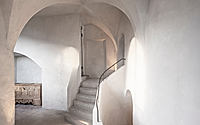
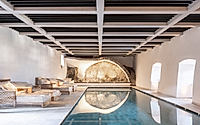
Daily life once organized around cloister, cells, and refectory now underpins a hotel program tuned to movement and rest. Circulation follows existing routes where possible, with stairways, corridors, and portals preserved as the primary armature for guests. Former monastic cells now hold spa rooms, their modest proportions lending calm rather than grandeur, and the quiet sequence of chambers suits contemporary rituals of wellness. Public rooms cluster near historic focal points, so the building’s former communal heart still gathers people even as their activities change.
Layering Past And Present
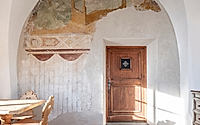
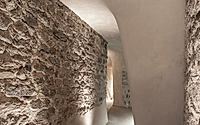
The strategy of uncovering guides every intervention, from stripped-back plaster that reveals stone joints to precise insertions that read as contemporary yet reversible. Historic components are stabilized and continued as clearly legible layers, never camouflaged as new nor erased under uniform finishes. New work steps back from the 12th-century crypt and its monumental Christ figure, allowing that volume to remain a strong, singular presence. Archaeological evidence from Roman times is held within this sequence, so guests move across a timeline that spans nearly two millennia.
Local Craft And Material Logic
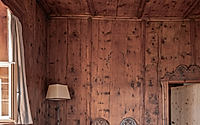
Local materials and traditional craftsmanship tie the renewed complex to its region, reinforcing continuity rather than novelty. Masonry, timber, and finishes draw on familiar techniques so that new walls, floors, and joinery converse quietly with their predecessors. Reversible elements—built to be removed without harm—provide contemporary comfort while respecting the building’s protected status, a practical response to heritage oversight. This approach reduces structural intrusion and keeps the historic shell largely intact, even as it gains insulation, services, and the requirements of a five-star hotel.
Garden And Landscape Memory
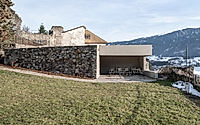
Outside, a herb garden reconstructed from 13th-century sources reconnects the monastery to its agricultural and medicinal past. Planting follows documented species and layouts, so guests encounter a living archive rather than a decorative courtyard. The garden extends the interior narrative into the open air, translating monastic self-sufficiency and care into a contemporary hospitality setting. From this terrace, visitors look back to the stone ensemble and forward across Val Badia, reading how building and landscape have shaped each other over centuries.
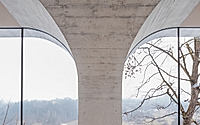
As the hotel prepares to open in December 2025, the complex stands neither as museum nor theme set, but as a working structure with layered memory. Light still enters through deep-set openings that once framed cloister life and now frame arrival, bathing new interventions without erasing old textures. On this hill above the village, past and present hold together in a building that continues to gather people under long-used roofs.
Photography by null17 Architektur
Visit null17 Architektur