Casa in Via Buonarroti: Historic Apartment Reframed in Central Rome
Casa in Via Buonarroti sits inside a historic building in Rome, Italy, where damaSTUDIO works with the apartment’s long memory rather than against it. Barrel vaults, painted ceilings, and hexagonal terracotta floors anchor the renovation, while a clear contemporary attitude refines circulation, daily comfort, and the material palette. The result is a home that reads as one narrative, even as old and new keep their distinct voices.


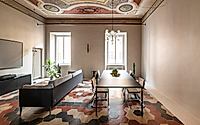
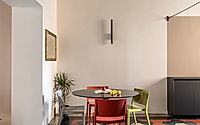
Light catches the tempera-painted ceilings and runs across hexagonal terracotta, drawing the eye from room to room. Under the barrel vaults, new surfaces sit quietly alongside the old, adding use and clarity without noise.
Within this second-floor apartment in a late 19th-century building, damaSTUDIO works on an existing framework rich with decoration and memory. The project restores an almost intact residence and updates it for present-day living, with particular care for color, flooring, and surface character. Throughout, the interior palette guides the renovation: historic elements remain legible, while contemporary insertions bring order, storage, and comfort.
The apartment belongs to a historic block in Rome’s Esquilino district, with a horseshoe-shaped plan that gathers living, sleeping, and service rooms around a central entrance. Rather than erase that structure, the renovation clarifies it through selective openings, re-proportioned service rooms, and reworked finishes that create a consistent visual thread. Materials, tones, and textures carry the story from corridor to kitchen, from bedroom to mezzanine study.
Revealing Existing Character
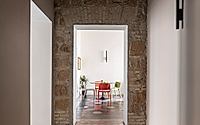
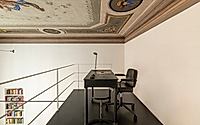
One of the most telling moves happens right at the entrance, where recent plaster is stripped away to uncover the masonry and barrel vault. This gesture sets the tone: the building fabric is not background but an active part of the interior’s narrative, with its texture and depth catching shadow along the corridor. Ceiling paintings regain brightness through careful cleaning and precise color restoration, so their tempera figures and borders reassert presence without overwhelming daily life. Minimal intervention on the historic surfaces keeps their patina, yet the renewed light gives them new clarity.
Terracotta As Continuous Ground
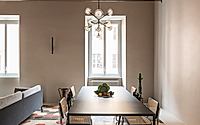
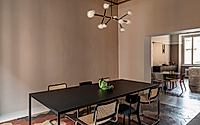
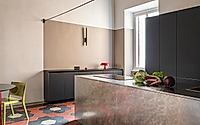
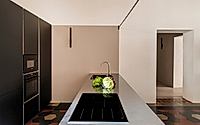
Across the rooms, hexagonal terracotta flooring becomes a quiet but insistent guide underfoot. Its three-tone pattern—terracotta, dove grey, and anthracite—shifts in geometry from one room to the next, while maintaining a cohesive palette that links the apartment. Sanding and waxing revive the tiles rather than replace them, so small irregularities in tone read as part of the house’s history. New elements take their cues from these colors, choosing complementary shades that sit adjacent to the floors with easy rapport.
Balancing Living And Service Rooms
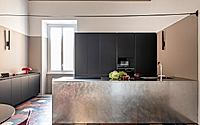
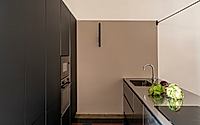
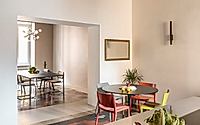
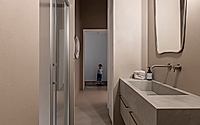
In the living area, a large opening between kitchen and sitting room changes daily rhythms more than it changes walls. The new connection preserves the horseshoe logic while allowing conversation, light, and views to pass between cooking and gathering zones. Service rooms to the other side are reworked with equal care for use and material order: an enlarged bathroom, new ante-bathroom, and laundry find clearer relationships and more practical adjacencies. Finishes in these rooms follow the same restrained palette, so even the most functional corners feel part of one continuous interior.
Bedrooms With Layered Functions
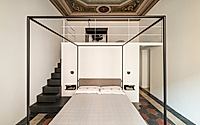
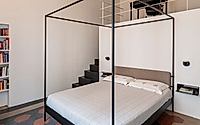
The sleeping area now unfolds as two single bedrooms and a double bedroom, each read clearly along the reconfigured circulation. In the main room, a walk-in wardrobe and mezzanine study use the generous height, inserting contemporary carpentry and structure that sit lightly against the historic shell. Colors and surfaces in these pieces are chosen for compatibility, not mimicry, so new volumes are legible yet calm. The result is a layered interior where storage, work, and rest coexist among vaults, tall doors, and original floors.
Kitchen And Living In Dialogue
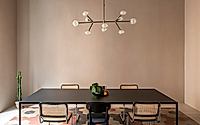
Within the living room and kitchen, the interplay between decoration and new furniture reaches its clearest expression. Historic ceiling paintings and wall details remain central, while a brushed steel peninsula and darker contemporary furnishings bring a cooler, precise counterpoint. These newer pieces adopt strong, simple forms, allowing color and material contrast to do the work rather than ornament. Each room holds multiple layers—floor pattern, ceiling imagery, modern volumes—yet the consistent palette and measured joins keep the composition readable.
By the time one circles back to the entrance, the sequence of surfaces feels continuous, from exposed masonry to polished terracotta to brushed metal. Light runs along restored paintings and across new joinery, binding decades of construction into a single, steady rhythm. The apartment carries its 19th-century origins forward, not by freezing them, but by giving them a contemporary partner in color, texture, and everyday use.
Photography by Vito Corvasce
Visit damaSTUDIO