House of Monitors by Williamson Williamson
House of Monitors sits on the Scarborough, Canada edge as a compact house shaped by light and structure. Designed by Williamson Williamson, the project responds to fragile bluff conditions with a precise mix of concrete shoring and cantilevered wood volumes. Within this tailored envelope, daily life unfolds against controlled daylight, tactile finishes, and a clear reading of how the building is made.


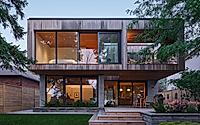
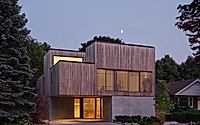
Light slips between concrete shells and a cantilevered wood form, drawing the eye toward the distant lake. On the approach, the house reads as layered construction rather than a single object. Inside, shifting daylight tracks across raw structure, finished carpentry, and the white surfaces of tall monitors.
House of Monitors is a house in Scarborough, Canada by Williamson Williamson that treats construction as both shelter and subject. The project grows from unstable bluff soils, using concrete to shore the escarpment while forming inhabitable rooms and cores. Every move returns to material: how it holds back earth, conducts light, and supports long-term stability.
Building With The Bluff
From the sandy soils of the escarpment, concrete volumes emerge as inhabitable shoring that responds directly to unstable ground. These forms minimize disturbance while turning engineering necessity into the structural and spatial backbone of the house. A restrained footprint sits on the narrow tableland, respecting neighboring houses and the fragile edge condition. Long-term stability replaces visual bravado, giving the structure a measured, grounded presence.
Above the concrete, a wood volume cantilevers toward both street and lake, creating a clear reading of base and body. Intersections and subtractions between these pieces deepen sections, set up cross-views, and shape how sunlight reaches into the plan. What reads as a simple house from the street is, in fact, a calibrated stack of volumes tuned to geology and light. The engineered escarpment below never disappears from the story of the building.
Light Monitors And Volumes
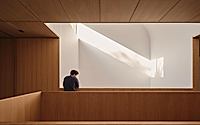
Daylight is gathered, redirected, and cut into the structure through a series of white painted light monitors. These tall elements amplify natural light deep into the interior, reducing dependence on fixtures while establishing a clear hierarchy between raw shell and luminous insert. One central monitor rises 26 feet, creating a vertical volume defined more by daylight than by enclosure. The result is generous without excess floor area, a tall room of changing light rather than a simple double-height void.
A centrally located painting studio sits within this daylight strategy as a finely tuned tool. Developed through iterative studies and virtual simulations, the room carries a north-facing clerestory and a radiused ceiling that spreads light evenly across working surfaces. Here, concrete and wood recede while even, controlled illumination supports the owner’s craft. The studio holds the house’s technical precision in concentrated form.
Concrete Core, Tactile Lining
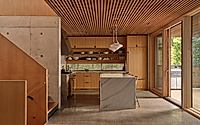
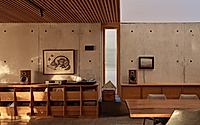
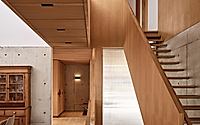
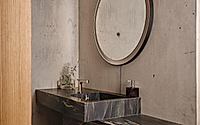
Concrete forms the service core, tying the house back to the bluff as structure, shoring, and thermal mass. Storage and pantry rooms along the street create a thickened service layer that buffers the interior from close neighbors and organizes daily routines. Circulation and primary rooms are wrapped in wood millwork that meets the concrete with a clear, tactile edge. Hard structure and warm lining sit in direct conversation, each sharpening the other.
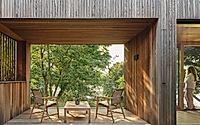
Entry occurs beneath the front cantilever through a reeded glass door that admits daylight while preserving privacy along the tight street. Above, the white monitors catch and scatter light over concrete and wood, registering time and weather across their surfaces. An elemental palette of concrete, wood, glass, and paint is chosen for durability, repairability, and long-term performance. Nothing feels decorative; every material carries structural or environmental work.
Rooms Along The Edge
From the street side, the service band frames movement toward the lake. Dining, kitchen, and living rooms flank the stair and open toward water views, using the concrete base as a steady plinth. Above, bedrooms, an office, and an upper living area share light and outlooks with one another and with the central monitor. Connections run vertically and diagonally, so rooms read as part of a larger carved volume rather than isolated boxes.
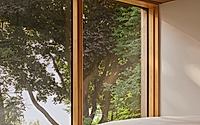
The primary bedroom and deck face the lake, taking advantage of the bluff’s height, while secondary rooms sit behind a slatted façade that manages privacy and sun. Along the street, this screen tempers views in and out, letting residents tune openness to changing use. Across the house, material decisions align with environmental responsibility and site stewardship. Structure does double duty as shoring, as thermal mass, and as the visible frame of daily life.
As the light shifts across the bluff, concrete and wood hold their calm register against the engineered landscape. The house maintains a low profile on the street yet carries a deep, material narrative inside. Over time, the calibrated monitors, cores, and volumes keep revealing how the building is made and how it meets its precarious ground.
Photography by Doublespace Photography
Visit Williamson Williamson