In a Park by L ARCHITECTS
In a Park sits in Singapore, Singapore as a compact home reworked by L ARCHITECTS for a client whose life now orbits around plants. The project transforms an original three-bedroom apartment into a place where horticulture meets everyday routines, using material choices and careful planning to support a growing collection of greenery. It reads as both a renovation and a quiet manifesto on how domestic life can grow alongside living things.


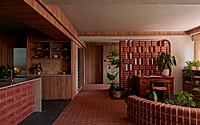
Morning light grazes a low brick curve before it meets glossy leaves and the pale floor beyond. The interior stays calm, while the textures of brick and foliage pull the eye across the rooms in an easy sweep.
This home is a renovation of a three-bedroom apartment in the northeast of Singapore, planned by L ARCHITECTS for a horticulturist whose plant collection outgrew the original layout. The work focuses on reconciling daily living with a deep attachment to gardening, turning the rooms into a kind of domestic park. Material choices, especially an obsolete double-bullnose brick, structure that ambition and give the home its new mood.
The client’s life shifted during the pandemic, when gardening moved from pastime to permanent routine, yet the apartment lagged behind that change. Existing walls and corners restricted where plants could be sited and how they could thrive, and mornings began without visual contact with greenery. The new scheme treats that gap as a brief, reorganizing rooms and surfaces around the idea that plants should not be afterthoughts but part of every day.
Recasting A Park Brick
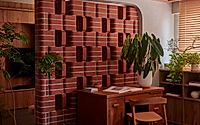
The designers turn to a modest element from older public parks in Singapore: the double-bullnose brick once common in benches, planter edges, and walkways. Production had stopped, and only 571 pieces remained at a local supplier, which sharpened how carefully each unit had to be used. Within the apartment, that quantity becomes a constraint and a guide, directing where mass, curve, and touch points should land. The project doesn’t chase novelty; it draws out the latent character of an ordinary brick brought indoors.
Curved Wall And Shared Bench
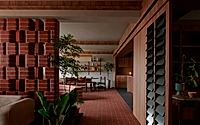
Rounded edges of the double-bullnose brick soften transitions between rooms that once felt rigid. A tessellated freestanding wall now sits between study and living area, filtering views rather than blocking them and giving plants a textured backdrop. Between study and dining, the bricks swell into a curved bench that acts as a shared threshold, with seating accessible from both sides. People can sit, pause, and talk here; plants cluster nearby, so daily movement threads through both greenery and masonry.
Everyday Life With Greenery
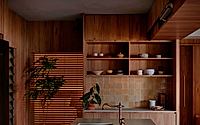
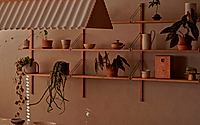
The renovated home is planned so the client can quite literally wake up to plants rather than pass them in circulation. Living, dining, and study zones now read as one open, fluid sequence, with the brick elements guiding how bodies and views move around clusters of foliage. Surfaces and edges double as ledges for pots, while low heights keep leaves in the same visual field as seating and tables. Gardening shifts from weekend activity to an integrated part of morning and evening routines.
Restraint And Material Presence
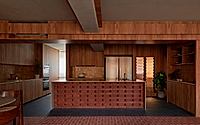
By working with a finite batch of discontinued bricks, the project resists the pull toward high-tech finishes and instead leans on care in proportion and detail. Each run of masonry has to earn its place, whether as partial wall, bench, or edge that guides circulation around planters. The result feels economical yet specific, where a single humble material shapes how rooms are read and used. Restraint allows ordinary elements to hold attention without noise.
As daylight shifts, shadows deepen along the curved brick faces and plant leaves catch glancing reflections. The apartment reads as a compact park framed by walls rather than fences, tuned to everyday rhythms. In this setting, gardening, rest, and work share the same gentle infrastructure of brick and light, proving that modest materials can quietly carry a changed way of living.
Photography by Jovian Lim
Visit L ARCHITECTS