Restoration of a Barn in Mantua
The restoration and redevelopment of a barchessa in Mantua transforms an abandoned agricultural building into a refined and spacious home in Mantua, Italy. Architect Giulia Prandi works with the existing brick structure, adding new steel and wood elements to organize family life while keeping the original rural character intact. The result is a peaceful home environment, where the historic masonry, warm light, and measured contemporary interventions interact harmoniously.


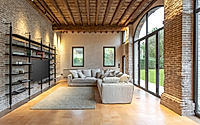
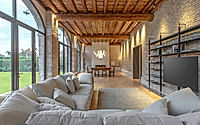
Morning light washes across the long brick arcade, sliding over cotto floors and a linen sofa before spilling toward the garden. Inside, timber beams carry a soft, amber glow that sets the tone for the transformed rural house.
Once a disused agricultural building, the house in Mantova is now a single-family residence shaped by a careful conservative renovation. Giulia Prandi retains the robust brick shell and timber roof, inserting new structural and spatial elements that respect the original proportions. The project leans on adaptive reuse: old walls and columns stay legible, while steel stairs, mezzanines, and crisp openings recalibrate the building for contemporary domestic life.
Reworking The Rural Shell
The long barchessa volume keeps its rhythm of brick piers and large arched openings, now glazed to frame uninterrupted views of the surrounding fields. Inside, laterizio brick remains exposed along key walls, paired with lime-based plaster that softens corners and reflects daylight deep into the rooms. Structural consolidation underpins the entire intervention, yet the visual language remains spare: new steel profiles sit slender against the historic masonry, legible as a contemporary layer rather than camouflage. Thick walls, solid columns, and the timber roof mark the house’s agricultural origin, now tuned toward comfort instead of storage.
Double-Height Heart
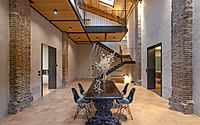
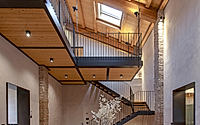
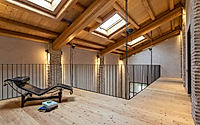
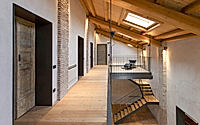
At the core, a tall central hall opens to the roof, with brick pillars flanking a long dining table set on warm cotto flooring. Above, a floating steel stair and gallery in wood and metal thread through the volume, drawing the eye upward to skylights that pour light down the walls. The mezzanine walkway connects bedrooms and a quiet reading niche, its slender balustrades allowing views back to the hall and across to restored timber trusses. This vertical sequence turns what was once empty height into the social heart of the house, binding ground and upper level through movement and sightlines.
Living Along The Arcade
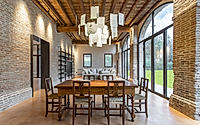
In the former portico, the living and dining areas align with the garden-facing arches, now infilled with tall steel-framed glazing. A large sectional sofa rests against brick and plaster, oriented toward both the view and a lean black metal shelving wall that carries books, objects, and the television. Over the dining table, a sculptural pendant holds sheets of paper-like elements, its glow grazing the brick and adding a light, almost playful counterpoint to the heavy structure. The continuous cotto floor ties salon and arcade together, so the house reads as one extended room opening onto lawn and horizon.
Quiet Rooms Under Timber
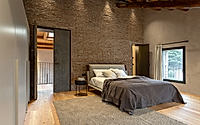
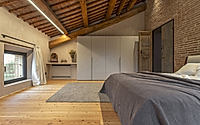
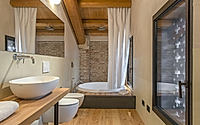
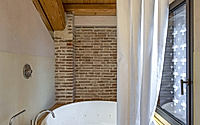
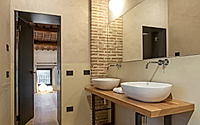
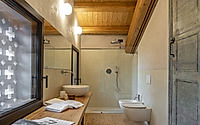
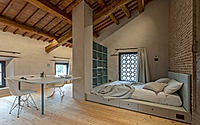
Upstairs, bedrooms and bathrooms sit beneath exposed wooden ceilings, where natural boards and restored beams keep a consistent material calm. In the main bedroom, an exposed brick wall anchors the bed, while wide-plank flooring and a neutral rug temper the room’s verticality. Bathrooms carry the same palette into more intimate proportions, with lime-washed walls, timber countertops on steel frames, and simple white basins placed in a row. Large windows, some screened by brickwork outside, bring in filtered light that slides across the floors and fixtures without glare.
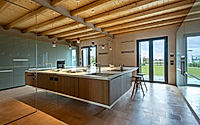
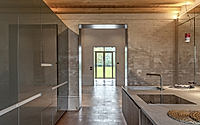
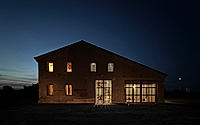
On both levels, the project uses contemporary elements sparingly so the historic structure leads. New doors sit as dark, sharp-edged portals within thick walls, and glass partitions in the kitchen and other rooms maintain generous sightlines. Throughout, the interplay of old masonry, timber, steel, and glass turns a once-abandoned outbuilding into a house attuned to everyday routines. As evening falls and light recedes from the arcade, the warm interior glows against the rural landscape, proof that the barchessa’s next chapter is firmly in use.
Photography courtesy of Giulia Prandi
Visit Giulia Prandi