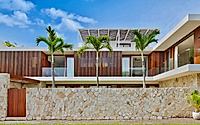
Villa Ivy and Elisa by Riccardo Rubelli
Villa Ivy and Elisa stand in the village of Seseh in Bali, Indonesia, where Riccardo Rubelli draws the house deep into its tropical setting. Two villas share a calm dialogue between masonry, timber, and planted courts, their rooftop terraces tuned to breezes from the nearby beach. Inside, modern volumes and Balinese materials meet in a measured way that keeps the daily rhythm relaxed and quietly precise.


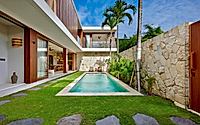
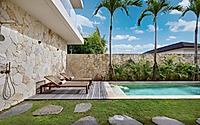
Low stone walls mark the edge of the plot, their rough texture catching the sun as it moves across the gardens and pools. Beyond them, white masonry and teak volumes rise above courtyards planted with tropical greenery, drawing the eye toward the rooftop terraces and the soft line of the sky.
This house project in Seseh, Bali, Indonesia brings together two villas by Riccardo Rubelli, arranged around gardens, pools, and elevated terraces tuned to sea breezes. The composition focuses on how interiors feel and function in a humid climate, using light, airflow, and material warmth to support daily life. Every move links rooms to outdoor courts and terraces so that furniture, finishes, and openings work as one continuous interior landscape.
Balancing Volumes And Gardens
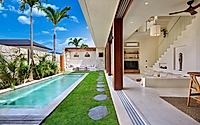
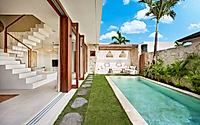
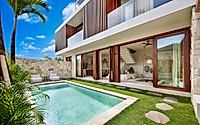
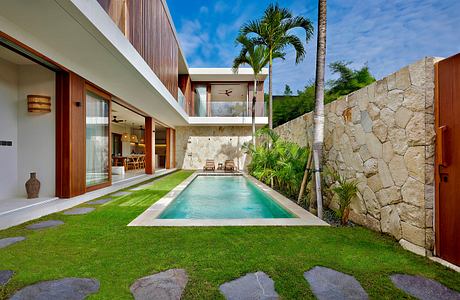
Each villa reads as a teak wood volume held within a crisp white masonry shell, with natural stone walls defining patios along the plot. These stone boundaries carve out gardens and pools that act as outdoor living rooms, shaded by foliage and cooled by water close to the main rooms. Vertical greenery climbs and softens the pure volumes, tempering the tropical sun and giving bedrooms and terraces a calmer outlook. The composition feels both ordered and loose, with planted courts slipping between the built forms.
Opening Rooms To Air And Light
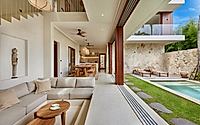
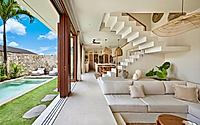
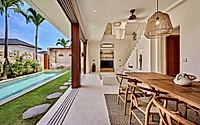
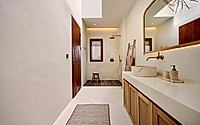
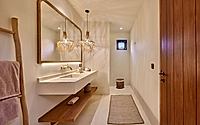
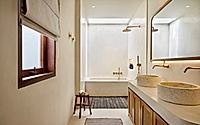
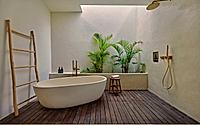
Orientation and cross-ventilation guide the layout, so living areas and bedrooms open wide to capture breezes from the nearby beach. Nearly full-length sliding windows retract along the ground floor, erasing hard boundaries so interior and garden read as a single lived-in zone. Upstairs, skylights bring daylight into bedrooms and bathrooms, softening the polished surfaces below and cutting reliance on artificial light during the day. Rooftop terraces extend this vertical journey, with white metal pergolas and bamboo covers filtering sun into dappled shade.
Teak, Rattan, And Bamboo Layers
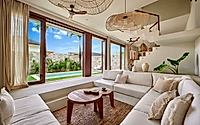
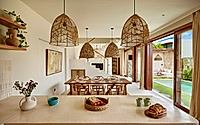
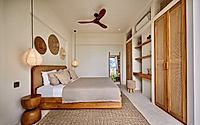
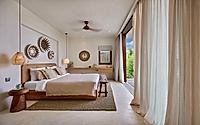
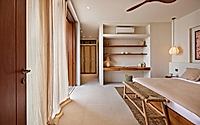
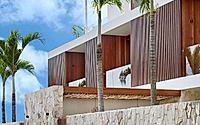
Material choices tie interior character back to the island, using wood, rattan, and bamboo for windows, furniture, lamps, and smaller objects. Teak slats wrap solid parts of the upper volume, hiding service windows for bathrooms and storage while maintaining a continuous vertical rhythm outside. On the terraces, full-height wooden windows slide open from bedrooms, turning thresholds into lived edges where chairs, textiles, and potted plants cluster. Lamps and woven pieces in rattan and bamboo soften the harder masonry, catching light and shadow in a way that feels unmistakably Balinese.
Sculpted Interiors In Terrazzo
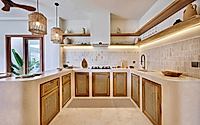
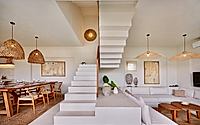
Inside, pure built-in volumes in terrazzo or polished concrete give form to stairs, sofas, kitchens, and wardrobes without relying on excess decoration. These elements read as sculpted blocks emerging from the floor, keeping lines clean so that grainy terrazzo and the sheen of concrete carry most of the visual weight. Freestanding furniture stays restrained in number, which lets textures—teak, rattan, bamboo, and stone—take the lead over color or pattern. The result is a minimalist environment where necessary pieces feel deliberate and nothing distracts from air, light, and the view into gardens.
Daily life plays out between ground-floor living rooms that open to pools and sun decks, and upper levels reserved for bedrooms, skylit bathrooms, and planted rooftop terraces. As the day warms, residents move upward into shaded roofs and deeper gardens, always within sight of timber, stone, and lush planting. By evening, the masonry and wood glow against the darkening foliage, and the interiors return to quiet, measured rooms shaped by their own materials.
Photography by Riccardo Rubelli
Visit Riccardo Rubelli