Cenourão Penthouse — From Urban Rooftop to Verdant Private Retreat
Cenourão Penthouse crowns an emblematic modern tower in São Paulo, Brazil, where architect Orlando Denardi refashions a duplex apartment into a bright, porous home. The renovation leans on Brazilian materials, contemporary furniture, and a new terrace sequence that draws breeze, vegetation, and daylight deep into the rooms. Across two levels, the apartment fuses personal collections, restored structure, and a careful palette, turning a once-segmented plan into a layered domestic landscape.
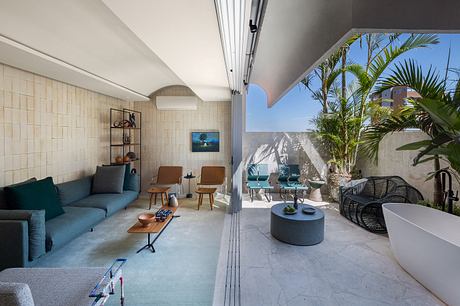
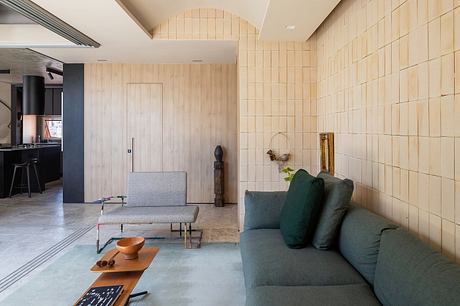
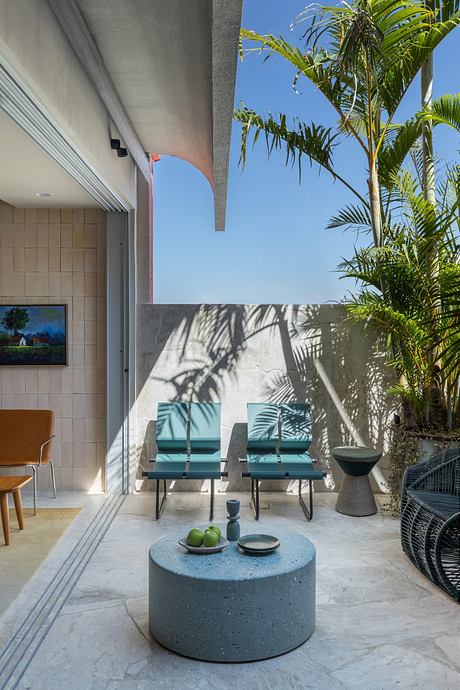
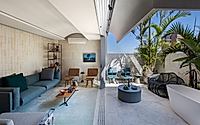
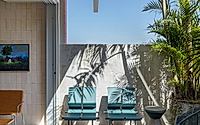
Morning light hits the terrace stone and runs straight into the living room, catching on marble slabs and vertical brick. A palm rises above the parapet, its fronds silhouetted against the São Paulo skyline.
This penthouse apartment in São Paulo, Brazil, reworked by architect Orlando Denardi, turns a split-level duplex into a home organized around light, material, and collected objects. The project occupies a 125-square-meter property in the iconic “Cenourão” tower, where a once-fragmented layout becomes an open sequence linking terrace, living room, kitchen, and upper-level suite. Interior palette and furnishing anchor the transformation, tying original modern concrete to warm stone, wood, and contemporary Brazilian pieces.
Opening The Duplex Core
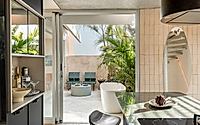
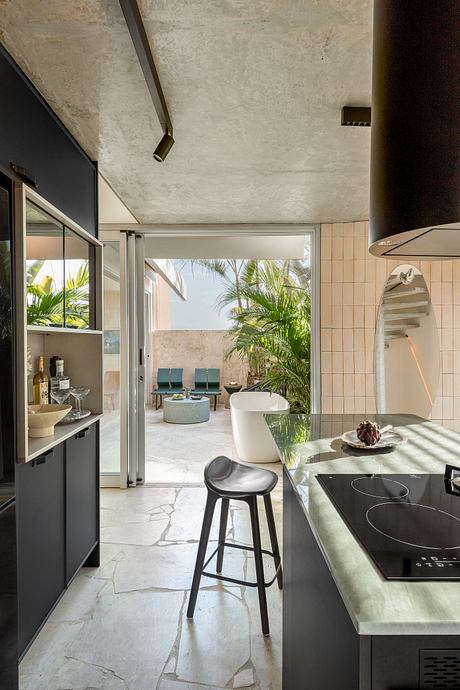
The renovation starts by stripping out diagonal walls and a dated service zone, carving a new living room where circulation once pinched and light stalled. A former wooden deck and elevated concrete pool are removed, allowing the terrace to sit flush with the interior floor. Sliding aluminum and glass frames, now set in tracks embedded in the marble, pull back so living, dining, kitchen, and balcony operate as one continuous field. The linear drain that hides within this threshold keeps the floor level consistent from inside to outside, reinforcing that continuity underfoot.
Half-height masonry barriers at the patio edge make way for full-height openings, giving the eye a clear run across rooms and out to the city. A semi-curved metal eave, sheathed in cementitious panels, extends the tower’s original soft geometry while shielding the frames from summer storms. On dry days the terrace reads as an outdoor room; on wet days, the eave and glazing still permit a wide view and generous daylight.
Marble, Wood, And Adobe Rhythm
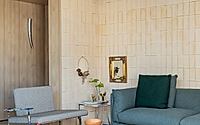
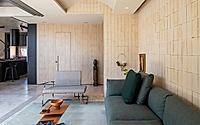
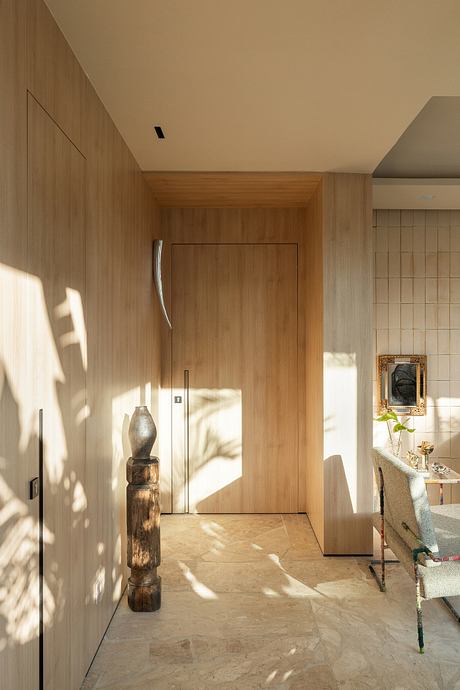
Material continuity is deliberate. Irregular marble slabs with an antiquated finish lay a pale, cool ground that runs from the entry hall out to the terrace. Walls shift between light-toned wood panels and adobe bricks, their vertical joints lining up so grain and bond work in tandem rather than in competition. This trio of surfaces creates a calm backdrop for furniture silhouettes and art, but each texture holds its own under changing daylight.
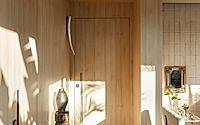
At the entrance, wood clads walls and ceiling, swallowing door leaves into a single volume that reads like a timber portal. A polished aluminum Presa sconce by Estúdio Orth punctuates this plane, its sheen catching the brass of a rustic totem and ceramic vase by Isadora Mourão. The combination sets the tone: industrial finishes in quiet conversation with handmade pieces. Warm color carries through to the living room, where a tapestry’s gradient from green to earth tones guides the palette of upholstery and leather.
Living Room As Gallery
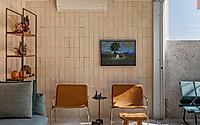
In the main sitting area, the C113 V2 sofa by Marcus Ferreira anchors the plan with deep green fabric that nods to the terrace vegetation. Tobogã armchairs in caramel leather, Sonia benches by Sergio Rodrigues, and a Jequitibá wood coffee table build a low horizontal landscape that lets the brick and wood envelope stay visible. Against the wall, a Wire Frame shelf from Vírgula Ovo carries books and small objects, while a painting by Antônio Soriano adds a layer of family memory.
Opposite, the limited-edition Nós armchair and side table by Luciana Martins and Gerson de Oliveira extend the sculptural mood. Cast-metal objects by Estúdio Orth—Príncipe, Figa, and Cálice—cluster on the side table, their polished surfaces catching fragments of daylight and lamplight. A wall-mounted Elo Energia piece from P.roduto introduces another note of relief and shadow. When the sliding frames open, this living arrangement stretches toward the balcony, encouraging guests to drift between sofa group and outdoor chairs during gatherings.
Kitchen, Dining, And Terrace Life
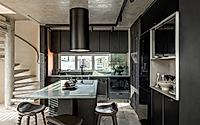
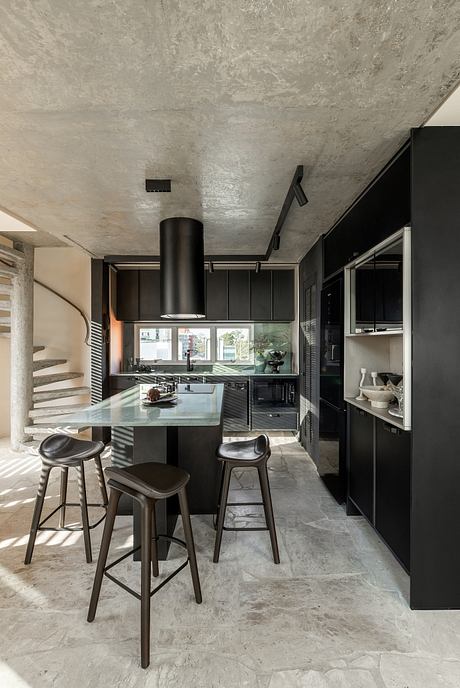
The kitchen restoration peels back old paint to expose the original concrete slab and stair, reconnecting the duplex to its early 1980s structure. Black cabinetry recedes to the background, acting as a quiet container for appliances while a silver-toned portico lightens the quartzite countertop. Emerald Green quartzite, with its soft green ground and gray veining, wraps both island and worktop, echoing the living room tapestry and the palm outside. A low opening in the panel to the laundry room gives the family’s cat, Theo, a discreet passage.
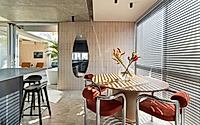
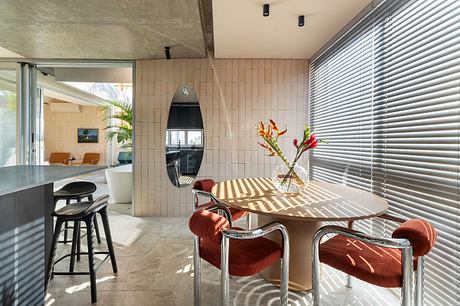
A round dining table in caramel leather by Marcus Ferreira sits near a generous window fitted with a metal blind that filters strong morning and afternoon sun. Chroma chairs by Felipe Protti wrap around the table, their profiles lit by a neon lamp tucked under the stair, sourced from artist Kleber Matheus. Outside, the terrace trades its former pool for a bathtub, easier to maintain and better aligned with everyday use. Stone flooring climbs the boundary walls, framing large ceramic pots where planting stands in for absent garden beds.
A five-meter palm becomes the terrace’s vertical anchor and the first element seen on entering the apartment. Its canopy shades part of the deck, softens views to neighboring towers, and ties the natural tones of stone, leather, and brick back to the idea of an urban garden. Contemporary Brazilian seating—22 armchairs by Paulo Mendes da Rocha with MMBB and the Caçua armchair by Sérgio J. Matos—grounds the terrace as a second living room in the air.
Private Level And Color Memory
Upstairs, a compact family room doubles as TV lounge and workspace, furnished with Vice-Versa chaise longues from Vírgula Ovo that migrated from the couple’s previous home. Objects gathered on travels rest on a side table, while a suspended sculpture above the stair and a painting by Marcos Varanda pull the eye upward. Even here, the material story continues, with soft textures and earthy tones echoing those below.
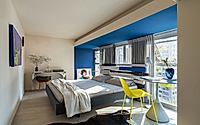
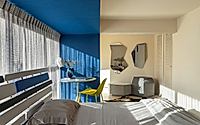
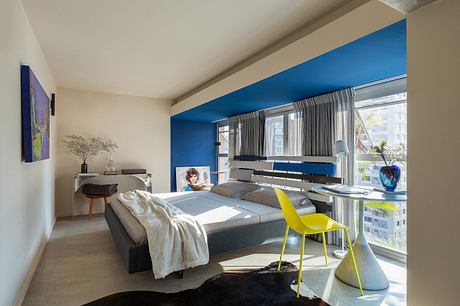
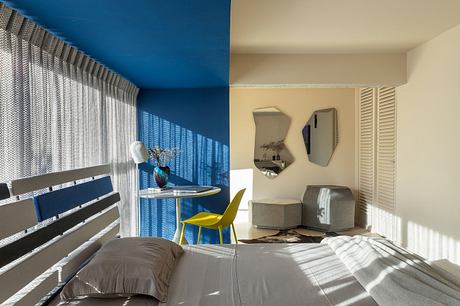
The suite occupies what was once an attic volume, its lower ceiling driving a different kind of composition. Beams near the windows hide behind a new drywall band, which integrates indirect lighting for a gentler nighttime glow. To carry forward a beloved color from their earlier apartment, the couple wraps the bedroom portico in Klein Blue, a vivid frame around more neutral surfaces. The Tiras bed by Luciana Martins and Gerson de Oliveira, with linear upholstered panels in gray and blue, sits low to suit the height and brings a museum-recognized Brazilian piece into everyday use.
In the half-bath, brick walls, stone flooring, and a suspended Travertino Silver marble countertop condense the material palette into a smaller volume. Rino Rosto mirror, Argola hanger, and Sino sconce—again by Estúdio Orth—balance stone and brick with polished metal accents. Every room folds furniture, light, and texture into a coherent narrative that holds from entry hall to rooftop bathtub.
By the time evening settles over Pinheiros, interior lamps pick up where daylight leaves off, grazing curved ceilings and brick relief. The palm sways above the terrace edge, its profile now a shadow against the lit apartments beyond. Inside, marble, wood, adobe, and Brazilian pieces keep the duplex grounded, turning a once-generic penthouse into a home tuned to material memory and daily ritual.
Photography courtesy of Orlando Denardi
Visit Orlando Denardi