Résidence Saint-Damien by Anne Carrier Architecture
Résidence Saint-Damien places a contemporary house along the river in Saint-Damien, Québec, Canada, by Anne Carrier Architecture. The project stretches between farmland and mountain, shaping a linear rural dwelling for a large family that follows the contours of the land and the forest canopy. Across its length, the house manages the shift from field to treeline with a calm, deliberate architectural rhythm.


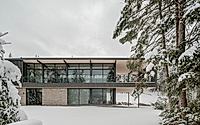
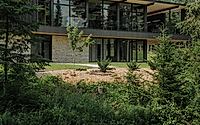
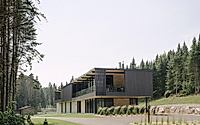
Soft light slips through tall conifers as the house comes into view, its long volume running just above the ground. Stone, wood, and glass track the river’s edge while the forest gathers closely around.
This is a house for a large family, set on their farmland in Saint-Damien, Québec, Canada, and conceived by Anne Carrier Architecture as a precise response to site and climate. The real estate type is straightforward—a house—but its layout and material presence follow the land’s topography, the river’s bends, and the existing vegetation in detail. Context drives every move, from the hovering upper level to the covered terrace that draws daily life out toward fields and water.
River Edge Approach
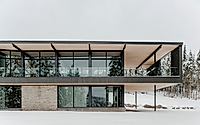
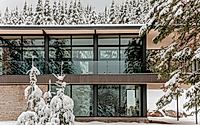
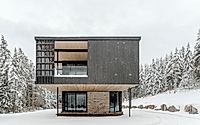
Arrival happens through mature conifers, where the volume sits quietly within the forest framework. The natural stone base meets the ground, while the upper level in vertical wood cladding takes on the tone and rhythm of bark. From this angle, mass and landscape read together, with the darker base deepening the sense that the wooden upper band hovers just above the terrain. The approach sequence keeps the river close but partially veiled, delaying the full view until one moves deeper into the house.
Terrace Along Fields
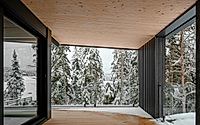
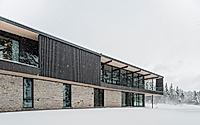
A covered terrace runs as a clear axis in the landscape, aligned with the bridge that spans the river. Vertical slats line this outdoor room, their rhythm echoing the volumetric breaks of the house while filtering light throughout the day. The terrace links the two ends of the linear volume and sets up a continuous relationship with the main façade facing water and fields. Moving along it, family members stay close to the river’s sound and the open farmland, even when they remain under cover.
Living Level With Views
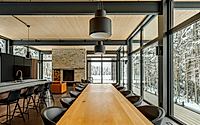
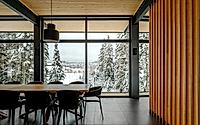
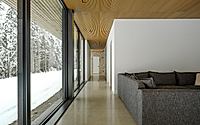
Fragmentation of the long bar creates a central joint that holds the entrance and stair. That hinge marks the shift between day and night areas, so circulation naturally clarifies family routines. Living rooms sit on the upper floor, elevated to capture unobstructed views of river, fields, and mountain while pulling in generous natural light. From here the landscape reads as a broad continuous band, yet the articulated plan still shelters more intimate corners for quieter moments.
Materials Rooted In Landscape
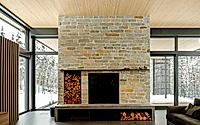
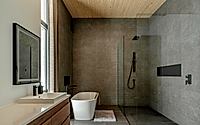
Stone, wood, and steel set a calm, durable palette, used both structurally and as cladding to establish continuity inside and out. Wood decking with high load-bearing capacity allows for a slender structural profile, which in turn lets the roofline shift to address specific views and sun angles. Below, a continuous clerestory glazing band wraps the perimeter, maintaining a constant line of sky and treetops and sharpening the impression of a roof plane floating above the living areas. Material choice and assembly reinforce the reading of the house as grounded in its territory yet visually light toward the forest canopy.
In daily use, the family moves between river edge, terrace, and elevated rooms with a steady awareness of light, weather, and seasonal change. Paths trace the sinuous course of the water while rooms hold more protective pockets facing the trees. By aligning siting strategy, careful volumetric breaks, and a palette tuned to bark, stone, and earth, the house feels firmly tied to its landscape. Over time, shifting patterns of use and evolving family needs play out against this stable frame of field, forest, and river.
Photography by Paul Dussault
Visit Anne Carrier Architecture