House on the Edge of the Plain by Skupaj Arhitekti
House on the Edge of the Plain sits at the soft edge of Murska Sobota, Slovenia, where suburban plots meet the long horizon of the Pannonian plain. Skupaj Arhitekti use a spare, low house to translate that threshold condition into architecture, pairing exposed concrete with loose gravel and generous glazing. The result is a calm, minimalist house that reads as part landscape, part dwelling.


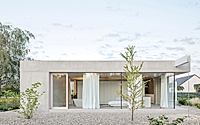
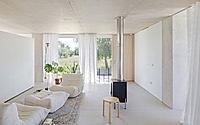
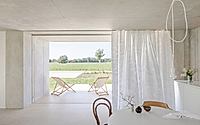
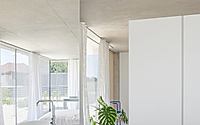
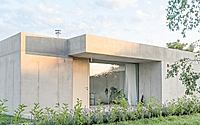
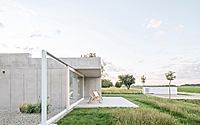
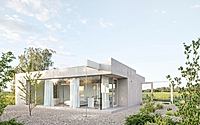
A low concrete volume rests in a field of pale gravel, its glass walls drawing long reflections of the sky and the distant tree line. Inside, daylight washes across white curtains, soft seating, and a smooth concrete ceiling, while the horizon stays present through wide panes.
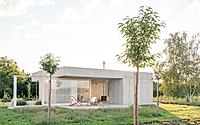
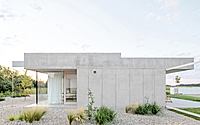
This single-story house at the fringe of Murska Sobota translates the flat Pannonian plain into a horizontal, concrete dwelling. Skupaj Arhitekti root the house in exposed concrete mixed with aggregate from the nearby Mura river, tying construction directly to geology and memory. Material logic drives the project: structure, enclosure, and finish converge so that the house reads as condensed terrain rather than an object added to it.
Casting The Plain
From the garden, the building reads as a quiet bar of concrete laid parallel to the horizon, broken only by deep openings. Gravel gathered from Mura river deposits blankets the ground plane, softening the meeting of wall and soil while echoing the aggregate locked inside the concrete frame. Slender trees and grasses punctuate this stony surface, so planting grows out of the same granular field that defines the house. Concrete becomes both perimeter and datum, expressing the functional order of the plan while staying level with the surrounding suburban roofs.
Concrete As Interior Shell
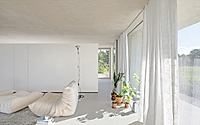
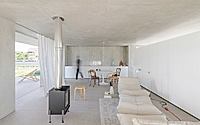
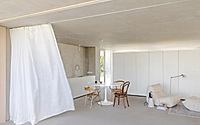
Stepping inside, the structure remains fully legible; walls, ceiling, and floor register as a continuous concrete shell with fine aggregate visible in the surface. White built-in cabinetry lines one side, sliding away visually so the load-bearing frame can read without interruption. A freestanding metal stove rises from the floor, its flue cutting a crisp vertical against the horizontal slab, underlining the tectonic clarity of the room. Furniture stays low and soft, so bodies rest against a backdrop of raw material rather than decorative finish.
Gravel Thresholds And Glazing
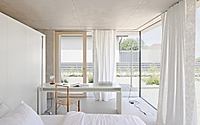
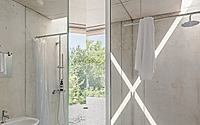
Large glass panes slide open onto shallow terraces, where the interior floor passes almost flush into gravel and grass. This thin threshold allows bare feet to move from concrete to stone to meadow in a single step, reinforcing the sense that the house condenses the plain rather than interrupting it. Light curtains hang within the depth of the openings, sometimes pulled across as a soft layer between glass and room. When wind moves them, the rigid frame and loose textile read together as two registers of enclosure.
Rooms Within A Rational Frame
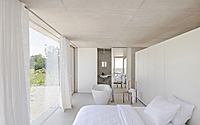
Inside, the plan follows a simple functional sequence, yet the continuous concrete envelope keeps each room tied to the same structural rhythm. Living, cooking, and eating share one long volume, with subtle shifts in furnishings rather than solid partitions marking use. The bedroom extends this logic: bed, freestanding tub, and a desk align along the glazing so daily routines stay close to the open field outside. Storage and services compress into planar elements, allowing the structural grid and material palette to remain the primary spatial cues.
As evening light drops, the concrete reads warmer, holding the imprint of the day across its fine-grained surface. Curtains glow against the dusk, and the gravel field returns to shadow while the house continues the line of the plain. Material, structure, and ground stay tightly bound, so the dwelling feels less like an object on the edge and more like a precise thickening of the landscape itself.
Photography by Ana Skobe
Visit Skupaj Arhitekti