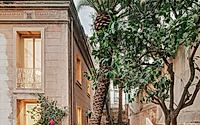
Villa Parque by h3o architects
Villa Parque recasts a late-19th-century house in Barcelona, Spain as a contemporary family home by h3o architects. The renovation treats the detached house as a place to reconnect with neighborhood roots while opening it to light, garden, and shared daily life. Across two primary levels and a deep rear garden, the project balances generous proportions with an intimate, enveloping atmosphere tailored to a couple beginning a new chapter.


Morning light reaches deep into the old house, washing the whitewashed vaults and catching on dark wood and black leather. Below, bedrooms open directly to planted ground while above, family life gathers around the kitchen and an expanded balcony that looks out to the garden.
Villa Parque is a detached house reimagined as a contemporary family home in Barcelona, Spain by h3o architects. The project works with a late-19th-century structure, turning a once-closed volume into a brighter, more permeable house that aligns daily routines with garden and park. Plan and sequence drive the transformation, organizing three intertwined realms: social rooms above, private rooms below, and a secluded rear garden that threads them together.
Inside, a couple returning to their childhood neighborhood finds a house calibrated for shared life while still holding traces of memory. Living areas cluster on the upper floor, raised above the garden yet always oriented toward it, while the lower level gathers quiet rooms in closer contact with soil and shade.
Stacking Daily Life
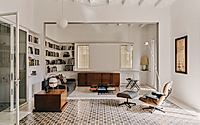
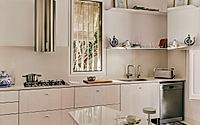
The house organizes activity vertically, treating the upper floor as the social hinge and the lower level as a sheltered retreat. From street level, visitors step directly into the elevated upper floor, where kitchen, foyer, living room, and dining room share one generous, light-filled volume. High ceilings and the long sweep of the traditional barrel-vaulted brick ceiling trace movement from arrival to the balcony edge. Downstairs, a semi-basement level collects bedrooms and resting areas, where a quieter atmosphere supports slower routines.
Binding House And Garden
At the back, the garden reads as a continuation of the neighboring urban park rather than a private leftover yard. New openings on both levels turn the house toward this green depth, increasing visual permeability and drawing the eye out from social rooms and bedrooms alike. An exterior stair drops from the widened balcony to the garden, so movement from kitchen to lawn becomes a simple, direct gesture. That balcony also acts as a lookout, catching breezes above the plantings and extending daily life outdoors.
Shaping Two Realms Within
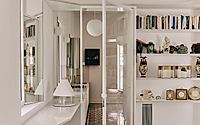
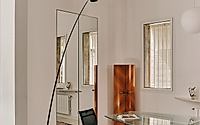
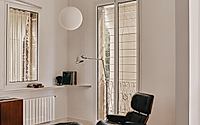
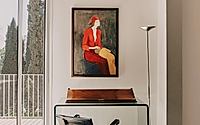
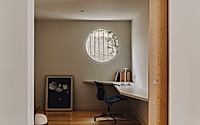
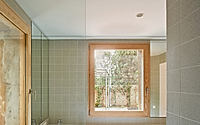
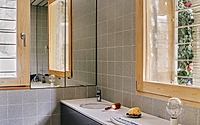
The upper level leans into brightness and clarity, using exposed volta catalana ceilings that are whitewashed to amplify daylight across the room. Dark wood cabinetry, black leather pieces, and patterned hydraulic tiles mark a sequence of zones without closing them off, and mirrors along certain walls pull garden reflections deep inside. Below, wooden floors and finishes in gentle beige and sea green tones create a more introspective realm, where contact with the ground and garden edges supports rest. Together, these two interiors form a legible rhythm: social above, contemplative below.
Guiding Movement In Color
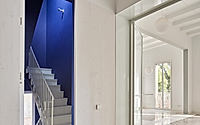
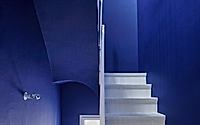
A vivid Klein blue staircase recasts an existing connection as a spatial event rather than a neutral link between floors. The stair rises as a chromatic anchor at the center of the plan, making everyday circulation a clear, memorable path from quiet rooms to shared life and out toward the balcony. Zigzag geometry, a signature of the studio, reinforces that movement in subtler ways, surfacing in garden paths, the fountain, the balcony’s oblique pillar, and built-in kitchen and shelving elements inside. That repeated geometry stitches together the different levels and uses into one recognizable sequence.
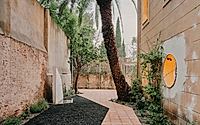
Outside, boundary walls stripped back to original stone carry a metal mesh for climbing plants, so enclosure will slowly soften under layers of shade. Existing vegetation mixes with low-irrigation Mediterranean plantings, while rainwater from the insulated and thermally conditioned roof irrigates the garden. As the house settles into its renewed life, light, movement, and planting work together, giving daily routines a clear, grounded route from street to rooms to park-edge garden.
Photography by Claudia Mauriño
Visit h3o architects