Kokako Heights House On a Wild Bluff Facing Whale Island in Matatā
Kokako Heights House sits above Matatā, New Zealand, with a clear view to the coast and native bush. Designed by Arkhē in 2024, the house reads as a modest, site-led composition focused on light, breeze, and careful orientation. This compact house places rooms along the land’s edges and pulls the living areas toward the view, trading excess for clarity and durable, low-energy comfort.


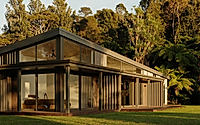
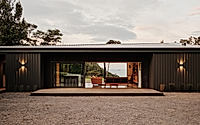
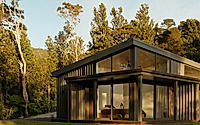
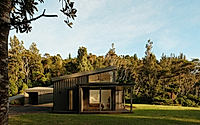
Morning light thins across the northern verandah, catching the grain of dark cedar. A folded roof lifts toward the east, where a glazed corner and clerestory draw sun deep into the rooms.
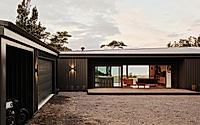
This house is a compact coastal dwelling in Matatā by Arkhē, set for conservation-minded clients who asked for shelter, restraint, and direct contact with the site. The plan tracks the land’s edges and privileges outlook and climate response, letting orientation, shading, and ventilation do the heavy lifting.
Site-Led Placement
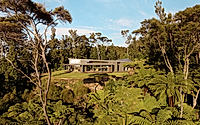
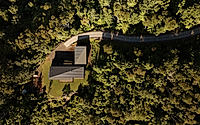
Volumes line the western and northern boundaries to simplify access and guard the heart of the site. The main dwelling holds the northern edge for uninterrupted views to the ocean and Whale Island, while a separate shed follows the ground’s rise. Movement stays straightforward: arrival from the west, then a gentle turn toward light, view, and the lee of the bush.
Roof Meets Sun
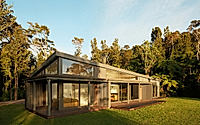
A distinctive folded roof steps up toward the east to capture morning sun and sky. At the high point, a fully glazed corner and a raking clerestory bring controlled brightness across the day—balanced by a verandah that checks summer glare along the northern elevation. The shed roof mirrors the terrain, lifting toward the western bank and keeping the compound low against the bushline.
Rooms to Outlooks
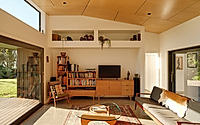
The plan keys each room to a specific outlook and light condition. To the east, the main bedroom benefits from the roof apex and a tall volume washed with early light, while guest rooms on the opposite end face native bush and a quieter microclimate. Between them, an open-plan living area runs wide with full-width sliders and a clerestory, so the coastal horizon and inland green read as equal protagonists.
Material, Shade, Thermal
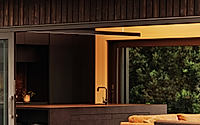
Cladding works in two registers: charred and brushed Japanese cedar brings tactility where hands meet walls, while robust metal siding recedes into the surrounding greens. Inside, moody dark tones ground the rooms, and a golden birch plywood ceiling tracks the roof’s rake, warming the light with a soft reflective glow. A concrete floor acts as thermal mass; the verandah blocks high summer angles yet lets winter sun in to charge the slab.
Passive Systems at Work
Heating stays lean with a highly efficient in-slab system as the sole active source. High-performance glass wool insulation and low-emission double glazing reduce losses, while generous windows, sliding stackers, and ceiling fans set up cross-breezes during warm months. The result is low operational energy with comfort dialed to the seasons (and no fussing with complicated kit).
Late sun brushes the cedar as shadows extend along the verandah and into the bush edge. The view holds steady, the rooms breathe, and the compact footprint keeps the land’s presence at the fore.
Photography courtesy of Arkhē
Visit Arkhē