Claustro House by Espiral Arquitectos
Claustro House anchors a hill town in Zapallar, Chile, with a clear, almost classical idea reworked for family life. Espiral Arquitectos centers the house on a cloistered courtyard, drawing movement inwards and light from above, while a two-level plan separates social rhythms from retreat. A private exterior and a porous core create a deliberate contrast that suits the coastal setting and a multigenerational routine.


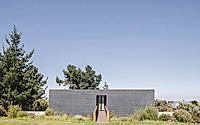
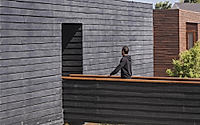
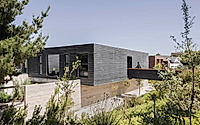
A low, private volume meets the street with a dark, guarded face. Step across a bridge and the house opens to a bright, central court that pulls the eye inward and upward.
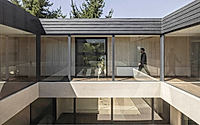
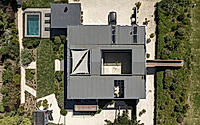
This is a house, yet it’s arranged like a cloister: a square plan, an interior perimeter of movement, and rooms grouped around a void that brings daylight from above. In Zapallar, Espiral Arquitectos uses the courtyard to organize daily life and calibrate the relationship between exposure and retreat, making circulation the quiet engine of the home.
Enter Over A Bridge
Arrival happens slightly above street level, where a bridge spans to the main floor and marks a threshold from public realm to inner world. The lift in level grants the social rooms, the master suite, and a guest room a privileged vantage, catching the sea beyond while holding privacy from the street. That small act—ascending—sets the tone and cues the internal loop that traces the courtyard’s edge.
Square Plan, Clear Circulation
The plan is a disciplined square, its perimeter thickened into a gallery that links rooms without crossing the court. Corners bend activity back toward the center, so daily paths skim glass and void rather than exterior walls, keeping the outside façade intentionally quiet. Transparency aims inward; the house turns translucent toward its heart and hermetic toward the street, which steadies the atmosphere and reduces distraction.
Two Levels, One Core
Program stacks by use and climate, with the upper level handling gatherings and hosting while the lower, more protected tier holds the remaining bedrooms. This arrangement trims maintenance and heating when only part of the home is in use, letting the family live compactly or expand for guests without losing coherence. Both tiers still read as one: the courtyard stitches them together, its vertical openness and central light tying movement and sightlines across floors.
Light Managed From Above
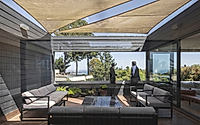
Inside, daylight is controlled rather than diffuse, dropping in as zenithal light through the large internal court. That measured exposure keeps rooms neutral, luminous, and warm, while outer walls stay solid to temper glare and wind. The contrast between dark, private exterior surfaces and a bright, inward core gives each room a steady clarity (and an easy orientation) throughout the day.
Growth Without Drift
The project anticipates change through phased planning, designed to expand surface area over time without losing its massing or identity. That strategy protects the square’s composure and the court’s proportion, so future adjustments don’t unravel the plan’s logic or its measured sequence.
By dusk, the courtyard glows while the street face stays quiet. Movement slides the inner perimeter, light softens on the floors, and the square holds. The house breathes inward—calm, legible, and ready for the next turn of daily life.
Photography courtesy of Espiral Arquitectos
Visit Espiral Arquitectos