Masseria San Lorenzo: Restored Farmhouse
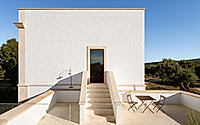
Masseria San Lorenzo anchors a 19th-century farmstead on the outskirts of Ostuni, Italy, brought back to life by studio Flore & Venezia. The project restores a rural complex of stone volumes among ancient olive trees, reworking its rooms for contemporary comfort while holding tight to the building’s agricultural past. Every move is calibrated, from the revived facades to the reorganized interiors, so daily life flows easily between the house and the surrounding land.


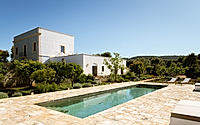
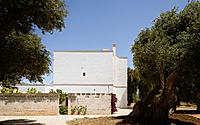
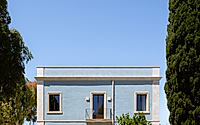
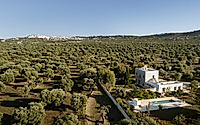
Approaching through the olive trees, the masseria comes into view as a pale volume against deep green foliage, its stone walls marked by time. Light spills through new openings onto old masonry, so the first impression is of a building that carries its age yet accommodates a calmer, contemporary rhythm.
This rural residence stands on a former working farm outside Ostuni, carefully reworked by Flore & Venezia in 2025. The intervention restores a 19th-century complex of main house and former storage rooms, treating them as a single organism rather than scattered outbuildings. Attention stays on recovering existing fabric and adjusting the plan so old structures serve present-day living without losing their agricultural character.
Inside, the project concentrates on connection: tying together once-disparate rooms, aligning circulation, and allowing visual links between interior and countryside. Outside, courtyards, garden, and pool extend everyday patterns into the open air, so the building engages constantly with its fields and trees.
Reworking The Farmstead
The main house originally rose over two levels with a string of ground-floor storage rooms tacked on, each with its own entrance and use. Flore & Venezia introduce a calibrated extension that fuses these pieces into a continuous domestic sequence, a measured connector rather than a showy graft. This move restores coherence to the plan, letting residents move from one wing to another without leaving the shelter of the thick stone shell.
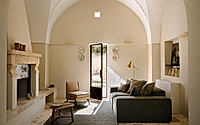
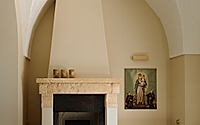
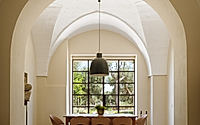
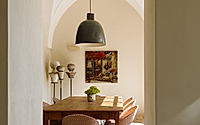
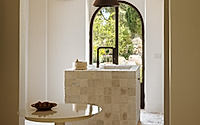
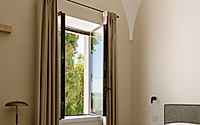
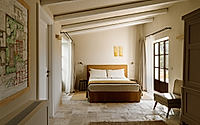
Local stone remains the structural backbone, reading as massive load-bearing walls and cross-vaulted ceilings with visible age in every joint. Surfaces carry deep texture, so restored plaster and exposed masonry catch shadows as much as sun. On the ground floor, original chianche paving returns underfoot, its limestone slabs smoothing toward thresholds and anchoring the rooms in their rural origins.
Living Rooms In Stone
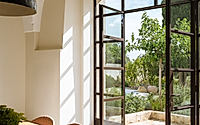
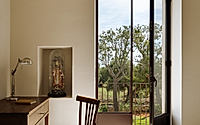
The principal living area opens toward the countryside through a large glass wall that frames olive trees and sky. Daylight reaches deep into the vaulted rooms, tracing arcs across the stone and drawing out subtle color shifts in the chianche floor. Within this volume, sitting and dining zones share the same robust envelope, so daily routines play out under the same historic curves once used for farm work.
The kitchen occupies two adjoining rooms, keeping a modest scale even as it serves contemporary needs. Intimate proportions and natural materials preserve a domestic, rural tone rather than slipping into a purely ornamental setting. Cooking, gathering, and passing through all remain close to the original thickness of the walls, which still regulate temperature and sound between inside and outside.
Sleeping Wings And Terraces
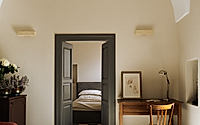
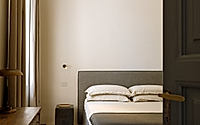
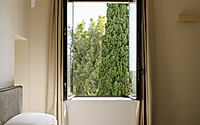
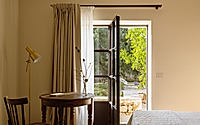
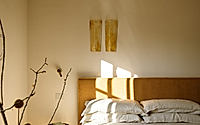
On the ground floor, two independent bedrooms sit with their own bathrooms and direct access to the garden. Each room touches the landscape as much as the interior, so waking, washing, and stepping out become one continuous gesture. Privacy grows from the original layout, now sharpened by new openings and careful positioning of doors.
A preserved stone stair climbs to the upper level, kept as a working relic of the first construction. At the landing, a bright sitting room centers the floor, with circulation radiating to two further en-suite bedrooms. The master room opens to a panoramic terrace with a small hydromassage pool, a contained outdoor room where water, stone, and view come together in quiet alignment.
Tiles, Courtyards, And Garden Rooms
New cement tiles with floral patterns lay across the first-floor living area, intentionally engaging the period cementine preserved in the bedrooms. Old and new motifs share the same scale and chromatic weight, so the floor reads as one continuous surface rather than an abrupt collage. This restrained overlay allows decoration to signal time, turning circulation routes into a subtle narrative of past and present.
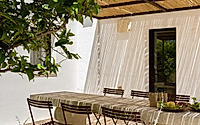
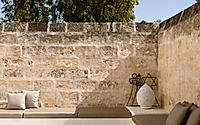
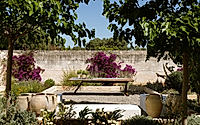
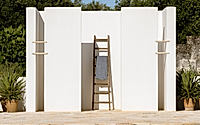
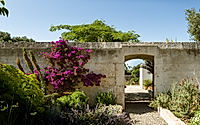
Outside, the composition divides into two courtyards and a larger garden threaded with monumental olive trees. The front courtyard forms an outdoor living room with built-in seating and a river-stone ground plane framed by blocks of ancient tufo, bringing tactile contrast underfoot. Behind the house, a more secluded courtyard functions almost as a green salon, with a citrus grove casting dappled shade over a long stone table set for open-air meals.
In the wider garden, a swimming pool sits with an ample sunbathing area and discreet outdoor showers integrated into the planting. Water, stone, and trees share a loose geometry, so the pool reads as part of the agricultural landscape rather than a detached amenity.
Color And Memory On The Facade
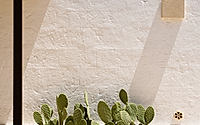
A stratigraphic study of the main facade reveals traces of a soft sky-blue pigment under layers of later paint. That discovery shapes the exterior’s renewed identity, with the gentle hue reinstated to recall earlier decades without resorting to pastiche. The color sharpens the masseria against the vegetation, restoring luminosity while keeping the architecture firmly rooted in local memory.
By the time the day cools and shadows lengthen across the chianche, the house reads as both shelter and record. New comforts sit within old walls without pretense, inviting use rather than spectacle. Masseria San Lorenzo stands as a rural residence where continuity, not contrast, guides change.
Photography by Carlo Oriente
Visit Flore & Venezia