Riviera Apartment by Marina Salles
Riviera Apartment sits above the beach in Bertioga, Brazil, where Marina Salles shapes a coastal home around soft light, sand tones, and unbroken sea views. This apartment unfolds as a relaxed retreat, balancing Brazilian authenticity with a gentle Mediterranean mood for a couple who wanted comfort and practicality without losing the warmth of a lived-in seaside address.


Morning light pours across the water and reaches straight through the glass, sliding over sand-toned porcelain and pale walls until it settles on the warm grain of wood. Inside the 250-square-meter (2,691-square-foot) apartment, every surface responds to this glow, trading loud color for texture and a spectrum of whites and beiges.
Riviera Apartment is a seaside retreat in Bertioga, on São Paulo’s northern coastline, conceived by architect and interior designer Marina Salles for a couple seeking calm, practicality, and ease. This is an apartment, but the layout and material palette echo a beach house, bringing the serenity of sea and sand indoors through light, color, and tactility.
From the social rooms to the bedrooms, the project leans on a restrained palette: sand-toned porcelain, white structure, and layered woods that shift from slatted ceilings to woven fibers and cane. The throughline is the interior composition itself, where furniture, finishes, and crafted pieces bring Brazilian authenticity together with a sunlit, understated Mediterranean atmosphere.
Opening Living To Horizon
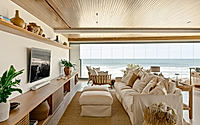
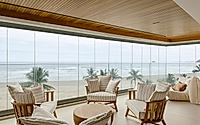
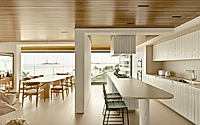
The irregular floor plan and diagonals of the building give the apartment two long glass façades, one for the social area and one for the bedrooms, both directed toward the sea. An existing balcony once sat as a buffer in front of the living room; its framing is removed, the floor is leveled, and interior and exterior merge into a single visual plane. Structural beams and columns stay exposed, but they are painted white, allowing their rhythm to read against a wooden slatted ceiling without adding weight.
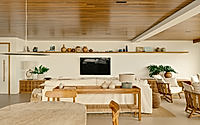
Across the social zone, sand-toned porcelain tile recalls the beach while standing up to sea air and sandy feet. The continuous floor underlines the apartment’s fluid character, with furniture placement rather than walls defining where living, dining, and kitchen begin and end. From the primary sofa arrangement, a 180-degree panorama opens to crystalline water, horizon line, and a distant island.
Composing The Social Room
Near the entrance, the TV area leans into low, linear elements that keep the view clear. A long cabinet with wooden lattice fronts runs along the wall, its sliding doors hiding or revealing equipment as needed. Above, a matching shelf stretches the same length and provides a quiet stage for books, objects, and artisanal pieces from nearby makers, tying personal memory to local craft.
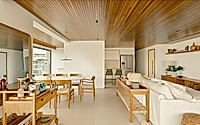
The main seating composition follows the apartment’s palette of quiet warmth. A sofa in natural cotton twill, with removable covers ready for coastal maintenance, anchors the arrangement with striped and woven cushions that underscore its casual character. Poufs sit close at hand for feet or extra guests, resting on a synthetic weave rug that adds another subtle layer of texture underfoot. Behind the sofa, a console in wood and tucum fiber, designed by Marina Salles, carries decorative objects and links the living zone to the open kitchen.
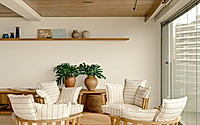
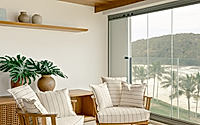
Closer to the glass, four wooden armchairs echo the striped waterproof canvas of the sofa, repeating the maritime rhythm without using literal nautical motifs. At the center, a solid wood coffee table grounds the group, its volume and grain reinforcing the apartment’s organic, tactile energy. By the window, a single armchair in soft beige, requested by the resident, is placed as a contemplative point directed solely at the horizon.
Kitchen As Social Core
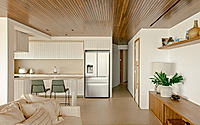
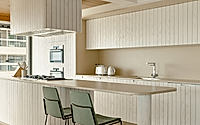
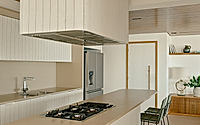
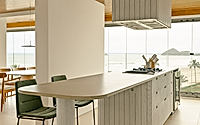
The kitchen extends from the living area without a visual break, relying on an island to create both focus and flow. This island is treated as a continuous volume, almost a box around the cooktop, with a sand-toned stone top that stretches and wraps, part of it resting on a circular vertical support. The base is finished with white-stained wooden slats that reveal the grain, reading like a natural patina rather than a flat surface.
Clip stools by Fernando Jaeger line one side of the island, turning cooking into a social act and encouraging conversation between the person at the cooktop and those seated nearby. Behind, cabinets and counters repeat the same combination of patinated wood and sand-colored stone, with a generous central niche framed in stone marking the main preparation zone. Where a barbecue once stood, the oven tower and refrigerator now slot into place, freeing the room from clutter and keeping the material sequence intact.
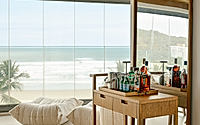
Between living and kitchen, a structural column becomes part of the composition rather than an obstacle. One is painted white and treated as a calm pivot between zones; another receives a wood-framed mirror and a bar trolley designed by the architect for her MS Design line, turning a technical necessity into an everyday ritual corner.
Dining Beside The Glass
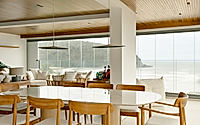
The dining area sits directly by the large window facing the sea, allowing meals to share the same horizon as the living seating. A wooden table topped with glossy Taj Mahal stone catches and reflects the light, throwing subtle reflections of water and sky across its surface. Around it, Copa chairs by Fernando Jaeger bring slim profiles and comfort without visual heaviness.
Overhead, the air-conditioning system withdraws from view. Linear vents are tucked into the ceiling, preserving clean lines and letting the wood, stone, and soft fabrics take visual precedence. The result is a room where technical systems recede and material presence carries the atmosphere.
Quiet Private Wing
A narrow corridor, gently chamfered along its edges, leads from the social areas to the private rooms, compressing movement so that the bedrooms feel more secluded. The original four-bedroom layout is reworked into three rooms, giving the master suite extra depth and width by merging two former bedrooms. Comfort takes precedence here, with every decision tuned to the quieter pace the couple wanted.
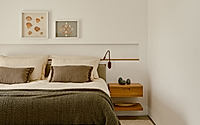
In the master suite, a horizontal wooden niche runs across the main wall, acting as both headboard and shelf for books, glasses, and small objects. Recessed lighting tucked into this band casts a warm, directed glow suited to reading without flooding the whole room. Floating bedside tables with slim lower shelves repeat the same wood detailing, keeping the floor visually clear.
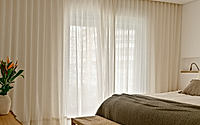
Bed linens mix linen and cotton in greens and natural tones that recall nearby vegetation and sand. A bench in wood and tucum fiber sits at the foot of the bed, reinforcing the link to the pieces in the social area. Above the headboard, shell artworks from the Algarve, handmade by the resident, add a personal layer that quietly punctuates the otherwise restrained composition.
The master closet continues the emphasis on climate-aware materials. White-framed doors with synthetic cane panels encourage constant ventilation, an essential move in the coastal setting, while solid wood handles add warmth to the touch. Guest bedrooms follow the same language: smaller side niches take the place of bedside tables, striped upholstered headboards bring measured color, and straightforward open cabinetry keeps storage practical.
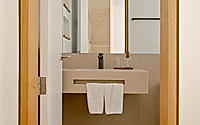
Bathrooms maintain the project’s material thread with light stone countertops, wooden vanities, and built-in wall niches that keep toiletries organized without visual clutter. The palette stays soft and natural, allowing daylight to bounce and expand each compact room.
In the end, the apartment reads as an extension of the beach just beyond the glass. Sand-toned floors, white structure, and layers of wood and woven fibers tie daily routines to the changing sky. From sunrise to sunset, residents move through rooms that hold the sea in view and let quiet materials do the work of comfort.
Photography by Fran Parente
Visit Marina Salles