Casa Monti Parioli: Color-Rich Roman Apartment for Modern Living
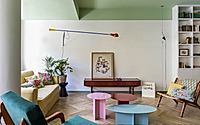
Casa Monti Parioli turns a once-generic 1950s apartment in Rome, Italy into a vivid home tailored to a young family of three. Costanza Santovetti Studio reworks the plan around a stainless steel and marble kitchen, using it as a clear visual anchor. Color, geometry, and light now knit together daily life, replacing the former monochrome shell with a lively yet ordered interior.


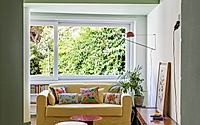
Light filters through large glass openings and catches on stainless steel, pulling the eye toward the heart of the apartment. A second-floor perch in a 1950s building gives the rooms a calm elevation above the street, while new colors and forms carry that stillness into a livelier domestic rhythm. Day-to-day life unfolds around that quiet brightness.
This is a family apartment in Rome reshaped by Costanza Santovetti Studio for a young trio ready to leave an all-white interior behind. The project works within a complex layout, using a bold kitchen and tuned color palette to structure movement, storage, and display. Interior surfaces and custom pieces respond directly to those choices, so each room feels connected but not repetitive.
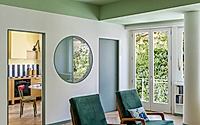
The commission arrives in 2023 with few historic details to protect, giving the studio freedom to rethink finishes and circulation. Irrecoverable period parquet makes way for new flooring, which works with abundant natural light to sharpen the contrast between old shell and current life. Large glass doorways and openings become key devices, drawing views between rooms and outward to greenery.
Kitchen As Keystone
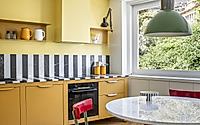
At the core stands the Very Simple Teklan Edition kitchen in stainless steel with Carrara and Marquinia marble, originally conceived by Tekla Evelina Severin. Clients choose this piece with enthusiasm, and it becomes both functional hub and aesthetic compass. Surfaces reflect daylight in a soft, metallic way, tempering the intensity of the surrounding yellows and greens. Relocating the kitchen to the apartment’s best corner, close to the terrace and overlooking greenery, turns everyday cooking into a more open, social act.
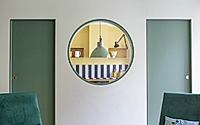
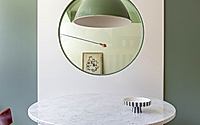
What was once a small, isolated room at the end of a corridor now connects visually to the living area through a glazed porthole and sliding doors. These panels and mechanisms form a carefully tuned system that keeps relationships between rooms flexible yet legible. When open, the sequence reads as a continuous, luminous volume; when closed, the family can separate noise and activity without losing the sense of connection. That balance keeps the plan adaptable to different rhythms of use.
Openings Shape Daily Life
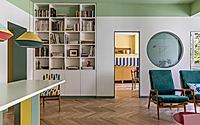
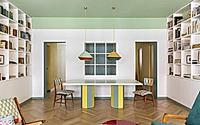
The intervention doesn’t rely on color alone; it leans heavily on new apertures to choreograph movement and views. The wall between dining room and corridor is cut with side openings and a nine-niche pass-through bookcase, turning a former barrier into a place for exchange. Books, objects, and small collections sit within arm’s reach, so circulation doubles as a slow visual promenade. Permeability replaces separation, giving the apartment a sense of quiet dialogue between rooms.
Glass, niches, and carefully sized cuts in walls redirect light as much as people. Natural illumination travels farther into the plan, landing on cabinetry fronts and painted surfaces that pick up subtle shifts in tone throughout the day. Those adjusted thresholds help dissolve residual corridor-like segments, softening the old compartmentalized character. Every doorway or cutout feels purposeful, never arbitrary.
Color Threads Through Rooms
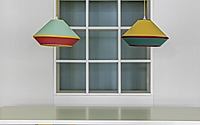
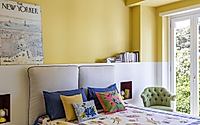
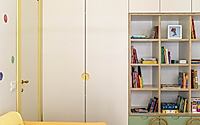
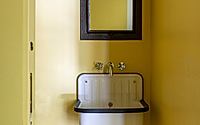
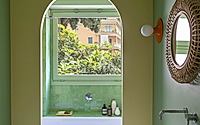
From the kitchen outward, color sets the emotional register. Yellows and greens drawn from the Teklan model extend into living, bathrooms, and bedrooms, where they shape built-in furniture and detailing. Cabinetry, wall lights, handles, and objects adopt a playful, geometric language, giving storage and hardware a clear graphic presence. Surfaces stay practical for family life yet still hold a strong visual rhythm.
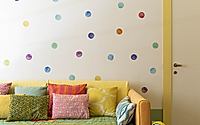
Circles, spheres, and arches repeat as a deliberate motif, stitching together otherwise distinct rooms. The glazed porthole near the kitchen becomes a symbolic anchor, echoed in rounded forms throughout the home. In the child’s room, wallpaper filled with circular patterns turns that reference into a joyful field, tying personal territory back to the shared core. Geometry, more than ornament, becomes the quiet common thread for everyday routines.
In the end, the transformed apartment reads as a fluid, luminous home tuned to collections, memories, and contemporary ways of living. Light, color, and measured openings replace the previous blankness with a clear but gentle order. From morning in the reflective kitchen to evening in the patterned bedrooms, the rooms support family life with a calm sense of continuity.
Photography by ELLER Studio / Serena Eller Vainicher
Visit Costanza Santovetti Studio